Department Medical Sciences, University of Ferrara, Via Aldo Moro, 8, Cona, Ferrara, Italy.
Department of Clinical and Experimental Sciences, University of Pisa, Pisa, Italy.
J Endocrinol Invest. 2023 Sep;46(9):1891-1899. doi: 10.1007/s40618-023-02048-w. Epub 2023 Mar 27.
The prevalence of hypothyroidism among older patients hospitalized for COVID-19 and its association with mortality is unclear. This study aims to investigate the prevalence of hypothyroidism in older COVID-19 inpatients and verify if this comorbidity is associated with a specific pattern of onset symptoms and a worse prognosis.
COVID-19 inpatients aged ≥ 60 years, participating in the GeroCovid acute wards cohort, were included. The history of hypothyroidism was derived from medical records and the use of thyroid hormones. Sociodemographic data, comorbidities, symptoms/signs at the disease onset and inflammatory markers at ward admission were compared between people with vs without history of hypothyroidism. The association between hypothyroidism and in-hospital mortality was tested through Cox regression.
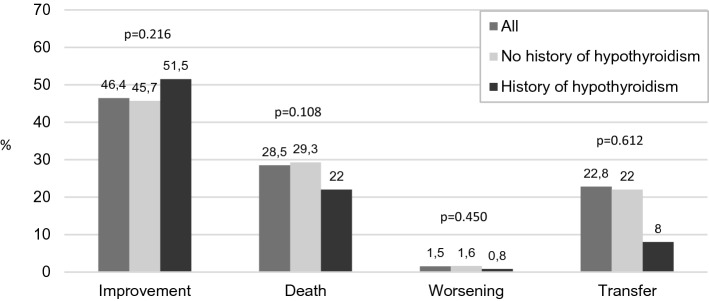
Of the 1245 patients included, 8.5% had a history of hypothyroidism. These patients were more likely to present arterial hypertension and obesity compared with those without an history of hypothyroidism. Concerning COVID-19 clinical presentation, patients with hypothyroidism had less frequently low oxygen saturation and anorexia but reported muscle pain and loss of smell more commonly than those without hypothyroidism. Among the inflammatory markers, patients with hypothyroidism had higher lymphocytes values. At Cox regression, hypothyroidism was associated with reduced in-hospital mortality only in the univariable model (HR = 0.66, 95% CI 0.45-0.96, p = 0.03); conversely, no significant result were observed after adjusting for potential confounders (HR = 0.69, 95% CI 0.47-1.03, p = 0.07).
Hypothyroidism does not seem to substantially influence the prognosis of COVID-19 in older people, although it may be associated with peculiar clinical and biochemical features at the disease onset.
COVID-19 住院老年患者中甲状腺功能减退症的患病率及其与死亡率的关系尚不清楚。本研究旨在调查老年 COVID-19 住院患者中甲状腺功能减退症的患病率,并验证这种合并症是否与特定的发病症状模式和较差的预后相关。
纳入年龄≥60 岁、参与 GeroCovid 急性病房队列的 COVID-19 住院患者。从病历和甲状腺激素的使用中得出甲状腺功能减退症的病史。比较有和无甲状腺功能减退症病史的患者在入院时的社会人口统计学数据、合并症、症状/体征和炎症标志物。通过 Cox 回归检验甲状腺功能减退症与住院死亡率的关系。
在纳入的 1245 名患者中,8.5%有甲状腺功能减退症病史。与无甲状腺功能减退症病史的患者相比,这些患者更可能患有动脉高血压和肥胖症。就 COVID-19 的临床表现而言,甲状腺功能减退症患者的低氧饱和度和食欲不振较少,但肌肉疼痛和嗅觉丧失较常见。在炎症标志物中,甲状腺功能减退症患者的淋巴细胞值较高。在单变量模型中,甲状腺功能减退症与住院死亡率降低相关(HR=0.66,95%CI 0.45-0.96,p=0.03);然而,在调整潜在混杂因素后,未观察到显著结果(HR=0.69,95%CI 0.47-1.03,p=0.07)。
甲状腺功能减退症似乎不会显著影响老年人 COVID-19 的预后,但它可能与疾病发病时的特殊临床和生化特征相关。