Bruce Courtenay R, Kamencik-Wright Ashleigh, Zuniga-Georgy Natalie, Vinh Thomas M, Shah Hema, Shallcross Jamie, Giammattei Charlie, O'Rourke Colleen, Smith Mariana, Bruchhaus Lindsey, Bowens Yashica, Goode Kimberly, Arabie Lee Ann, Sauceda Katherine, Pacha Majeedah, Martinez Sandra, Chisum James, Saldaña DO R Benjamin, Desai S Nicholas, Awar Melina, R Vernon Thomas
System Patient Experience, Houston Methodist Hospital System, Houston, TX, USA.
Information Technology Division, Houston Methodist Hospital System, Houston, TX, USA.
J Patient Exp. 2023 Mar 22;10:23743735231154963. doi: 10.1177/23743735231154963. eCollection 2023.
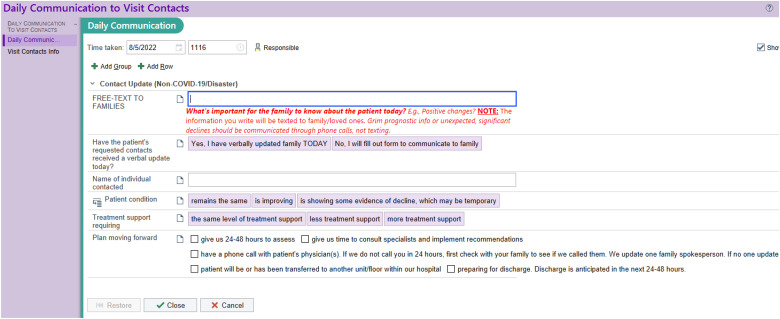
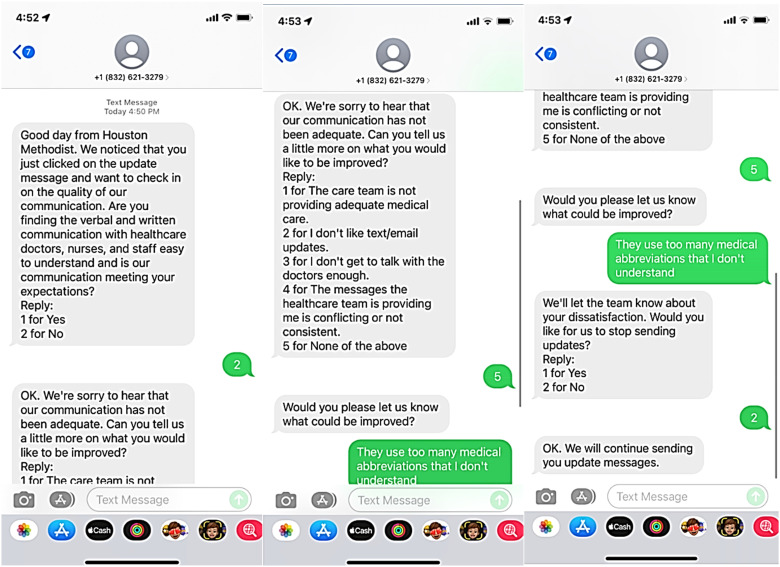
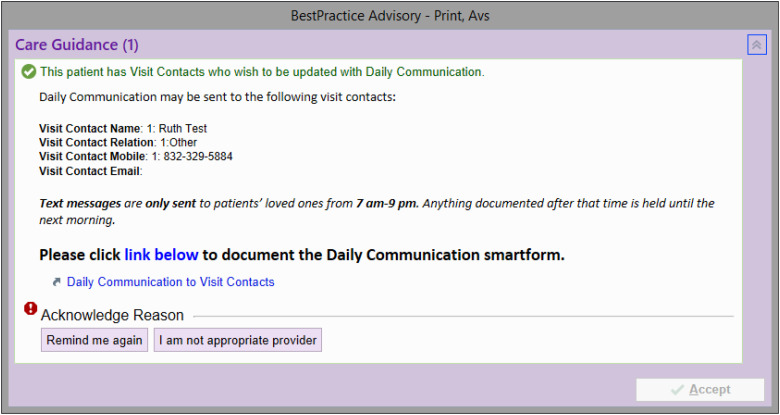
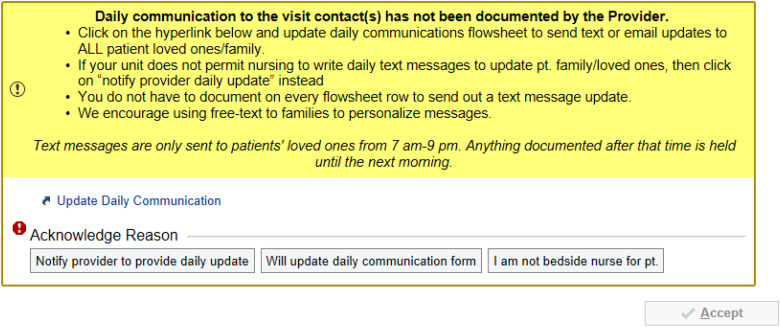
While there is an evolving literature on the benefits of texting and patient-centered technologies, texting initiatives have not focused on family members. We sought to identify patients' family members' perspectives on facilitators and barriers to using 1 digital texting innovation to promote family-centered care during patients' hospitalizations. This qualitative study was conducted at a tertiary care center in Houston, consisting of 7 hospitals (1 academic hospital and 6 community hospitals), involving analyzation of 3137 comments from family members who used the digital texting technology. Thematic analysis methods were used. The data analysis for loved ones' feedback resulted in 4 themes as facilitators: (1) inpatient text messaging keeps loved ones updated and connected (n = 611); (2) inpatient text messaging allows for stronger continuity of communication (n = 69); (3) messaging promotes a sense of staff compassion and service (n = 245); and (4) messaging reduces phone calls (n = 65). The data analysis resulted in 4 themes as barriers to text messaging helpfulness: (1) messages could feel generic (n = 31); (2) inpatient texting was not needed if all loved ones were regularly at bedside (n = 6); (3) messages could have a perceived delay (n = 37); and (4) security features could impact convenience (n = 29). Our findings indicate that family members and loved ones value inpatient text messages, not only for the information the messages provide, but also because the act of writing text messages and preparing loved ones shows inclusiveness, compassion, and family-centered care.
虽然关于短信及以患者为中心的技术的益处的文献在不断发展,但短信倡议尚未关注家庭成员。我们试图确定患者家庭成员对于使用一种数字短信创新手段在患者住院期间促进以家庭为中心的护理的促进因素和障碍的看法。这项定性研究在休斯顿的一家三级护理中心进行,该中心由7家医院组成(1家学术医院和6家社区医院),涉及对3137条使用数字短信技术的家庭成员的评论进行分析。采用了主题分析方法。对亲人反馈的数据分析得出了4个作为促进因素的主题:(1)住院短信让亲人了解最新情况并保持联系(n = 611);(2)住院短信实现了更强的沟通连续性(n = 69);(3)短信传递增强了工作人员的同情心和服务意识(n = 245);(4)短信减少了电话沟通(n = 65)。数据分析得出了4个作为短信有用性障碍的主题:(1)信息可能感觉缺乏针对性(n = 31);(2)如果所有亲人都能经常在床边,就不需要住院短信(n = 6);(3)信息可能会有延迟感(n = 37);(4)安全功能可能会影响便利性(n = 29)。我们的研究结果表明,家庭成员和亲人重视住院短信,不仅因为短信提供的信息,还因为编写短信和关心亲人的行为体现了包容性、同情心和以家庭为中心的护理。