Department of Health, Human Performance, and Recreation, Exercise Science Research Center, University of Arkansas, Fayetteville, Arkansas, United States.
Cell and Molecular Biology Graduate Program, University of Arkansas, Fayetteville, Arkansas, United States.
Am J Physiol Cell Physiol. 2023 May 1;324(5):C1101-C1109. doi: 10.1152/ajpcell.00071.2023. Epub 2023 Mar 27.
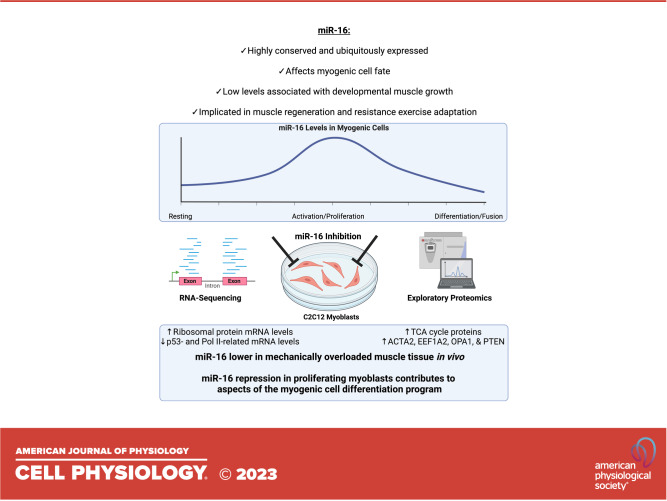
MicroRNAs (miRs) control stem cell biology and fate. Ubiquitously expressed and conserved miR-16 was the first miR implicated in tumorigenesis. miR-16 is low in muscle during developmental hypertrophy and regeneration. It is enriched in proliferating myogenic progenitor cells but is repressed during differentiation. The induction of miR-16 blocks myoblast differentiation and myotube formation, whereas knockdown enhances these processes. Despite a central role for miR-16 in myogenic cell biology, how it mediates its potent effects is incompletely defined. In this investigation, global transcriptomic and proteomic analyses after miR-16 knockdown in proliferating C2C12 myoblasts revealed how miR-16 influences myogenic cell fate. Eighteen hours after miR-16 inhibition, ribosomal protein gene expression levels were higher relative to control myoblasts and p53 pathway-related gene abundance was lower. At the protein level at this same time point, miR-16 knockdown globally upregulated tricarboxylic acid (TCA) cycle proteins while downregulating RNA metabolism-related proteins. miR-16 inhibition induced specific proteins associated with myogenic differentiation such as ACTA2, EEF1A2, and OPA1. We extend prior work in hypertrophic muscle tissue and show that miR-16 is lower in mechanically overloaded muscle in vivo. Our data collectively point to how miR-16 is implicated in aspects of myogenic cell differentiation. A deeper understanding of the role of miR-16 in myogenic cells has consequences for muscle developmental growth, exercise-induced hypertrophy, and regenerative repair after injury, all of which involve myogenic progenitors.
微小 RNA(miRs)控制干细胞的生物学和命运。普遍表达和保守的 miR-16 是第一个被认为与肿瘤发生有关的 miRNA。miR-16 在发育性肥大和再生过程中的肌肉中含量较低。它在增殖的肌源性祖细胞中富集,但在分化过程中受到抑制。miR-16 的诱导会阻止成肌细胞分化和肌管形成,而敲低则会增强这些过程。尽管 miR-16 在成肌细胞生物学中具有核心作用,但它如何介导其强大的作用尚不完全清楚。在这项研究中,在增殖的 C2C12 成肌细胞中敲低 miR-16 后进行的全转录组和蛋白质组分析揭示了 miR-16 如何影响成肌细胞的命运。miR-16 抑制 18 小时后,相对于对照成肌细胞,核糖体蛋白基因的表达水平更高,p53 通路相关基因的丰度更低。在同一时间点的蛋白质水平上,miR-16 敲低全局上调三羧酸(TCA)循环蛋白,同时下调 RNA 代谢相关蛋白。miR-16 抑制诱导与成肌分化相关的特定蛋白,如 ACTA2、EEF1A2 和 OPA1。我们扩展了先前在肥大肌肉组织中的工作,并表明 miR-16 在体内机械性超负荷的肌肉中含量较低。我们的数据共同指出了 miR-16 如何参与成肌细胞分化的各个方面。深入了解 miR-16 在成肌细胞中的作用对肌肉发育生长、运动诱导的肥大以及损伤后的再生修复具有重要意义,所有这些都涉及到成肌祖细胞。