Dede Zeynep, Tumer Kader, Kan Tugce, Yucel Burcu
Health Institutes of Turkey, Turkey Biotechnology Institute, Istanbul, Turkey.
Health Institutes of Turkey, Turkey Cancer Institute; Istanbul Medeniyet University Faculty of Medicine, Department of Medical Biology, Istanbul, Turkey.
Medeni Med J. 2023 Mar 28;38(1):88-94. doi: 10.4274/MMJ.galenos.2023.29599.
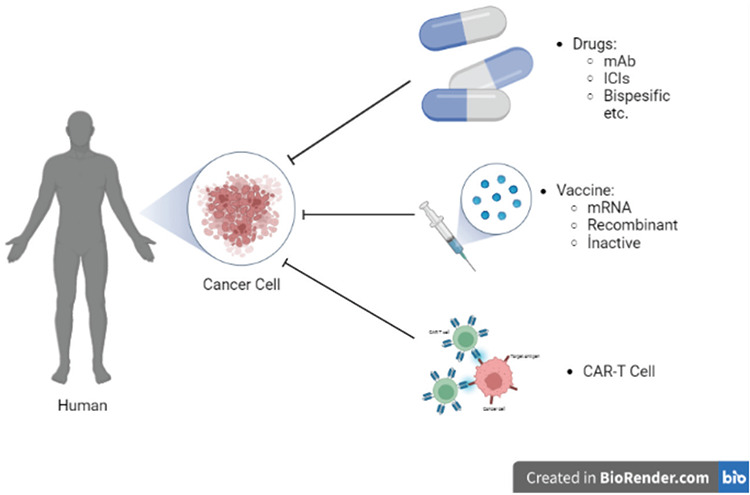
Cancer is a disease that results from the uncontrolled proliferation and growth of cells. Due to early detection methods, there is a decrease in death rates in many types of cancer. However, among the causes of death worldwide, cancer still ranks second after cardiovascular diseases. Therefore, cancer research has focused mainly on developing more effective treatments to reduce deaths from cancer. With a better understanding of the molecular mechanisms in cancer cells, advances in cancer treatment have evolved and changed. The main priority of research is to develop treatment modalities with the highest response rate and less side effects. In this context, immunotherapies have started a new era in cancer treatments. In this review, an overview of the future of next-generation treatment methods is presented by including the most preferred immunotherapy methods.
癌症是一种由细胞不受控制地增殖和生长所导致的疾病。由于早期检测方法的应用,许多类型癌症的死亡率有所下降。然而,在全球范围内的死因中,癌症仍仅次于心血管疾病,位居第二。因此,癌症研究主要集中在开发更有效的治疗方法以降低癌症死亡率。随着对癌细胞分子机制的深入了解,癌症治疗取得了进展并发生了变化。研究的主要重点是开发有效率最高且副作用较小的治疗方式。在这种背景下,免疫疗法开启了癌症治疗的新时代。在本综述中,通过纳入最常用的免疫疗法,对下一代治疗方法的未来进行了概述。