Distefano Fabio, Pasta Salvatore, Epasto Gabriella
Department of Engineering, University of Messina, C.da Di Dio, 98166 Messina, Italy.
Department of Engineering, University of Palermo, Viale delle Scienze, 90128 Palermo, Italy.
J Funct Biomater. 2023 Feb 24;14(3):125. doi: 10.3390/jfb14030125.
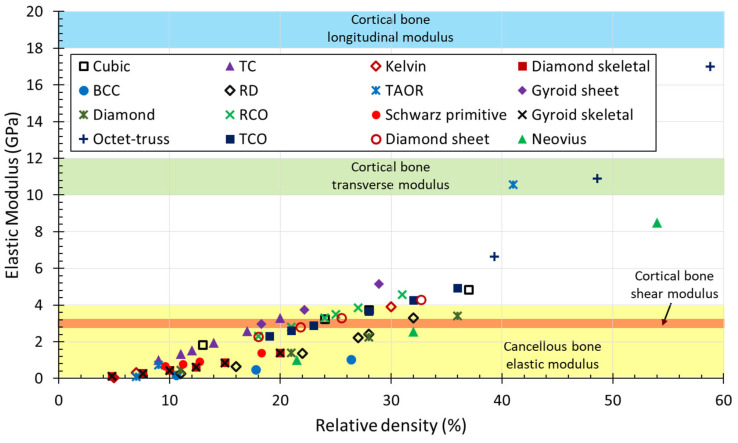
The progress in additive manufacturing has remarkably increased the application of lattice materials in the biomedical field for the fabrication of scaffolds used as bone substitutes. Ti6Al4V alloy is widely adopted for bone implant application as it combines both biological and mechanical properties. Recent breakthroughs in biomaterials and tissue engineering have allowed the regeneration of massive bone defects, which require external intervention to be bridged. However, the repair of such critical bone defects remains a challenge. The present review collected the most significant findings in the literature of the last ten years on Ti6Al4V porous scaffolds to provide a comprehensive summary of the mechanical and morphological requirements for the osteointegration process. Particular attention was given on the effects of pore size, surface roughness and the elastic modulus on bone scaffold performances. The application of the Gibson-Ashby model allowed for a comparison of the mechanical performance of the lattice materials with that of human bone. This allows for an evaluation of the suitability of different lattice materials for biomedical applications.
增材制造技术的进步显著提高了晶格材料在生物医学领域的应用,用于制造作为骨替代物的支架。Ti6Al4V合金因其兼具生物学和力学性能而被广泛应用于骨植入物。生物材料和组织工程领域的最新突破使得大面积骨缺损的再生成为可能,而这些骨缺损需要外部干预来进行桥接。然而,修复此类关键骨缺损仍然是一项挑战。本综述收集了过去十年文献中关于Ti6Al4V多孔支架的最重要研究结果,以全面总结骨整合过程对力学和形态学的要求。特别关注了孔径、表面粗糙度和弹性模量对骨支架性能的影响。吉布森-阿什比模型的应用使得能够将晶格材料的力学性能与人体骨骼的力学性能进行比较。这有助于评估不同晶格材料在生物医学应用中的适用性。