Gordon Center for Medical Imaging, Department of Radiology Massachusetts General Hospital, Harvard Medical School, Boston, MA, United States; LTCI, Télécom Paris, Institut Polytechnique de Paris, France.
Department of Computer Engineering, Université de Sherbrooke, Sherbrooke, QC, Canada.
Neuroimage. 2023 May 15;272:120056. doi: 10.1016/j.neuroimage.2023.120056. Epub 2023 Mar 26.
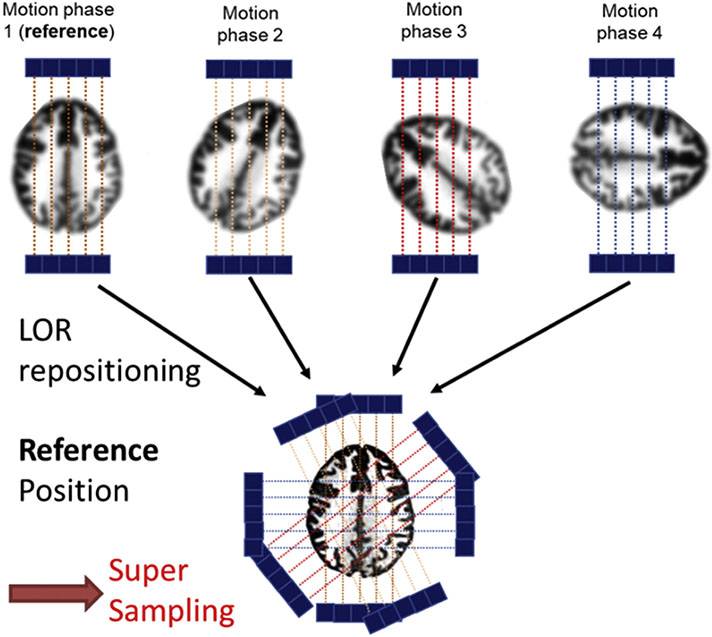
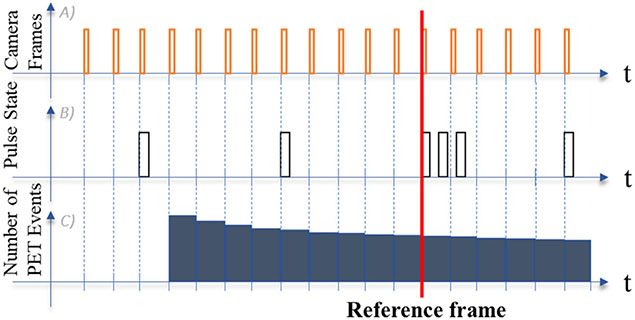
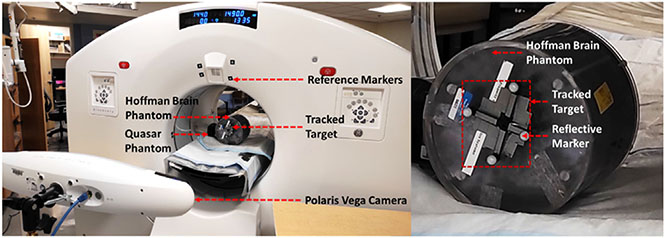
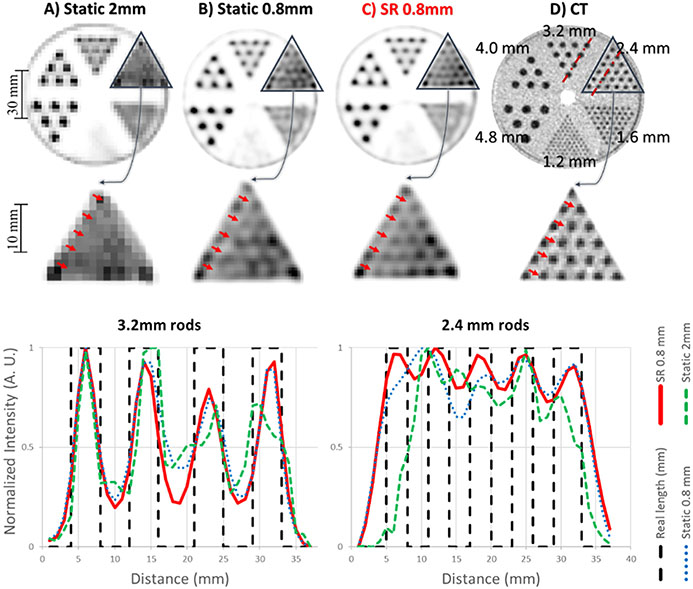
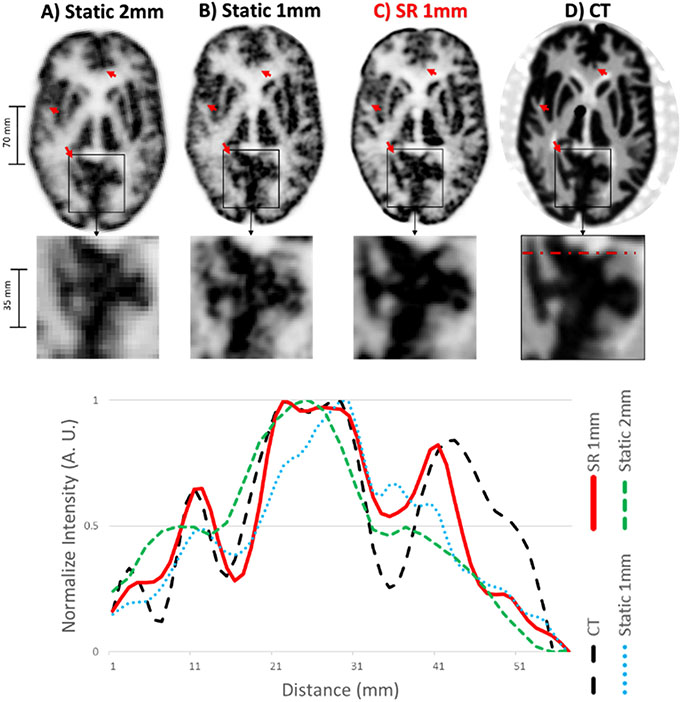
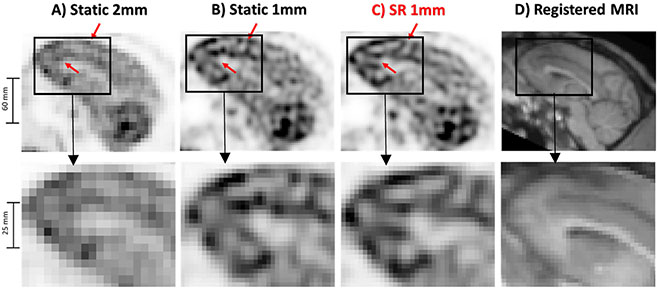
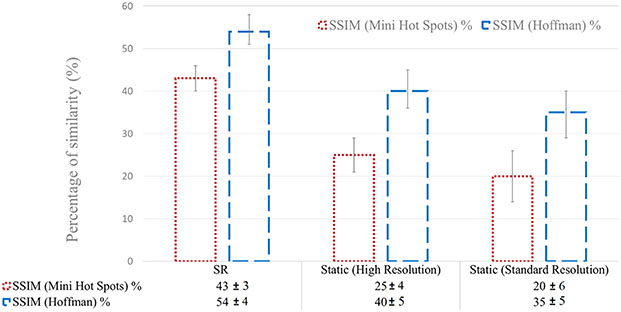
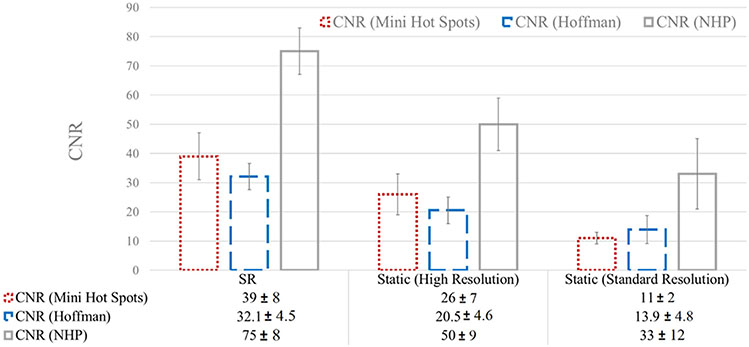
Super-resolution (SR) is a methodology that seeks to improve image resolution by exploiting the increased spatial sampling information obtained from multiple acquisitions of the same target with accurately known sub-resolution shifts. This work aims to develop and evaluate an SR estimation framework for brain positron emission tomography (PET), taking advantage of a high-resolution infra-red tracking camera to measure shifts precisely and continuously. Moving phantoms and non-human primate (NHP) experiments were performed on a GE Discovery MI PET/CT scanner (GE Healthcare) using an NDI Polaris Vega (Northern Digital Inc), an external optical motion tracking device. To enable SR, a robust temporal and spatial calibration of the two devices was developed as well as a list-mode Ordered Subset Expectation Maximization PET reconstruction algorithm, incorporating the high-resolution tracking data from the Polaris Vega to correct motion for measured line of responses on an event-by-event basis. For both phantoms and NHP studies, the SR reconstruction method yielded PET images with visibly increased spatial resolution compared to standard static acquisitions, allowing improved visualization of small structures. Quantitative analysis in terms of SSIM, CNR and line profiles were conducted and validated our observations. The results demonstrate that SR can be achieved in brain PET by measuring target motion in real-time using a high-resolution infrared tracking camera.
超分辨率(SR)是一种通过利用从同一目标的多次具有准确已知亚分辨率移位的采集获得的增加的空间采样信息来提高图像分辨率的方法。本工作旨在开发和评估一种用于脑正电子发射断层扫描(PET)的 SR 估计框架,利用高分辨率红外跟踪相机来精确和连续地测量移位。使用 NDI Polaris Vega(Northern Digital Inc),一种外部光学运动跟踪设备,在 GE Discovery MI PET/CT 扫描仪(GE Healthcare)上对移动体模和非人类灵长类动物(NHP)实验进行了研究。为了实现 SR,开发了两种设备的稳健的时间和空间校准以及列表模式有序子集期望最大化 PET 重建算法,该算法将 Polaris Vega 的高分辨率跟踪数据纳入其中,以基于事件的方式校正测量的线响应的运动。对于体模和 NHP 研究,与标准静态采集相比,SR 重建方法产生的 PET 图像具有明显更高的空间分辨率,允许更好地可视化小结构。进行了 SSIM、CNR 和线轮廓的定量分析,并验证了我们的观察结果。结果表明,通过使用高分辨率红外跟踪相机实时测量目标运动,可以在脑 PET 中实现 SR。