Department of Education, Roma Tre University, 20 Via del Castro Pretorio, 00185, Rome, Italy.
Department of Education, Psychology, Communication Sciences, University of Bari Aldo Moro, Bari, Italy.
Sci Rep. 2023 Mar 28;13(1):5028. doi: 10.1038/s41598-023-30287-7.
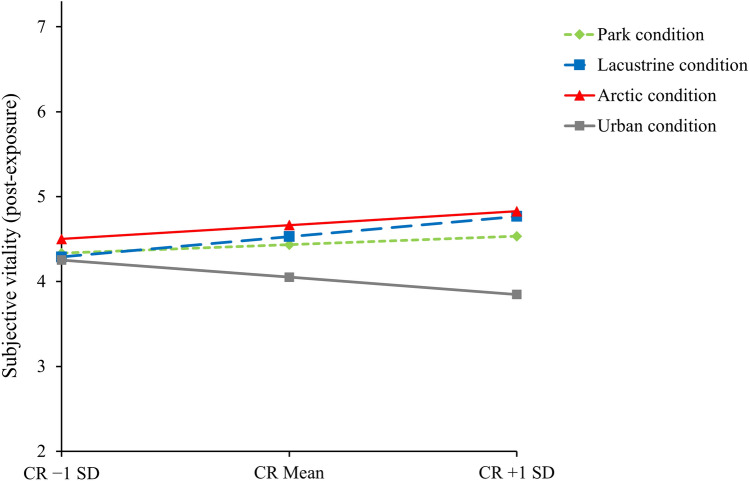
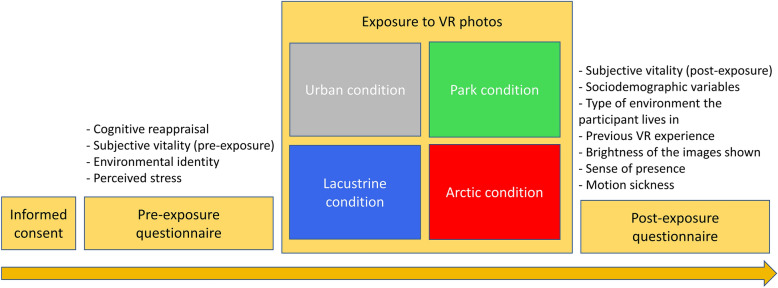
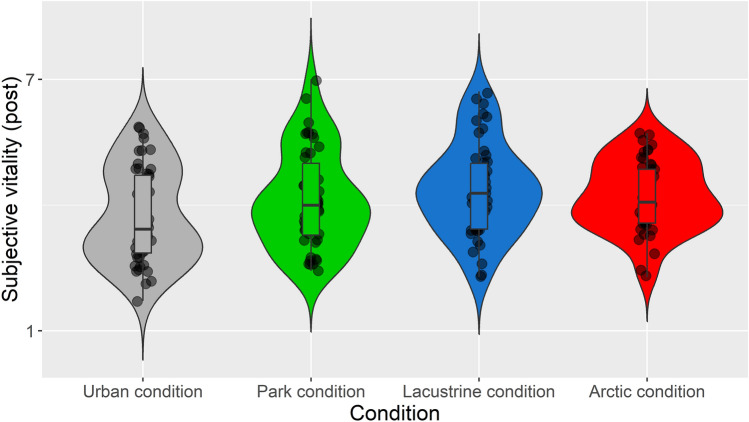
People who make habitual use of an emotion regulation strategy such as cognitive reappraisal may be more sensitive to the emotion cues coming from a surrounding natural environment and, thus, get more benefits from virtual nature exposure such as enhanced subjective vitality. However, no previous study investigated the moderating role of cognitive reappraisal in the relationship between exposure to different types of natural environments (a national park, a lacustrine environment, and an arctic environment vs. an urban environment) and subjective vitality. We designed a between-subject design (four conditions, one per type of environment) with a sample of 187 university students (M = 21.17, SD = 2.55). Participants were exposed to four 360° panoramic photos of the environment for one minute each with a virtual reality head-mounted display. The results of a multicategorical moderation analysis attested that there were two significant interactions, respectively between lacustrine and arctic environments and cognitive reappraisal. More specifically, for participants with low levels of habitual use of cognitive reappraisal, the effects of virtual nature (vs. urban) exposure on subjective vitality were not significant, while for participants with high levels, the effects were significant and positive. Findings show how the potential of virtual nature may be boosted with training aimed at increasing the general use of cognitive reappraisal, supports enhancing the applications of virtual nature, and demonstrates the need to take individual differences into account when determining the benefits of these applications.
经常使用认知重评这种情绪调节策略的人可能对周围自然环境中的情绪线索更为敏感,因此,从虚拟自然环境中获得的益处更多,例如增强主观活力。然而,以前的研究并没有调查认知重评在接触不同类型的自然环境(国家公园、湖泊环境和北极环境与城市环境)与主观活力之间的关系中的调节作用。我们设计了一个被试间设计(四个条件,每个环境一个条件),有 187 名大学生参加(M = 21.17,SD = 2.55)。参与者使用虚拟现实头戴式显示器分别观看每个环境的四张 360°全景照片,每张照片观看一分钟。多类别调节分析的结果证明存在两个显著的交互作用,分别是湖泊环境和北极环境与认知重评之间的交互作用。更具体地说,对于习惯性使用认知重评水平较低的参与者来说,虚拟自然(与城市相比)暴露对主观活力的影响不显著,而对于习惯性使用认知重评水平较高的参与者来说,这种影响是显著的、积极的。研究结果表明,如何通过增加认知重评的普遍使用的训练来增强虚拟自然的潜力,支持增强虚拟自然的应用,并证明在确定这些应用的益处时需要考虑个体差异。