Department of Clinical Pharmacy, School of Pharmacy, Sefako Makgatho Health Sciences University, Ga-Rankuwa, South Africa.
Research in Education, Amsterdam UMC location Vrije Universiteit Amsterdam, De Boelelaan 1118, Amsterdam, The Netherlands.
BMC Health Serv Res. 2023 Mar 28;23(1):290. doi: 10.1186/s12913-023-09222-z.
Incorporating clinical pharmacists in collaborative medical teams results in better patient treatment and health outcomes. In addition, the understanding of other healthcare professionals (HCPs) towards the role of clinical pharmacists can either facilitate or hinder the implementation and expansion of these services. The main distinction between pharmacists and clinical pharmacists lie in their different scope of duties. This study set out to explore other HCPs' understanding towards the role of the clinical pharmacists in South Africa, and to identify associated factors.
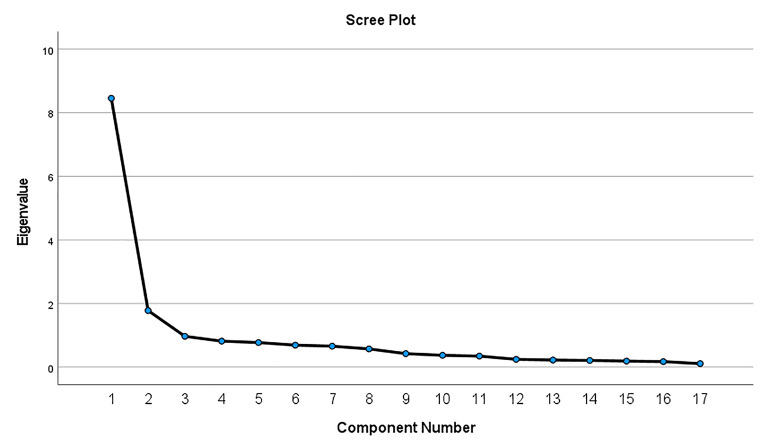
An exploratory, survey-based, quantitative study was conducted. A survey assessing HCPs' understanding based on the competencies and role of a clinical pharmacist was distributed to 300 doctors, nurses, pharmacists and clinical pharmacists. An exploratory factor analysis was carried out to determine the construct validity of the measurement. Items were analysed for grouping into subscales through principal components analysis. Differences in the variable scores for gender, age, work experience and previous experience working with a clinical pharmacist were analyzed using independent t-tests. Analysis of variance was used to analyze differences in the variable scores for the different HCPs and the different departments of work in the hospital.
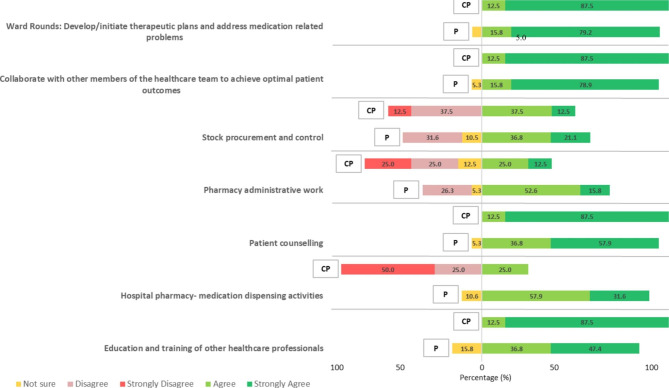
The factor analysis yielded two separate subscales, measuring HCPs' (n = 188) understanding towards the role of a clinical pharmacist, as well as the competencies of a clinical pharmacist. Doctors (85, n = 188) (p = 0.004) and nurses (76, n = 188) (p = 0.022), working in both surgical and non-surgical units, had significantly poorer understanding of the role of clinical pharmacists than clinical pharmacists (8, n = 188) and pharmacists (19, n = 188) (p = 0.028). Where specific clinical pharmacist activities were described, 5-16% of pharmacists were unsure whether an activity forms part of a clinical pharmacist's role. Over 50% of the clinical pharmacists disagreed that their role also includes pharmacist's activities, like stock procurement and control, pharmacy and administrative work, and hospital pharmacy-medication dispensing activities.
The findings highlighted the possible impact of role expectations and lack of understanding among HCPs. A standard job description with recognition from statutory bodies could promote other HCPs, as well as clinical pharmacists' understanding of their roles. Findings further suggested the need for interventions like interprofessional education opportunities, staff induction programmes and regular interprofessional meetings to foster acknowledgement of clinical pharmacy services, promoting the acceptance and growth of the profession.
将临床药师纳入协作医疗团队可改善患者治疗效果和健康结果。此外,其他医疗保健专业人员(HCPs)对临床药师角色的理解可能会促进或阻碍这些服务的实施和扩展。药师和临床药师之间的主要区别在于其职责范围不同。本研究旨在探讨南非其他 HCPs 对临床药师角色的理解,并确定相关因素。
进行了一项探索性、基于调查的定量研究。一项评估 HCPs 对临床药师基于其职责和能力的理解的调查,分发给 300 名医生、护士、药剂师和临床药师。进行了探索性因素分析以确定测量的构念效度。通过主成分分析对项目进行分组,以归入子量表。使用独立 t 检验分析性别、年龄、工作经验和与临床药师合作经验对变量得分的差异。方差分析用于分析不同 HCPs 和医院不同工作部门的变量得分差异。
因子分析产生了两个独立的子量表,分别衡量 HCPs(n=188)对临床药师角色的理解,以及临床药师的能力。在外科和非外科病房工作的医生(85 名,n=188)(p=0.004)和护士(76 名,n=188)(p=0.022)对临床药师角色的理解明显差于临床药师(8 名,n=188)和药剂师(19 名,n=188)(p=0.028)。当描述特定的临床药师活动时,5-16%的药剂师不确定该活动是否属于临床药师的职责范围。超过 50%的临床药师不同意他们的职责还包括药剂师的活动,如药品采购和控制、药房和行政工作以及医院药房药品配发活动。
研究结果强调了 HCPs 的角色期望和理解不足可能产生的影响。标准的工作描述和法定机构的认可可以促进其他 HCPs 以及临床药师对其角色的理解。研究结果进一步表明,需要进行干预措施,如开展跨专业教育机会、员工入职计划和定期跨专业会议,以促进对临床药学服务的认可,促进该专业的接受和发展。