Lee Sheng-Yu, Li Sung-Chou, Yang Chia-Yu, Kuo Ho-Chang, Chou Wen-Jiun, Wang Liang-Jen
Department of Psychiatry, Kaohsiung Veterans General Hospital, Kaohsiung 813, Taiwan.
Department of Psychiatry, College of Medicine, Kaohsiung Medical University, Kaohsiung 807378, Taiwan.
Children (Basel). 2023 Mar 5;10(3):513. doi: 10.3390/children10030513.
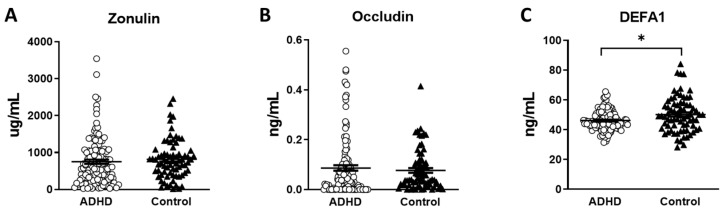
Attention-deficit/hyperactivity disorder (ADHD) is a commonly seen mental disorder in children. Intestinal permeability may be associated with the pathogenesis of ADHD. The study herein investigated the role of gut leakage biomarkers in the susceptibility of ADHD. A total of 130 children with ADHD and 73 healthy controls (HC) individuals were recruited. Serum concentrations of zonulin, occludin, and defensin (DEFA1) were determined. Visual attention was assessed with Conners' continuous performance test (CPT). In order to rate participants' ADHD core symptoms at home and school, their parents and teachers completed the Swanson, Nolan, and Pelham-Version IV Scale (SNAP-IV), respectively. We found significantly lower DEFA1 levels in the ADHD group compared to that in the HC group ( = 0.008), but not serum levels of zonulin and occludin. The serum levels of DEFA1 showed an inverse correlation with the inattention scores in the SNAP-IV parent form ( = 0.042) and teacher form ( = 0.010), and the hyperactivity/impulsivity scores in the SNAP-IV teacher form ( = 0.014). The serum levels of occludin showed a positive correlation with the subtest of detectability in the CPT ( = 0.020). Our study provides new reference into the relation between gut leakage markers and cognition, which may advance research of the pathophysiology of ADHD.
注意力缺陷多动障碍(ADHD)是儿童中常见的精神障碍。肠道通透性可能与ADHD的发病机制有关。本文的研究调查了肠道渗漏生物标志物在ADHD易感性中的作用。共招募了130名ADHD儿童和73名健康对照(HC)个体。测定了血清中闭合蛋白、闭锁蛋白和防御素(DEFA1)的浓度。用康纳斯连续作业测试(CPT)评估视觉注意力。为了评估参与者在家和学校的ADHD核心症状,他们的父母和老师分别完成了斯旺森、诺兰和佩勒姆第四版量表(SNAP-IV)。我们发现,与HC组相比,ADHD组的DEFA1水平显著降低(P = 0.008),但闭合蛋白和闭锁蛋白的血清水平没有显著差异。DEFA1的血清水平与SNAP-IV家长版(P = 0.042)和教师版(P = 0.010)中的注意力不集中得分,以及SNAP-IV教师版中的多动/冲动得分(P = 0.014)呈负相关。闭锁蛋白的血清水平与CPT中的可检测性子测试呈正相关(P = 0.020)。我们的研究为肠道渗漏标志物与认知之间的关系提供了新的参考,这可能会推动ADHD病理生理学的研究。