
高海拔登山对登山者认知功能的影响:一项荟萃分析。
The Effects of High-Altitude Mountaineering on Cognitive Function in Mountaineers: A Meta-Analysis.
机构信息
College of Physical Education, China University of Geosciences (Wuhan), Wuhan 430074, China.
College of Health Sciences and Technology, Rochester Institute of Technology, Rochester, NY 14623, USA.
出版信息
Int J Environ Res Public Health. 2023 Mar 14;20(6):5101. doi: 10.3390/ijerph20065101.
BACKGROUND
Nowadays, with the convenience of international traveling and driven by many individuals' fond dreams of challenging high-altitude exercises, high-altitude mountaineering is becoming increasingly popular worldwide. Therefore, we performed a meta-analysis to determine the effects of high-altitude mountaineering on cognitive functions in mountaineers before and after climbing.
METHODS
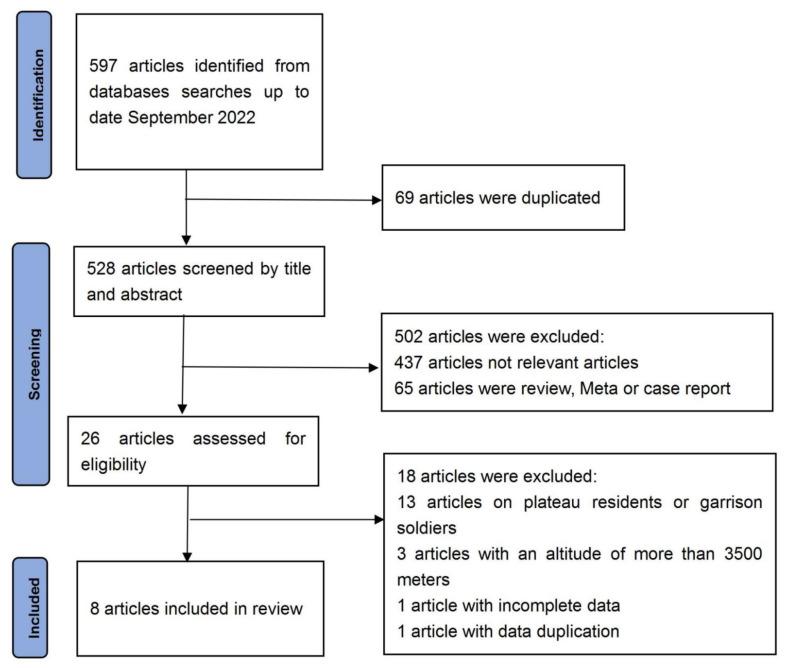
After a thorough electronic literature search and selection, eight studies were included in this meta-analysis, and the conducted test cycles ranged from 8 to 140 days. Eight variables were included in this meta-analysis: the Trail-Making Test (TMB), Digit Span-Forward (DSF), Digit Span-Backward (DSB), Finger Tapping Test-Right (FTR) Finger Tapping Test-Left (FTL), Wechsler Memory Scale Visual (WMSV), the Aphasia Screening Test (Verbal Items) (AST-Ver), and the Aphasia Screening Test (Visual Motor Errors) (AST-Vis). The effect sizes (ES) and forest plots of these eight variables were generated.
RESULTS
Five variables (TMB, ES = 0.39; DSF, ES = 0.57; FTR, ES = 0.50; FTL, ES = 0.16; WMSV, ES = 0.63) out of eight were significantly improved after high-altitude mountaineering, whereas the ES values of DSB, AST-Ver, and AST-Vis did not show significant improvement after climbing.
CONCLUSION
Despite two limitations, namely, methodological issues inherent in the meta-analysis and the inability to explain high heterogeneity between studies, this study is the first meta-analysis that has attempted to specify and compare the cognitive functions of mountaineers before and after high-altitude mountaineering. Furthermore, as a short-term plateau exercise, high-altitude mountaineering has no significant negative impacts on the cognitive functions of climbers. Future research is needed for a long period of high-altitude mountaineering.
背景
如今,随着国际旅行的便利以及许多人对高海拔运动挑战的梦想,高海拔登山在全球范围内变得越来越流行。因此,我们进行了一项荟萃分析,以确定登山者在登山前后的高海拔登山对认知功能的影响。
方法
经过彻底的电子文献搜索和选择,有八项研究被纳入本荟萃分析,进行的测试周期从 8 天到 140 天不等。本荟萃分析纳入了八个变量:连线测验(TMB)、数字跨度向前(DSF)、数字跨度向后(DSB)、手指敲击测试-右侧(FTR)、手指敲击测试-左侧(FTL)、韦氏记忆量表视觉(WMSV)、失语症筛查测试(言语项目)(AST-Ver)和失语症筛查测试(视觉运动错误)(AST-Vis)。生成了这八个变量的效应大小(ES)和森林图。
结果
八项变量中的五项(TMB,ES = 0.39;DSF,ES = 0.57;FTR,ES = 0.50;FTL,ES = 0.16;WMSV,ES = 0.63)在高海拔登山后显著改善,而 DSB、AST-Ver 和 AST-Vis 的 ES 值在登山后没有显示出显著改善。
结论
尽管存在两个局限性,即荟萃分析固有的方法学问题以及无法解释研究之间的高度异质性,但这项研究是第一项尝试具体说明和比较登山者在高海拔登山前后认知功能的荟萃分析。此外,作为一种短期高原运动,高海拔登山对登山者的认知功能没有显著的负面影响。需要进行长期的高海拔登山研究。
 Zotero 插件