Section of Preclinical and Translational Pharmacology, Department of Pharmacy, Health and Nutritional Sciences, University of Calabria, 87036 Rende, CS, Italy.
IRCCS Mondino Foundation, Via Mondino 2, 27100 Pavia, PV, Italy.
Int J Mol Sci. 2023 Mar 18;24(6):5800. doi: 10.3390/ijms24065800.
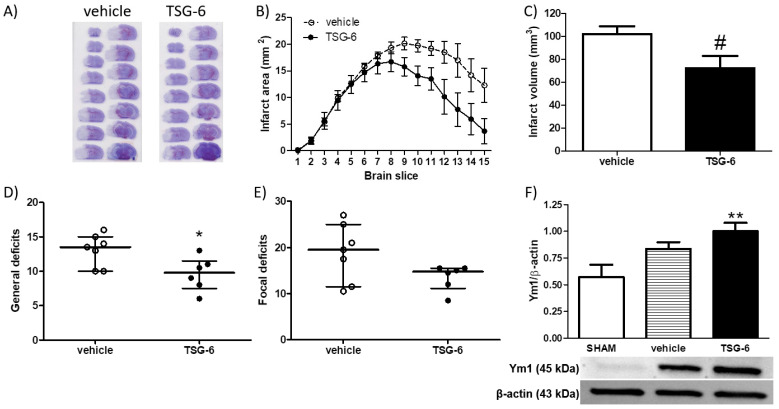
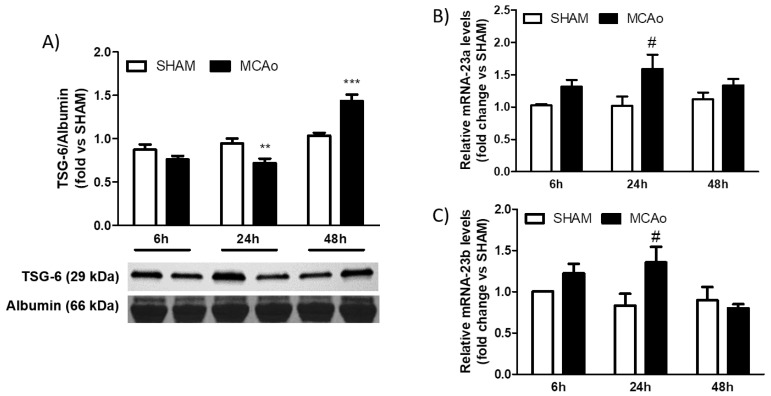
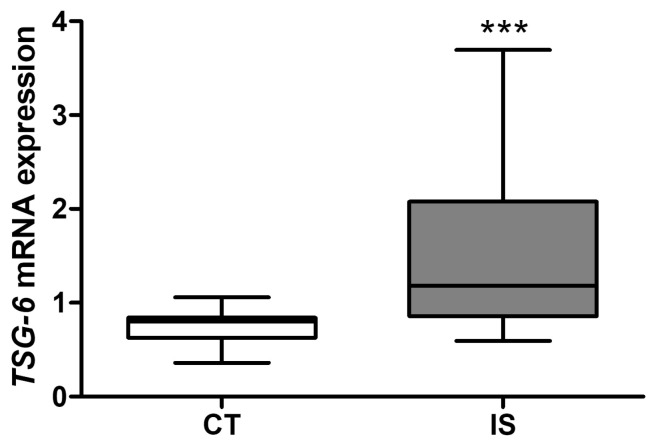
The identification of novel targets to modulate the immune response triggered by cerebral ischemia is crucial to promote the development of effective stroke therapeutics. Since tumour necrosis factor (TNF)-α-stimulated gene 6 (TSG-6), a hyaluronate (HA)-binding protein, is involved in the regulation of immune and stromal cell functions in acute neurodegeneration, we aimed to characterize its involvement in ischemic stroke. Transient middle cerebral artery occlusion (1 h MCAo, followed by 6 to 48 of reperfusion) in mice resulted in a significant elevation in cerebral TSG-6 protein levels, mainly localized in neurons and myeloid cells of the lesioned hemisphere. These myeloid cells were clearly infiltrating from the blood, strongly suggesting that brain ischemia also affects TSG-6 in the periphery. Accordingly, mRNA expression was elevated in peripheral blood mononuclear cells (PBMCs) from patients 48 h after ischemic stroke onset, and TSG-6 protein expression was higher in the plasma of mice subjected to 1 h MCAo followed by 48 h of reperfusion. Surprisingly, plasma TSG-6 levels were reduced in the acute phase (i.e., within 24 h of reperfusion) when compared to sham-operated mice, supporting the hypothesis of a detrimental role of TSG-6 in the early reperfusion stage. Accordingly, systemic acute administration of recombinant mouse TSG-6 increased brain levels of the M2 marker Ym1, providing a significant reduction in the brain infarct volume and general neurological deficits in mice subjected to transient MCAo. These findings suggest a pivotal role of TSG-6 in ischemic stroke pathobiology and underscore the clinical relevance of further investigating the mechanisms underlying its immunoregulatory role.
鉴定新型靶点以调节脑缺血引发的免疫反应对于促进有效的中风治疗至关重要。肿瘤坏死因子(TNF)-α刺激基因 6(TSG-6)是一种透明质酸(HA)结合蛋白,参与急性神经退行性变中免疫和基质细胞功能的调节,我们旨在研究其在缺血性中风中的作用。在小鼠中短暂性大脑中动脉闭塞(1 h MCAo,随后再灌注 6 至 48 小时)导致大脑 TSG-6 蛋白水平显著升高,主要定位于损伤半球的神经元和髓样细胞。这些髓样细胞明显从血液中浸润,强烈表明脑缺血也会影响外周血中的 TSG-6。相应地,缺血性中风发作后 48 小时,患者外周血单核细胞(PBMCs)中的 mRNA 表达升高,并且 1 h MCAo 后再灌注 48 小时的小鼠血浆中 TSG-6 蛋白表达升高。令人惊讶的是,与假手术小鼠相比,再灌注后急性期(即再灌注后 24 小时内)血浆 TSG-6 水平降低,支持 TSG-6 在早期再灌注阶段具有有害作用的假说。相应地,系统急性给予重组小鼠 TSG-6 增加了大脑中 M2 标志物 Ym1 的水平,从而显著减少了短暂性 MCAo 小鼠的脑梗死体积和一般神经功能缺损。这些发现表明 TSG-6 在缺血性中风发病机制中起关键作用,并强调了进一步研究其免疫调节作用的机制的临床相关性。