Section of Preclinical and Translational Pharmacology, Department of Pharmacy, Health and Nutritional Sciences, University of Calabria, 87036 Rende, CS, Italy.
Unidad de Investigación Neurovascular, Departamento de Farmacología y Toxicología, Facultad de Medicina, Instituto Universitario de Investigación en Neuroquímica, Universidad Complutense de Madrid, and Instituto de Investigación Hospital 12 de Octubre (Imas12), 28040 Madrid, Spain.
Int J Mol Sci. 2023 Jan 6;24(2):1162. doi: 10.3390/ijms24021162.
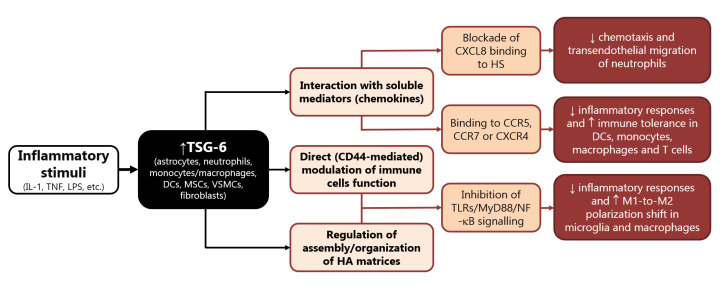
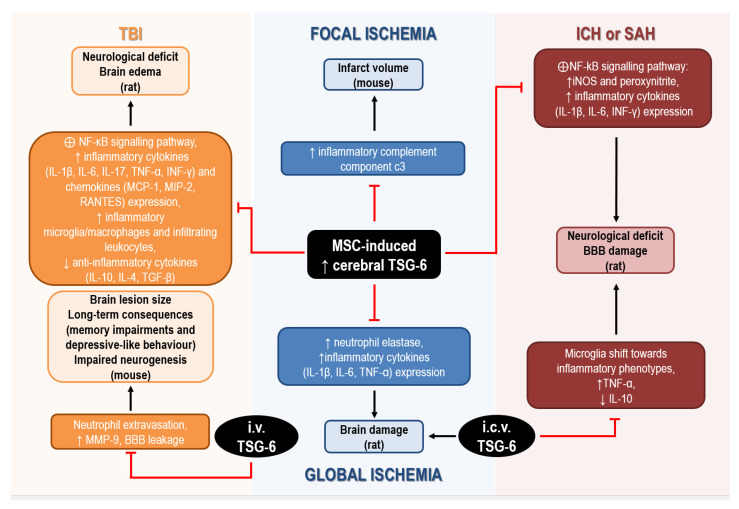
Tumor necrosis factor (TNF)-α-stimulated gene 6 (TSG-6), the first soluble chemokine-binding protein to be identified in mammals, inhibits chemotaxis and transendothelial migration of neutrophils and attenuates the inflammatory response of dendritic cells, macrophages, monocytes, and T cells. This immunoregulatory protein is a pivotal mediator of the therapeutic efficacy of mesenchymal stem/stromal cells (MSC) in diverse pathological conditions, including neuroinflammation. However, TSG-6 is also constitutively expressed in some tissues, such as the brain and spinal cord, and is generally upregulated in response to inflammation in monocytes/macrophages, dendritic cells, astrocytes, vascular smooth muscle cells and fibroblasts. Due to its ability to modulate sterile inflammation, TSG-6 exerts protective effects in diverse degenerative and inflammatory diseases, including brain disorders. Emerging evidence provides insights into the potential use of TSG-6 as a peripheral diagnostic and/or prognostic biomarker, especially in the context of ischemic stroke, whereby the pathobiological relevance of this protein has also been demonstrated in patients. Thus, in this review, we will discuss the most recent data on the involvement of TSG-6 in neurodegenerative diseases, particularly focusing on relevant anti-inflammatory and immunomodulatory functions. Furthermore, we will examine evidence suggesting novel therapeutic opportunities that can be afforded by modulating TSG-6-related pathways in neuropathological contexts and, most notably, in stroke.
肿瘤坏死因子 (TNF)-α 刺激基因 6 (TSG-6) 是哺乳动物中第一个被鉴定的可溶性趋化因子结合蛋白,它抑制中性粒细胞的趋化和跨内皮迁移,并减弱树突状细胞、巨噬细胞、单核细胞和 T 细胞的炎症反应。这种免疫调节蛋白是间充质干细胞 (MSC) 在多种病理情况下治疗效果的关键介质,包括神经炎症。然而,TSG-6 也在一些组织中持续表达,如大脑和脊髓,并且通常在单核细胞/巨噬细胞、树突状细胞、星形胶质细胞、血管平滑肌细胞和成纤维细胞中因炎症而上调。由于其能够调节无菌性炎症,TSG-6 在多种退行性和炎症性疾病中发挥保护作用,包括脑部疾病。新出现的证据提供了关于 TSG-6 作为外周诊断和/或预后生物标志物的潜在用途的见解,特别是在缺血性中风的背景下,该蛋白在患者中的病理生物学相关性也得到了证实。因此,在这篇综述中,我们将讨论 TSG-6 参与神经退行性疾病的最新数据,特别是重点关注其相关的抗炎和免疫调节功能。此外,我们还将研究表明在神经病理情况下调节 TSG-6 相关途径可以提供新的治疗机会的证据,尤其是在中风中。