Department of Physical Medicine and Rehabilitation, Mackay Memorial Hospital, Taipei 104, Taiwan.
Department of Mechanical Engineering, National Yang Ming Chiao Tung University, Hsinchu 300, Taiwan.
Int J Mol Sci. 2023 Mar 18;24(6):5814. doi: 10.3390/ijms24065814.
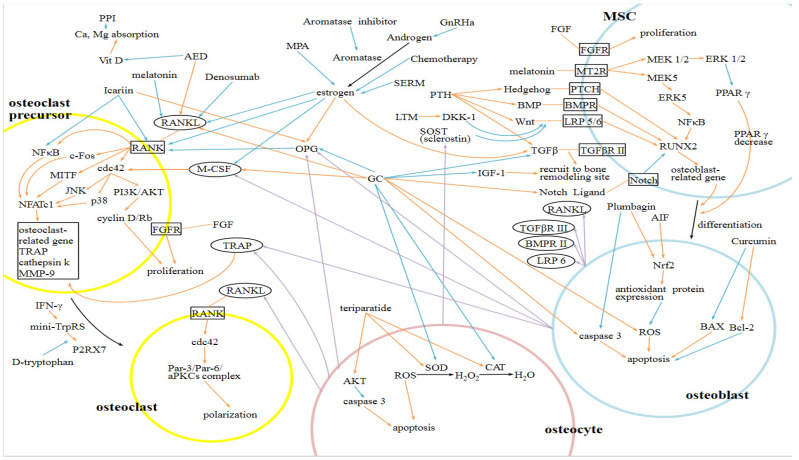
Osteoporosis resulting from an imbalance of bone turnover between resorption and formation is a critical health issue worldwide. Estrogen deficiency following a nature aging process is the leading cause of hormone-related osteoporosis for postmenopausal women, while glucocorticoid-induced osteoporosis remains the most common in drug-induced osteoporosis. Other medications and medical conditions related to secondary osteoporosis include proton pump inhibitors, hypogonadism, selective serotonin receptor inhibitors, chemotherapies, and medroxyprogesterone acetate. This review is a summary of the cellular and molecular mechanisms of bone turnover, the pathophysiology of osteoporosis, and their treatment. Nuclear factor-κβ ligand (RANKL) appears to be the critical uncoupling factor that enhances osteoclastogenesis. In contrast, osteoprotegerin (OPG) is a RANKL antagonist secreted by osteoblast lineage cells. Estrogen promotes apoptosis of osteoclasts and inhibits osteoclastogenesis by stimulating the production of OPG and reducing osteoclast differentiation after suppression of IL-1 and TNF, and subsequent M-CSF, RANKL, and IL-6 release. It can also activate the Wnt signaling pathway to increase osteogenesis, and upregulate BMP signaling to promote mesenchymal stem cell differentiation from pre-osteoblasts to osteoblasts rather than adipocytes. Estrogen deficiency leads to the uncoupling of bone resorption and formation; therefore, resulting in greater bone loss. Excessive glucocorticoids increase PPAR-2 production, upregulate the expression of Dickkopf-1 (DKK1) in osteoblasts, and inhibit the Wnt signaling pathway, thus decreasing osteoblast differentiation. They promote osteoclast survival by enhancing RANKL expression and inhibiting OPG expression. Appropriate estrogen supplement and avoiding excessive glucocorticoid use are deemed the primary treatment for hormone-related and glucocorticoid-induced osteoporosis. Additionally, current pharmacological treatment includes bisphosphonates, teriparatide (PTH), and RANKL inhibitors (such as denosumab). However, many detailed cellular and molecular mechanisms underlying osteoporosis seem complicated and unexplored and warrant further investigation.
由骨吸收和成骨之间的骨转换失衡引起的骨质疏松症是全球范围内的一个重要健康问题。绝经后妇女的激素相关性骨质疏松症主要是由于自然衰老过程中雌激素缺乏引起的,而糖皮质激素诱导的骨质疏松症仍然是药物诱导的骨质疏松症中最常见的。其他与继发性骨质疏松症相关的药物和医学状况包括质子泵抑制剂、性腺功能减退、选择性 5-羟色胺受体抑制剂、化疗药物和醋酸甲羟孕酮。本文综述了骨转换的细胞和分子机制、骨质疏松症的病理生理学及其治疗方法。核因子-κβ配体(RANKL)似乎是增强破骨细胞形成的关键解偶联因子。相比之下,骨保护素(OPG)是成骨细胞谱系细胞分泌的 RANKL 拮抗剂。雌激素通过刺激 OPG 的产生和抑制 IL-1 和 TNF 后 M-CSF、RANKL 和 IL-6 的释放,促进破骨细胞凋亡,并抑制破骨细胞形成,从而抑制破骨细胞形成。它还可以激活 Wnt 信号通路,增加成骨作用,并上调 BMP 信号通路,促进间充质干细胞从前成骨细胞向成骨细胞而不是脂肪细胞分化。雌激素缺乏导致骨吸收和成骨脱偶联;因此,导致更多的骨丢失。过量的糖皮质激素会增加 PPAR-2 的产生,上调成骨细胞中 Dickkopf-1(DKK1)的表达,并抑制 Wnt 信号通路,从而减少成骨细胞分化。它们通过增强 RANKL 的表达和抑制 OPG 的表达来促进破骨细胞的存活。适当的雌激素补充和避免过度使用糖皮质激素被认为是治疗激素相关性和糖皮质激素诱导性骨质疏松症的主要方法。此外,目前的药物治疗包括双膦酸盐、特立帕肽(PTH)和 RANKL 抑制剂(如地舒单抗)。然而,许多与骨质疏松症相关的详细细胞和分子机制似乎很复杂,还有待进一步研究。