• 文献检索
  • 文档翻译
  • 深度研究
  • 学术资讯
  • Suppr Zotero 插件Zotero 插件
  • 邀请有礼
  • 套餐&价格
  • 历史记录
应用&插件
Suppr Zotero 插件Zotero 插件浏览器插件Mac 客户端Windows 客户端微信小程序
定价
高级版会员购买积分包购买API积分包
服务
文献检索文档翻译深度研究API 文档MCP 服务
关于我们
关于 Suppr公司介绍联系我们用户协议隐私条款
关注我们

Suppr 超能文献

核心技术专利:CN118964589B侵权必究
粤ICP备2023148730 号-1Suppr @ 2026

文献检索

告别复杂PubMed语法,用中文像聊天一样搜索,搜遍4000万医学文献。AI智能推荐,让科研检索更轻松。

立即免费搜索

文件翻译

保留排版,准确专业,支持PDF/Word/PPT等文件格式,支持 12+语言互译。

免费翻译文档

深度研究

AI帮你快速写综述,25分钟生成高质量综述,智能提取关键信息,辅助科研写作。

立即免费体验

骨科领域中的人工智能应用:利用预测分析和机器学习预测关节镜下肩袖手术结果

Approaching Artificial Intelligence in Orthopaedics: Predictive Analytics and Machine Learning to Prognosticate Arthroscopic Rotator Cuff Surgical Outcomes.

作者信息

Potty Anish G, Potty Ajish S R, Maffulli Nicola, Blumenschein Lucas A, Ganta Deepak, Mistovich R Justin, Fuentes Mario, Denard Patrick J, Sethi Paul M, Shah Anup A, Gupta Ashim

机构信息

South Texas Orthopedic Research Institute (STORI Inc.), Laredo, TX 78045, USA.

The Institute of Musculoskeletal Excellence (TIME Orthopaedics), Laredo, TX 78041, USA.

出版信息

J Clin Med. 2023 Mar 19;12(6):2369. doi: 10.3390/jcm12062369.

DOI:10.3390/jcm12062369
PMID:36983368
原文链接:https://pmc.ncbi.nlm.nih.gov/articles/PMC10056706/
Abstract

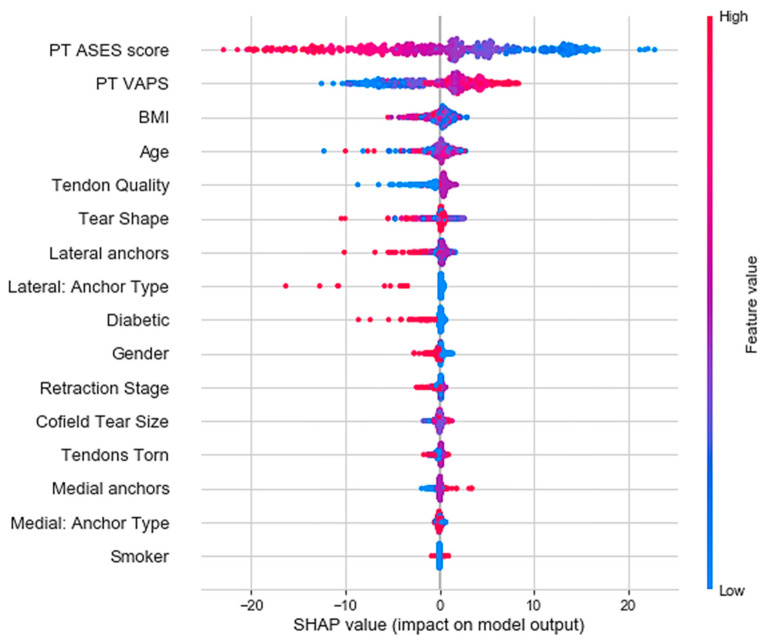
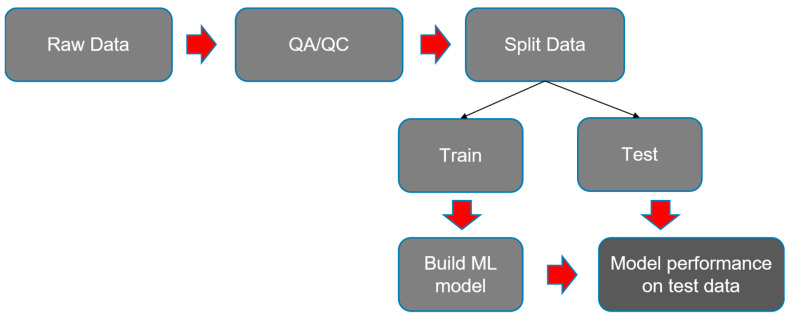
Machine learning (ML) has not yet been used to identify factors predictive for post-operative functional outcomes following arthroscopic rotator cuff repair (ARCR). We propose a novel algorithm to predict ARCR outcomes using machine learning. This is a retrospective cohort study from a prospectively collected database. Data were collected from the Surgical Outcome System Global Registry (Arthrex, Naples, FL, USA). Pre-operative and 3-month, 6-month, and 12-month post-operative American Shoulder and Elbow Surgeons (ASES) scores were collected and used to develop a ML model. Pre-operative factors including demography, comorbidities, cuff tear, tissue quality, and fixation implants were fed to the ML model. The algorithm then produced an expected post-operative ASES score for each patient. The ML-produced scores were compared to actual scores using standard test-train machine learning principles. Overall, 631 patients who underwent shoulder arthroscopy from January 2011 to March 2020 met inclusion criteria for final analysis. A substantial number of the test dataset predictions using the XGBoost algorithm were within the minimal clinically important difference (MCID) and substantial clinical benefit (SCB) thresholds: 67% of the 12-month post-operative predictions were within MCID, while 84% were within SCB. Pre-operative ASES score, pre-operative pain score, body mass index (BMI), age, and tendon quality were the most important features in predicting patient recovery as identified using Shapley additive explanations (SHAP). In conclusion, the proposed novel machine learning algorithm can use pre-operative factors to predict post-operative ASES scores accurately. This can further supplement pre-operative counselling, planning, and resource allocation. Level of Evidence: III.

摘要

机器学习(ML)尚未用于识别关节镜下肩袖修复术(ARCR)后预测术后功能结局的因素。我们提出了一种使用机器学习预测ARCR结局的新算法。这是一项基于前瞻性收集数据库的回顾性队列研究。数据收集自外科手术结局系统全球注册中心(美国佛罗里达州那不勒斯市的Arthrex公司)。收集术前以及术后3个月、6个月和12个月的美国肩肘外科医师学会(ASES)评分,并用于建立ML模型。将包括人口统计学、合并症、肩袖撕裂、组织质量和固定植入物等术前因素输入ML模型。然后,该算法为每位患者生成预期的术后ASES评分。使用标准的测试-训练机器学习原理,将ML生成的评分与实际评分进行比较。总体而言,2011年1月至2020年3月期间接受肩关节镜检查的631例患者符合最终分析的纳入标准。使用XGBoost算法对大量测试数据集的预测结果在最小临床重要差异(MCID)和显著临床获益(SCB)阈值范围内:术后12个月预测结果的67%在MCID范围内,而84%在SCB范围内。使用Shapley加性解释(SHAP)确定,术前ASES评分、术前疼痛评分、体重指数(BMI)、年龄和肌腱质量是预测患者恢复情况的最重要特征。总之,所提出的新型机器学习算法可以利用术前因素准确预测术后ASES评分。这可以进一步补充术前咨询、规划和资源分配。证据级别:III级。
https://cdn.ncbi.nlm.nih.gov/pmc/blobs/1c0a/10056706/e00be370ba15/jcm-12-02369-g007.jpg
https://cdn.ncbi.nlm.nih.gov/pmc/blobs/1c0a/10056706/35f27ad65634/jcm-12-02369-g001.jpg
https://cdn.ncbi.nlm.nih.gov/pmc/blobs/1c0a/10056706/4a26e1e13534/jcm-12-02369-g002a.jpg
https://cdn.ncbi.nlm.nih.gov/pmc/blobs/1c0a/10056706/52002e6f0763/jcm-12-02369-g003a.jpg
https://cdn.ncbi.nlm.nih.gov/pmc/blobs/1c0a/10056706/158cd39232b0/jcm-12-02369-g004.jpg
https://cdn.ncbi.nlm.nih.gov/pmc/blobs/1c0a/10056706/2612c4a74a98/jcm-12-02369-g005.jpg
https://cdn.ncbi.nlm.nih.gov/pmc/blobs/1c0a/10056706/e72f9e6d9e83/jcm-12-02369-g006.jpg
https://cdn.ncbi.nlm.nih.gov/pmc/blobs/1c0a/10056706/e00be370ba15/jcm-12-02369-g007.jpg
https://cdn.ncbi.nlm.nih.gov/pmc/blobs/1c0a/10056706/35f27ad65634/jcm-12-02369-g001.jpg
https://cdn.ncbi.nlm.nih.gov/pmc/blobs/1c0a/10056706/4a26e1e13534/jcm-12-02369-g002a.jpg
https://cdn.ncbi.nlm.nih.gov/pmc/blobs/1c0a/10056706/52002e6f0763/jcm-12-02369-g003a.jpg
https://cdn.ncbi.nlm.nih.gov/pmc/blobs/1c0a/10056706/158cd39232b0/jcm-12-02369-g004.jpg
https://cdn.ncbi.nlm.nih.gov/pmc/blobs/1c0a/10056706/2612c4a74a98/jcm-12-02369-g005.jpg
https://cdn.ncbi.nlm.nih.gov/pmc/blobs/1c0a/10056706/e72f9e6d9e83/jcm-12-02369-g006.jpg
https://cdn.ncbi.nlm.nih.gov/pmc/blobs/1c0a/10056706/e00be370ba15/jcm-12-02369-g007.jpg

相似文献

1
Approaching Artificial Intelligence in Orthopaedics: Predictive Analytics and Machine Learning to Prognosticate Arthroscopic Rotator Cuff Surgical Outcomes.骨科领域中的人工智能应用:利用预测分析和机器学习预测关节镜下肩袖手术结果
J Clin Med. 2023 Mar 19;12(6):2369. doi: 10.3390/jcm12062369.
2
Estimating the minimal clinically important difference of shoulder functional scores after arthroscopic rotator cuff repair: a prospective study.关节镜下肩袖修复术后肩关节功能评分的最小临床重要差异估计:一项前瞻性研究。
Arch Orthop Trauma Surg. 2024 Apr;144(4):1693-1701. doi: 10.1007/s00402-024-05222-8. Epub 2024 Feb 22.
3
Minimal Clinically Important Difference, Substantial Clinical Benefit, and Patient Acceptable Symptomatic State After Arthroscopic Rotator Cuff Repair.关节镜肩袖修复术后的最小临床重要差异、显著临床获益和患者可接受的症状状态。
Am J Sports Med. 2020 Sep;48(11):2650-2659. doi: 10.1177/0363546520943862. Epub 2020 Aug 19.
4
Predictive Modeling to Determine Functional Outcomes After Arthroscopic Rotator Cuff Repair.关节镜肩袖修复术后功能结局的预测模型。
Am J Sports Med. 2020 Jun;48(7):1559-1567. doi: 10.1177/0363546520914632. Epub 2020 May 14.
5
Mental health status, not resilience, influences functional recovery after arthroscopic rotator cuff repairs.心理健康状况而非适应力影响关节镜肩袖修复术后的功能恢复。
J Shoulder Elbow Surg. 2022 Jun;31(6S):S117-S122. doi: 10.1016/j.jse.2022.02.005. Epub 2022 Mar 12.
6
Time Required to Achieve Clinically Significant Outcomes After Arthroscopic Rotator Cuff Repair.关节镜肩袖修复术后达到临床显著结果所需的时间。
Am J Sports Med. 2020 Dec;48(14):3447-3453. doi: 10.1177/0363546520962512. Epub 2020 Oct 20.
7
What Change in American Shoulder and Elbow Surgeons Score Represents a Clinically Important Change After Shoulder Arthroplasty?美国肩肘外科医生评分的何种变化代表着肩关节置换术后具有临床意义的变化?
Clin Orthop Relat Res. 2016 Dec;474(12):2672-2681. doi: 10.1007/s11999-016-4968-z. Epub 2016 Jul 8.
8
Using Machine Learning to Predict Nonachievement of Clinically Significant Outcomes After Rotator Cuff Repair.使用机器学习预测肩袖修复术后临床显著结果未达成情况。
Orthop J Sports Med. 2023 Oct 19;11(10):23259671231206180. doi: 10.1177/23259671231206180. eCollection 2023 Oct.
9
Minimal clinically important differences in the American Shoulder and Elbow Surgeons, Simple Shoulder Test, and visual analog scale pain scores after arthroscopic rotator cuff repair.关节镜肩袖修复术后美国肩肘外科医生评分、简易肩测试和视觉模拟评分的最小临床重要差异。
J Shoulder Elbow Surg. 2020 Jul;29(7):1406-1411. doi: 10.1016/j.jse.2019.11.018. Epub 2020 Feb 17.
10
Anchorless Arthroscopic Transosseous and Anchored Arthroscopic Transosseous Equivalent Rotator Cuff Repair Show No Differences in Structural Integrity or Patient-reported Outcomes in a Matched Cohort.无锚点关节镜下经骨和有锚点关节镜下经骨修复肩袖撕裂的结构完整性和患者报告结果在匹配队列中无差异。
Clin Orthop Relat Res. 2020 Jun;478(6):1295-1303. doi: 10.1097/CORR.0000000000001151.

引用本文的文献

1
Red Staining of the LHB and the Rotator Interval on Arthroscopy-A Valid Indicator of Symptomatic Inflammation? A Machine Learning Assisted Investigation.关节镜检查时肱二头肌长头(LHB)和旋转间隙的红色染色:有症状炎症的有效指标?一项机器学习辅助研究
Orthop J Sports Med. 2025 Aug 13;13(8):23259671251360363. doi: 10.1177/23259671251360363. eCollection 2025 Aug.
2
Artificial intelligence in orthopedics: fundamentals, current applications, and future perspectives.骨科中的人工智能:基础、当前应用及未来展望。
Mil Med Res. 2025 Aug 4;12(1):42. doi: 10.1186/s40779-025-00633-z.
3
Changes in shoulder range of motion following arthroscopic rotator cuff repair: a systematic review.

本文引用的文献

1
Artificial intelligence-based applications in shoulder surgery leaves much to be desired: a systematic review.基于人工智能的肩部手术应用仍有很大的改进空间:一项系统评价。
JSES Rev Rep Tech. 2023 Jan 7;3(2):189-200. doi: 10.1016/j.xrrt.2022.12.006. eCollection 2023 May.
2
Developing a machine learning algorithm to predict probability of retear and functional outcomes in patients undergoing rotator cuff repair surgery: protocol for a retrospective, multicentre study.开发机器学习算法预测行肩袖修复手术患者再撕裂和功能结局的概率:一项回顾性、多中心研究方案。
BMJ Open. 2023 Feb 10;13(2):e063673. doi: 10.1136/bmjopen-2022-063673.
3
关节镜下肩袖修复术后肩关节活动范围的变化:一项系统评价
BMC Musculoskelet Disord. 2025 Jul 4;26(1):600. doi: 10.1186/s12891-025-08579-y.
4
Context-Aware Dual-Task Deep Network for Concurrent Bone Segmentation and Clinical Assessment to Enhance Shoulder Arthroplasty Preoperative planning.用于并发骨分割和临床评估以增强肩关节置换术前规划的上下文感知双任务深度网络。
IEEE Open J Eng Med Biol. 2025 Jan 9;6:269-278. doi: 10.1109/OJEMB.2025.3527877. eCollection 2025.
5
Detection of Acromion Types in Shoulder Magnetic Resonance Image Examination with Developed Convolutional Neural Network and Textural-Based Content-Based Image Retrieval System.利用改进的卷积神经网络和基于纹理的基于内容的图像检索系统在肩部磁共振成像检查中检测肩峰类型
J Clin Med. 2025 Jan 14;14(2):505. doi: 10.3390/jcm14020505.
6
Artificial Intelligence (AI): A Potential Game Changer in Regenerative Orthopedics-A Scoping Review.人工智能(AI):再生骨科领域潜在的游戏规则改变者——一项范围综述
Indian J Orthop. 2024 Jun 2;58(10):1362-1374. doi: 10.1007/s43465-024-01189-1. eCollection 2024 Oct.
7
Application of Artificial Intelligence in Shoulder Pathology.人工智能在肩部病理学中的应用。
Diagnostics (Basel). 2024 May 24;14(11):1091. doi: 10.3390/diagnostics14111091.
8
Artificial Intelligence for Clinically Meaningful Outcome Prediction in Orthopedic Research: Current Applications and Limitations.人工智能在骨科研究中用于具有临床意义的结果预测:当前应用与局限性
Curr Rev Musculoskelet Med. 2024 Jun;17(6):185-206. doi: 10.1007/s12178-024-09893-z. Epub 2024 Apr 8.
9
Rotator cuff tears.肩袖撕裂。
Nat Rev Dis Primers. 2024 Feb 8;10(1):8. doi: 10.1038/s41572-024-00492-3.
10
Advancements in the diagnosis and management of rotator cuff tears. The role of artificial intelligence.肩袖撕裂诊断与管理的进展。人工智能的作用。
J Orthop. 2023 Nov 8;47:87-93. doi: 10.1016/j.jor.2023.11.011. eCollection 2024 Jan.
Artificial Intelligence in the Management of Rotator Cuff Tears.
人工智能在肩袖撕裂管理中的应用。
Int J Environ Res Public Health. 2022 Dec 14;19(24):16779. doi: 10.3390/ijerph192416779.
4
Tear Size and Stiffness Are Important Predictors of Retear: An Assessment of Factors Associated with Repair Integrity at 6 Months in 1,526 Rotator Cuff Repairs.撕裂大小和刚度是再撕裂的重要预测因素:对1526例肩袖修复术后6个月时与修复完整性相关因素的评估。
JB JS Open Access. 2022 Sep 26;7(3). doi: 10.2106/JBJS.OA.22.00006. eCollection 2022 Jul-Sep.
5
The effects of obesity on 1-year functional outcomes after arthroscopic rotator cuff tear repair.肥胖对关节镜下肩袖撕裂修复术后1年功能预后的影响。
JSES Int. 2022 May 5;6(4):631-637. doi: 10.1016/j.jseint.2022.04.004. eCollection 2022 Jul.
6
Comparing the Predictors of Functional Outcomes After Arthroscopic Rotator Cuff Repair Modified Frailty Index, Clinical Frailty Scale, and Charlson Comorbidity Index.比较关节镜下肩袖修复术后功能结果的预测因素:改良虚弱指数、临床虚弱量表和查尔森合并症指数。
Orthop J Sports Med. 2021 Jul 15;9(7):23259671211005091. doi: 10.1177/23259671211005091. eCollection 2021 Jul.
7
Prediction of Shoulder Stiffness After Arthroscopic Rotator Cuff Repair.关节镜下肩袖修复术后肩关节僵硬的预测。
Am J Sports Med. 2021 Sep;49(11):3030-3039. doi: 10.1177/03635465211028980. Epub 2021 Jul 26.
8
Explainable AI: A Review of Machine Learning Interpretability Methods.可解释人工智能:机器学习可解释性方法综述
Entropy (Basel). 2020 Dec 25;23(1):18. doi: 10.3390/e23010018.
9
Factors Predicting Frequency and Severity of Postoperative Pain After Arthroscopic Rotator Cuff Repair Surgery.关节镜肩袖修复术后疼痛的频率和严重程度的预测因素。
Am J Sports Med. 2021 Jan;49(1):146-153. doi: 10.1177/0363546520971749. Epub 2020 Nov 23.
10
Artificial intelligence and machine learning in orthopedic surgery: a systematic review protocol.骨科手术中的人工智能与机器学习:一项系统综述方案
J Orthop Surg Res. 2020 Oct 19;15(1):478. doi: 10.1186/s13018-020-02002-z.