Tagyan Aya I, Yasser Manal M, Mousa Ahmed M, Alkhalifah Dalal Hussien M, Hozzein Wael N, Marzouk Marym A
Department of Botany and Microbiology, Faculty of Science, Beni-Suef University, Beni-Suef 62511, Egypt.
Department of Biology, College of Science, Princess Nourah bint Abdulrahman University, P.O. Box 84428, Riyadh 11671, Saudi Arabia.
J Fungi (Basel). 2023 Mar 21;9(3):382. doi: 10.3390/jof9030382.
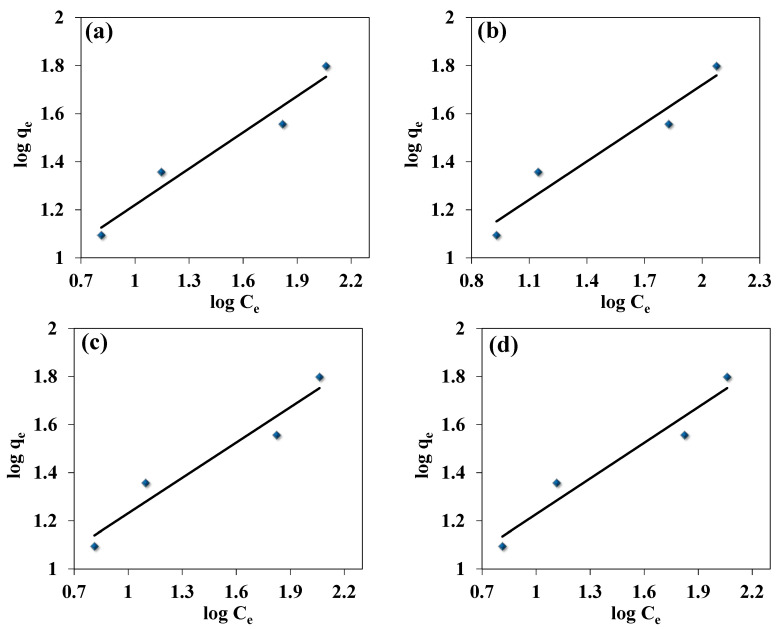
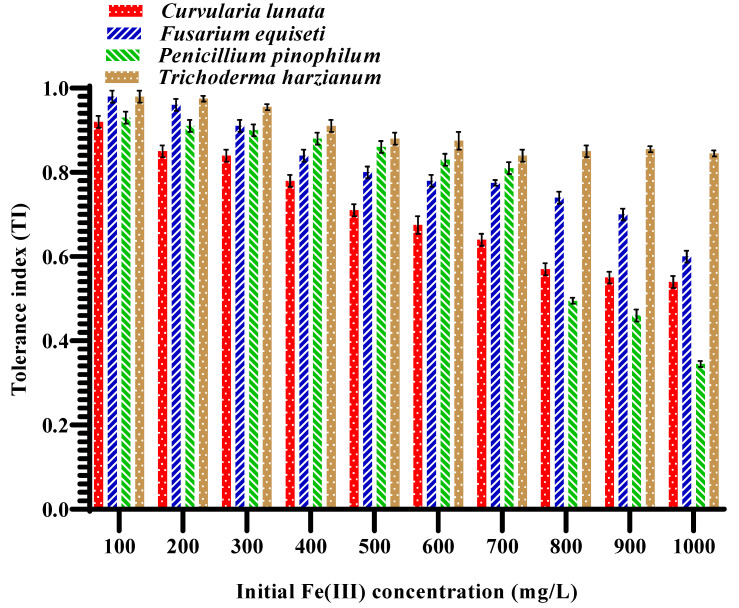
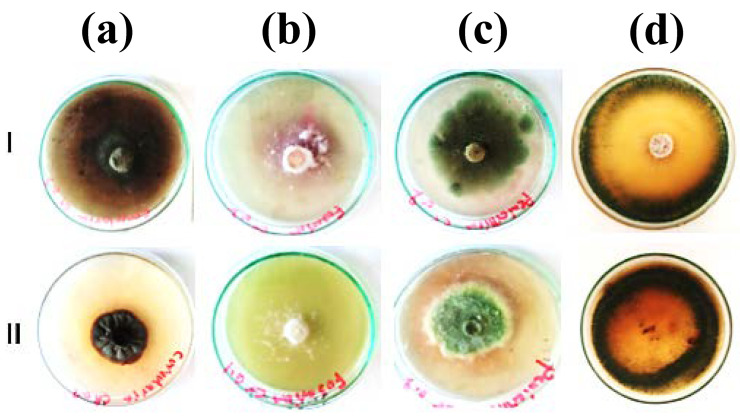
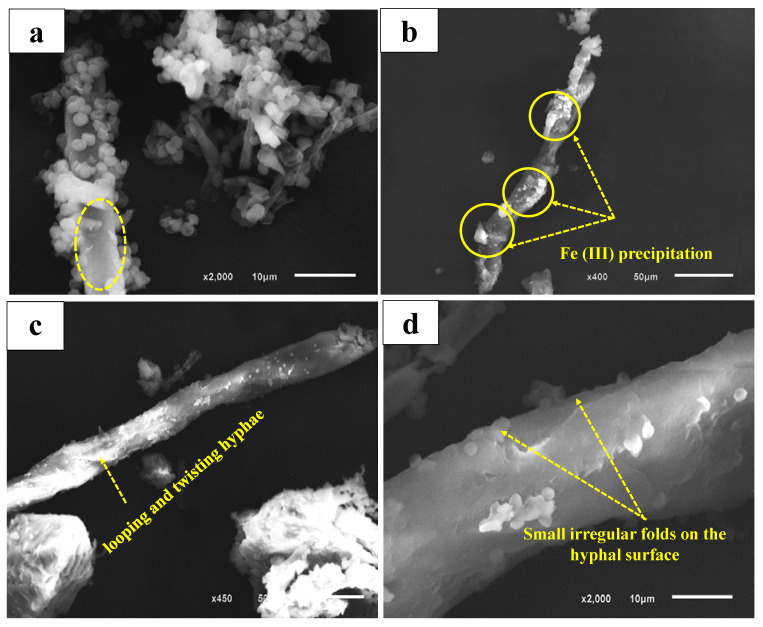
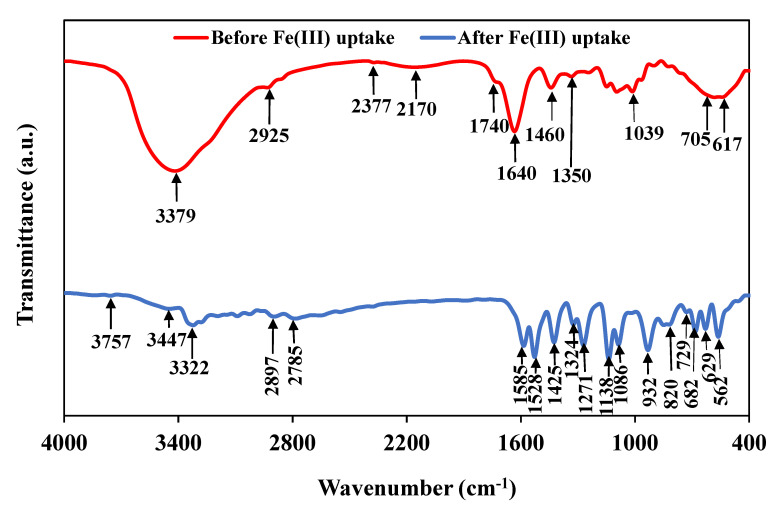
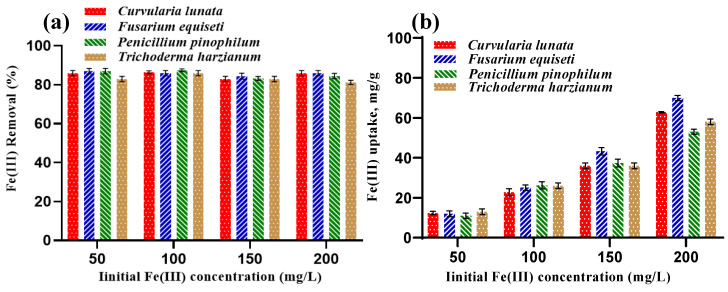
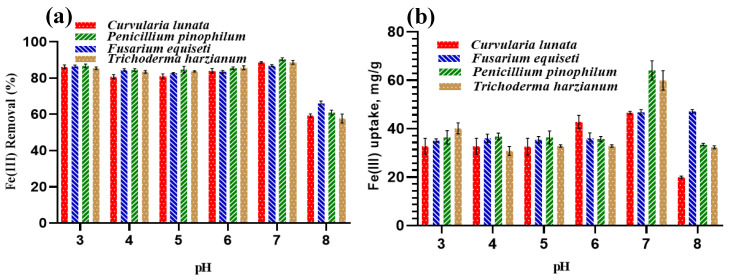
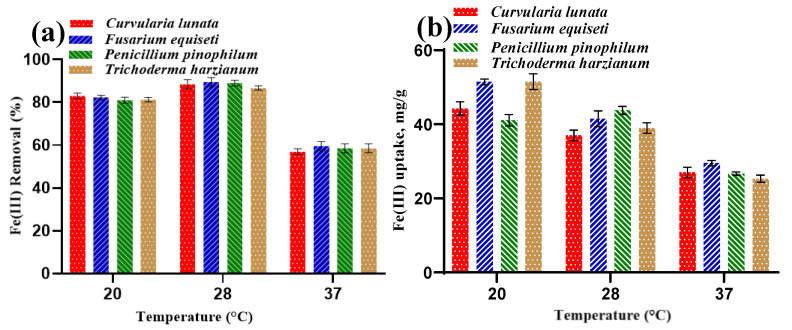
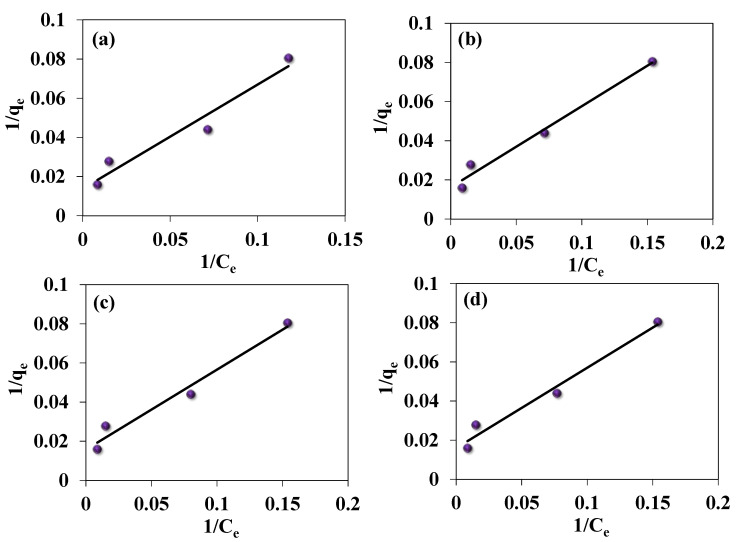
Mycoremediation is one of the most attractive, eco-friendly, and sustainable methods to mitigate the toxic effects of heavy metals. This study aimed to determine the mycoremediation capacity of metallophilic fungi isolated from heavy-metal-contaminated soil containing a high Fe(III) concentration (118.40 mg/kg). Four common fungal strains were isolated, including , , , and . These fungal strains were exposed to gradually increasing concentrations of Fe(III) of 100, 200, 300, 400, 500, 600, 700, 800, 900, and 1000 mg/L. Sophisticated techniques and tests were employed to investigate the mycoremediation capability, including tolerance index (TI), scanning electron microscopy (SEM), Fourier-transform infrared spectroscopy (FTIR), and adsorption isotherm. Furthermore, the impacts of initial concentration, pH, and temperature on the Fe(III) removal (%) and uptake capacity (mg/g) of the studied samples were investigated. The results were validated by statistical analysis using one-way ANOVA. It was found that the Fe(III) uptake with different ratios triggered alterations in the Fe(III) tolerance (TI) morphological (SEM), chemical (FTIR), and adsorption capacity properties. The highest Fe(III) tolerance for all studied fungal strains was achieved at 100 mg/L. Moreover, the optimum conditions of Fe(III) removal (%) for all studied fungal strains were within pH 7 and 28 °C, with similar performance at the initial Fe(III) concentration ranging from 50-200 mg/L. At the same time, the maximum Fe(III) uptake was achieved at pH 7, 20 °C, and 200 mg/L. Compared to other strains, the Fe(III) tolerance of was rise in the Fe(III) concentration. The Fe(III) uptake reaction was corroborated by best fitting with the Langmuir model, achieving optimum adsorption capacities of 61.34, 62.90, 63.30, and 72.46 mg/g for , , , , respectively. It can be deduced that the addressed fungi species can be applied in mycoremediation according to the utilized Fe(III) concentrations with more superiority for live .
真菌修复是减轻重金属毒性作用最具吸引力、生态友好且可持续的方法之一。本研究旨在确定从含铁(III)浓度高(118.40 mg/kg)的重金属污染土壤中分离出的嗜金属真菌的真菌修复能力。分离出四种常见真菌菌株,包括[此处原文缺失具体菌株名称]、[此处原文缺失具体菌株名称]、[此处原文缺失具体菌株名称]和[此处原文缺失具体菌株名称]。将这些真菌菌株暴露于逐渐增加的100、200、300、400、500、600、700、800、900和1000 mg/L的铁(III)浓度下。采用了精密技术和测试来研究真菌修复能力,包括耐受指数(TI)、扫描电子显微镜(SEM)、傅里叶变换红外光谱(FTIR)和吸附等温线。此外,研究了初始浓度、pH值和温度对所研究样品中铁(III)去除率(%)和吸收能力(mg/g)的影响。结果通过单向方差分析的统计分析进行验证。发现不同比例的铁(III)吸收引发了铁(III)耐受性(TI)、形态(SEM)、化学(FTIR)和吸附容量特性的变化。所有研究的真菌菌株在100 mg/L时达到最高铁(III)耐受性。此外,所有研究的真菌菌株铁(III)去除率(%)的最佳条件在pH 7和28°C范围内,当初始铁(III)浓度在50 - 200 mg/L范围内时性能相似。同时,在pH 7、20°C和200 mg/L时实现了最大铁(III)吸收。与其他菌株相比,[此处原文缺失具体菌株名称]的铁(III)耐受性随铁(III)浓度升高。铁(III)吸收反应通过与朗缪尔模型的最佳拟合得到证实,[此处原文缺失具体菌株名称]、[此处原文缺失具体菌株名称]、[此处原文缺失具体菌株名称]和[此处原文缺失具体菌株名称]的最佳吸附容量分别达到61.34、62.90、63.30和72.46 mg/g。可以推断,根据所利用的铁(III)浓度,所研究的真菌物种可应用于真菌修复,[此处原文缺失具体菌株名称]具有更大优势。