Zhou Jingyi, Ping An, Mao Jizhong, Gu Yichen, Liu Fengqiang, Shao Anwen
Department of Neurosurgery, Second Affiliated Hospital, School of Medicine, Zhejiang University, Hangzhou 310009, China.
Brain Research Institute, Zhejiang University, Hangzhou 310058, China.
Life (Basel). 2023 Mar 21;13(3):846. doi: 10.3390/life13030846.
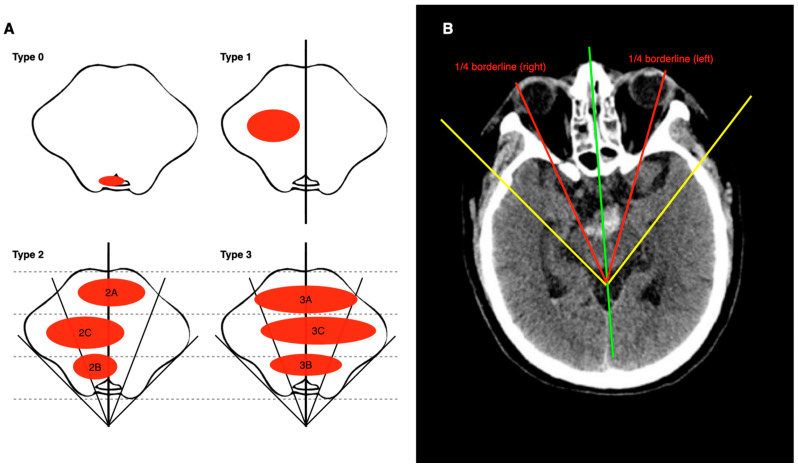
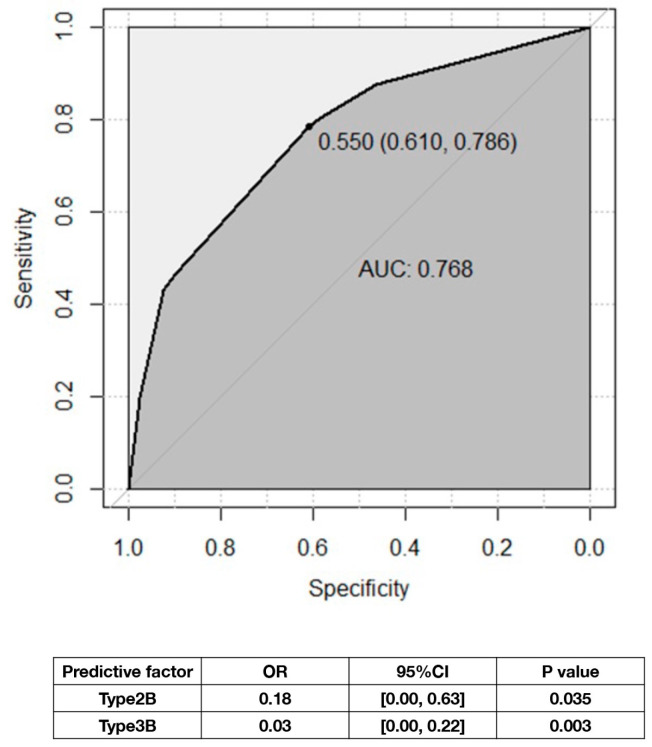
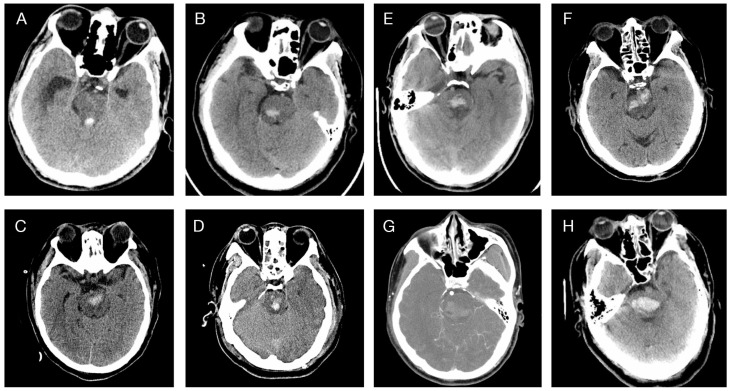
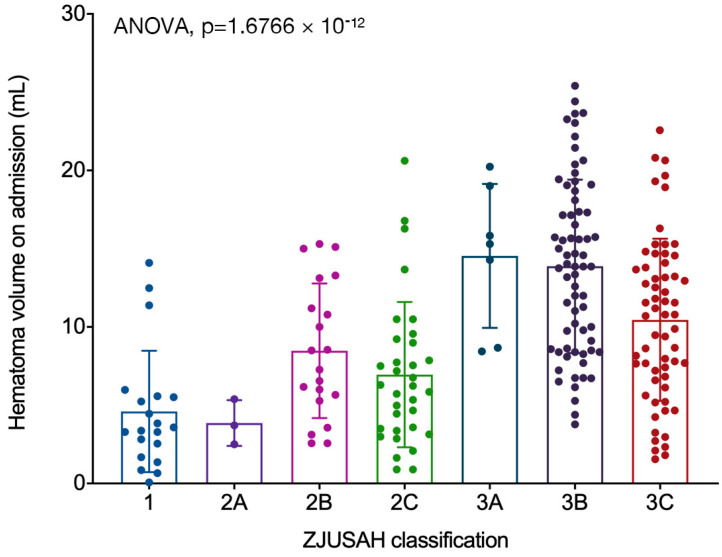
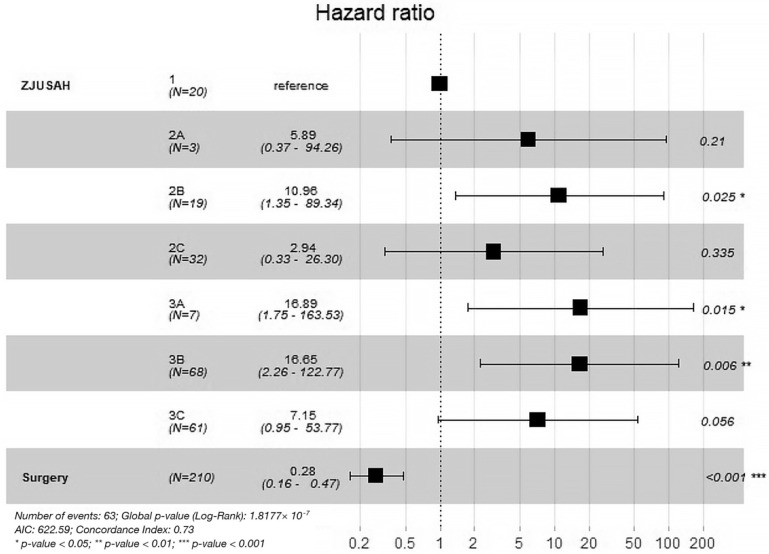
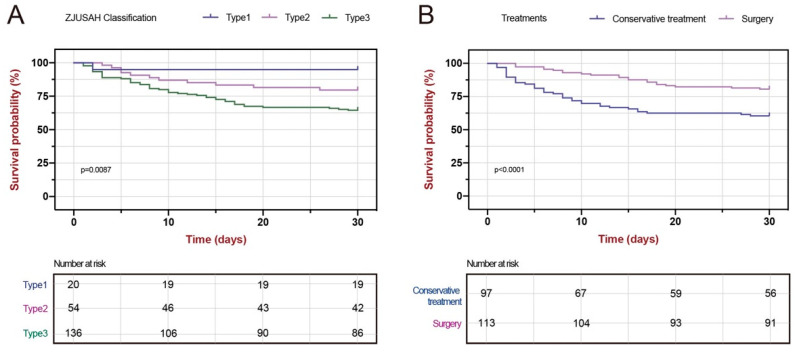
To analyze and improve ZJUSAH classification for primary brainstem hematoma, we retrospectively reviewed 211 patients with primary brainstem hemorrhage who were admitted to our institution between January 2014 and October 2020. The primary clinical outcomes were the 30-day survival rate and 90-day consciousness recovery rate, which were evaluated using the National Institutes of Health Stroke Scale score. Univariate logistic regression and multivariate Cox regression analyses were performed to evaluate the prognostic model. The overall 30-day survival rate of the 211 patients was 69.7%. The 30-day survival rate was 95% among Type 1 patients, 77.8% among Type 2 patients, and 63.2% among Type 3 patients. The 90-day consciousness recovery rate was 63.2% among Type 1 patients, 61.9% among Type 2 patients, and 30.2% among Type 3 patients. Our findings suggest that ZJUSAH classification can be optimized according to hematoma volume, with Type 3 patients with a hematoma larger than 12.4 mL tending to have a worse state of consciousness. Additionally, we discovered that ZJUSAH classification is valuable in predicting 30-day survival rates in conservative treatment patients. In conclusion, our study established and optimized a new CT-based hematoma classification system for primary brainstem hematoma, which facilitates treatment selection and prognostic prediction.
为分析和改进原发性脑干血肿的浙江大学附属第一医院(ZJUSAH)分类,我们回顾性分析了2014年1月至2020年10月期间收治于我院的211例原发性脑干出血患者。主要临床结局为30天生存率和90天意识恢复率,采用美国国立卫生研究院卒中量表评分进行评估。进行单因素逻辑回归和多因素Cox回归分析以评估预后模型。211例患者的总体30天生存率为69.7%。1型患者的30天生存率为95%,2型患者为77.8%,3型患者为63.2%。1型患者的90天意识恢复率为63.2%,2型患者为61.9%,3型患者为30.2%。我们的研究结果表明,ZJUSAH分类可根据血肿体积进行优化,血肿大于12.4 mL的3型患者意识状态往往较差。此外,我们发现ZJUSAH分类在预测保守治疗患者的30天生存率方面具有价值。总之,我们的研究建立并优化了一种基于CT的原发性脑干血肿新分类系统,有助于治疗选择和预后预测。