
无机杀菌剂对葡萄园生链格孢子囊壳形成的防治效果。
Efficiency of inorganic fungicides against the formation of Erysiphe necator chasmothecia in vineyards.
机构信息
Department of Crop Sciences, Institute of Plant Protection, University of Natural Resources and Life Sciences, Vienna, Gregor-Mendel-Strasse 33, Vienna, Austria.
出版信息
Pest Manag Sci. 2023 Sep;79(9):3080-3089. doi: 10.1002/ps.7487. Epub 2023 Apr 14.
BACKGROUND
A reduction in chasmothecia, an important inoculum of grape powdery mildew (Erysiphe necator Schwein.), is essential for disease control in vineyards; the use of fungicides during the formation of chasmothecia on vine leaves, late in the growing season, may accomplish this. Inorganic fungicides, such as sulphur, copper, and potassium bicarbonate, are very useful for this purpose because of their multisite mode of action. The aim of this study was to evaluate chasmothecia reduction using different fungicide applications late in the growing season in commercially managed vineyards and in an exact application trial.
RESULTS
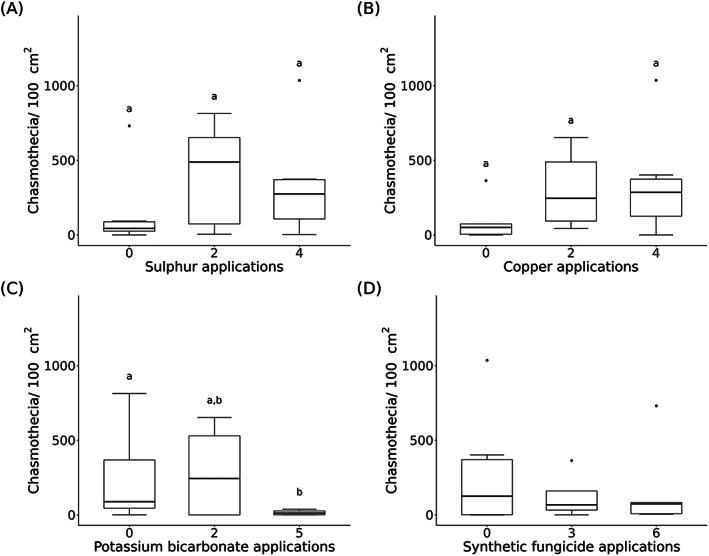
Chasmothecia on vine leaves were reduced in commercial vineyards by four copper (P = 0.01) and five potassium bicarbonate (P = 0.026) applications. The positive effect of potassium bicarbonate was also confirmed in the application trial, where two applications showed lower chasmothecia numbers than the control (P = 0.002).
CONCLUSION
The application of inorganic fungicides reduced the amount of chasmothecia as the primary inoculum source. Potassium bicarbonate and copper are of further interest for disease control as these fungicides can be used by organic and conventional wine growers. The application of these fungicides should be carried out as late as possible before harvest to reduce chasmothecia formation and, consequently, the potential for powdery mildew infestation in the subsequent season. © 2023 The Authors. Pest Management Science published by John Wiley & Sons Ltd on behalf of Society of Chemical Industry.
背景
减少子囊壳(葡萄白粉病的重要接种体)对于葡萄园的疾病控制至关重要;在生长季节后期,即在子囊壳形成于葡萄叶片上时使用杀菌剂可能会达到此目的。由于其多作用位点的作用模式,无机杀菌剂(如硫磺、铜和碳酸氢钾)非常适用于此目的。本研究旨在评估生长季节后期不同杀菌剂处理对子囊壳减少的效果,包括商业管理葡萄园和精确应用试验。
结果
在商业葡萄园,铜杀菌剂(P=0.01)和碳酸氢钾杀菌剂(P=0.026)各应用四次和五次可减少叶片上的子囊壳。碳酸氢钾的积极作用在应用试验中也得到了证实,其中两次应用的子囊壳数量低于对照(P=0.002)。
结论
无机杀菌剂的应用减少了作为主要接种源的子囊壳数量。碳酸氢钾和铜作为杀菌剂对有机和常规酿酒商具有进一步的吸引力,因为这些杀菌剂可以使用。这些杀菌剂的应用应在收获前尽可能晚地进行,以减少子囊壳的形成,从而降低下一季白粉病侵染的潜力。 © 2023 作者。Pest Management Science 由 John Wiley & Sons Ltd 代表化学工业协会出版。




 Zotero 插件