State Key Laboratory of Food Science and Technology, Jiangnan University, Wuxi, China.
School of Food Science and Technology, Jiangnan University, Wuxi, China.
Front Cell Infect Microbiol. 2023 Mar 13;13:1154346. doi: 10.3389/fcimb.2023.1154346. eCollection 2023.
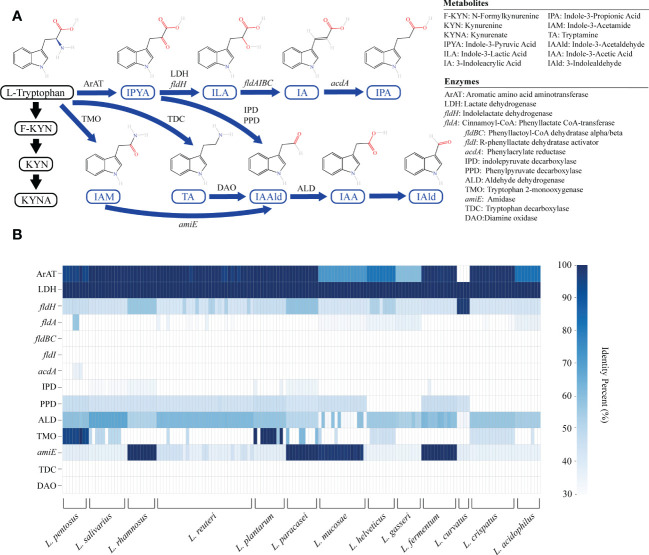
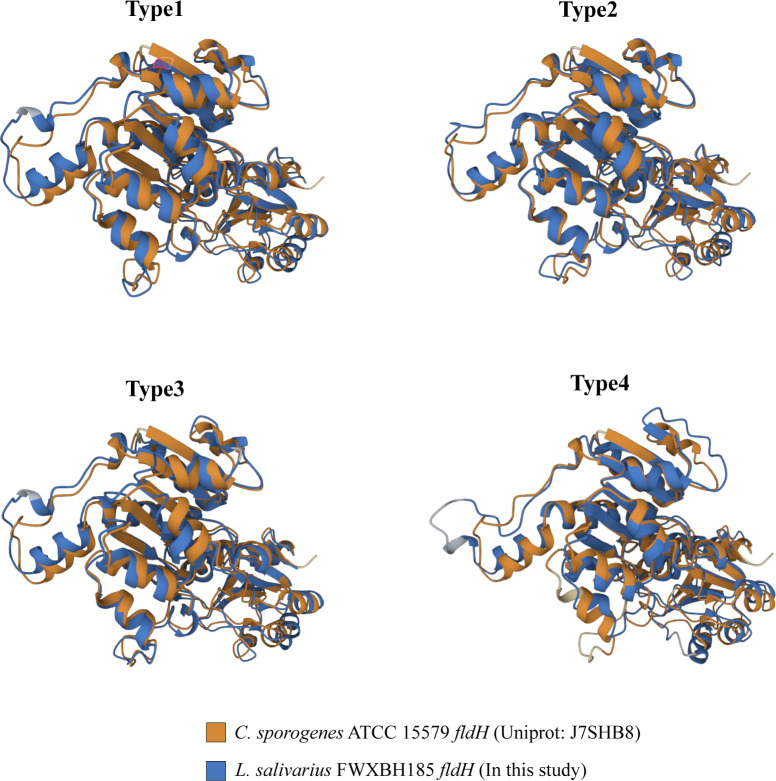
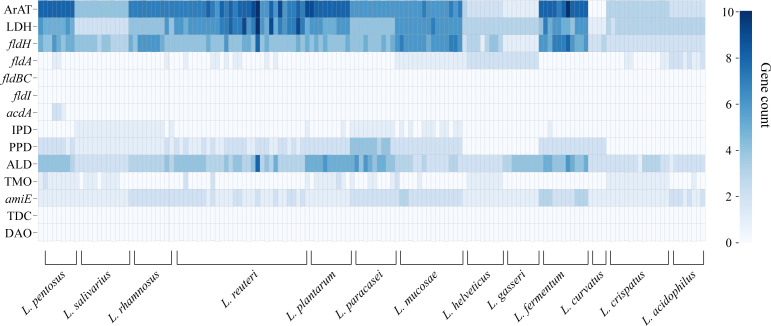
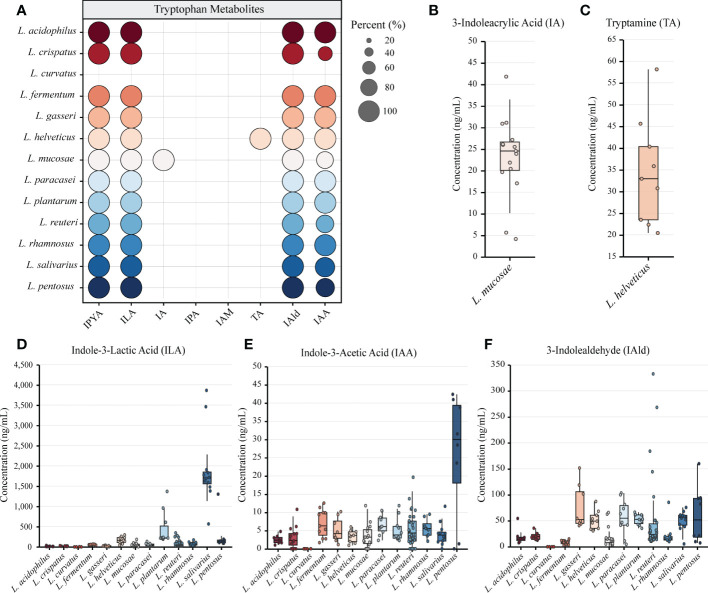
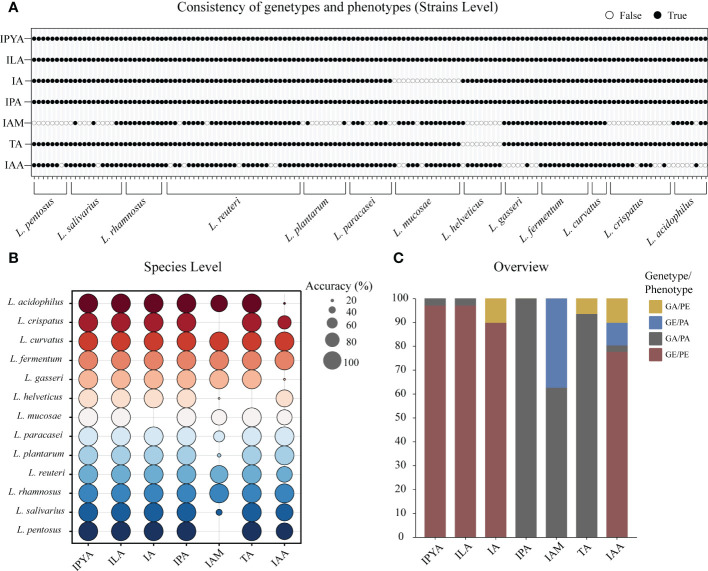
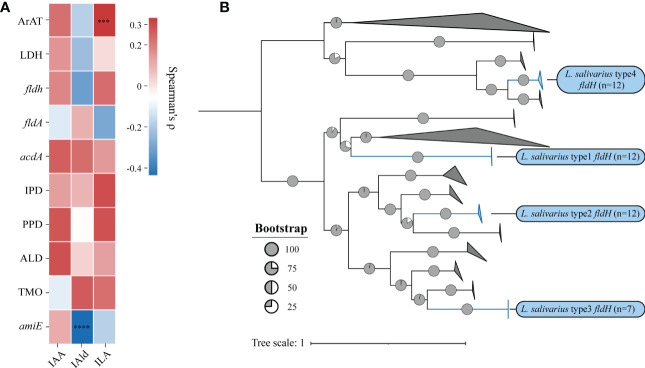
Tryptophan is metabolized by microorganisms into various indole derivatives that have been proven to alleviate diseases and promote human health. Lactic acid bacteria (LAB) are a broad microbial concept, some of which have been developed as probiotics. However, the capacity of most LAB to metabolize tryptophan is unknown. In this study, the aim is to reveal the rule of tryptophan metabolism in LAB by multi-omics. The findings showed that LAB were rich in genes for tryptophan catabolism and that multiple genes were shared among LAB species. Although the number of their homologous sequences was different, they could still form the same metabolic enzyme system. The metabolomic analysis revealed that LAB were capable of producing a variety of metabolites. Strains belonging to the same species can produce the same metabolites and have similar yields. A few strains showed strain-specificity in the production of indole-3-lactic acid (ILA), indole-3-acetic acid, and 3-indolealdehyde (IAld). In the genotype-phenotype association analysis, the metabolites of LAB were found to be highly consistent with the outcomes of gene prediction, particularly ILA, indole-3-propionic acid, and indole-3-pyruvic acid. The overall prediction accuracy was more than 87% on average, which indicated the predictability of tryptophan metabolites of LAB. Additionally, genes influenced the concentration of metabolites. The levels of ILA and IAld were significantly correlated with the numbers of aromatic amino acid aminotransferase and amidase, respectively. The unique indolelactate dehydrogenase in was the primary factor contributing to its large production of ILA. In summary, we demonstrated the gene distribution and production level of tryptophan metabolism in LAB and explored the correlation between genes and phenotypes. The predictability and specificity of the tryptophan metabolites in LAB were proven. These results provide a novel genomic method for the discovery of LAB with tryptophan metabolism potential and offer experimental data for probiotics that produce specific tryptophan metabolites.
色氨酸可被微生物代谢为各种吲哚衍生物,这些衍生物已被证明能缓解疾病并促进人类健康。乳酸菌(LAB)是一个广泛的微生物概念,其中一些已被开发为益生菌。然而,大多数 LAB 代谢色氨酸的能力尚不清楚。在这项研究中,目的是通过多组学揭示 LAB 中色氨酸代谢的规律。研究结果表明,LAB 富含色氨酸分解代谢基因,并且 LAB 物种之间存在多个共有基因。尽管它们的同源序列数量不同,但仍能形成相同的代谢酶系统。代谢组学分析表明,LAB 能够产生多种代谢物。属于同一物种的菌株可以产生相同的代谢物,且产量相似。少数菌株在吲哚-3-乳酸(ILA)、吲哚-3-乙酸和 3-吲哚乙醛(IAld)的产生方面表现出菌株特异性。在基因型-表型关联分析中,发现 LAB 的代谢物与基因预测的结果高度一致,特别是 ILA、吲哚-3-丙酸和吲哚-3-丙酮酸。总体预测准确率平均超过 87%,表明 LAB 色氨酸代谢物具有可预测性。此外,基因会影响代谢物的浓度。ILA 和 IAld 的水平分别与芳香族氨基酸转氨酶和酰胺酶的数量显著相关。独特的吲哚乳酸脱氢酶是其大量产生 ILA 的主要因素。综上所述,我们展示了 LAB 中色氨酸代谢的基因分布和产生水平,并探讨了基因与表型之间的相关性。证明了 LAB 中色氨酸代谢物的可预测性和特异性。这些结果为发现具有色氨酸代谢潜力的 LAB 提供了一种新的基因组方法,并为产生特定色氨酸代谢物的益生菌提供了实验数据。