Department of Ultrasound, The First Affiliated Hospital of Nanjing Medical University, Nanjing, China.
Department of Breast Surgery, The First Affiliated Hospital of Nanjing Medical University, Nanjing, China.
Diagn Interv Radiol. 2023 May 31;29(3):469-477. doi: 10.4274/dir.2022.22534. Epub 2023 Jan 25.
To determine whether the primary tumor features derived from conventional ultrasound (US) and contrast-enhanced US (CEUS) facilitate the prediction of positive axillary lymph nodes (ALNs) in breast cancer diagnosed as Breast Imaging Reporting and Data System (BI-RADS) category 4.
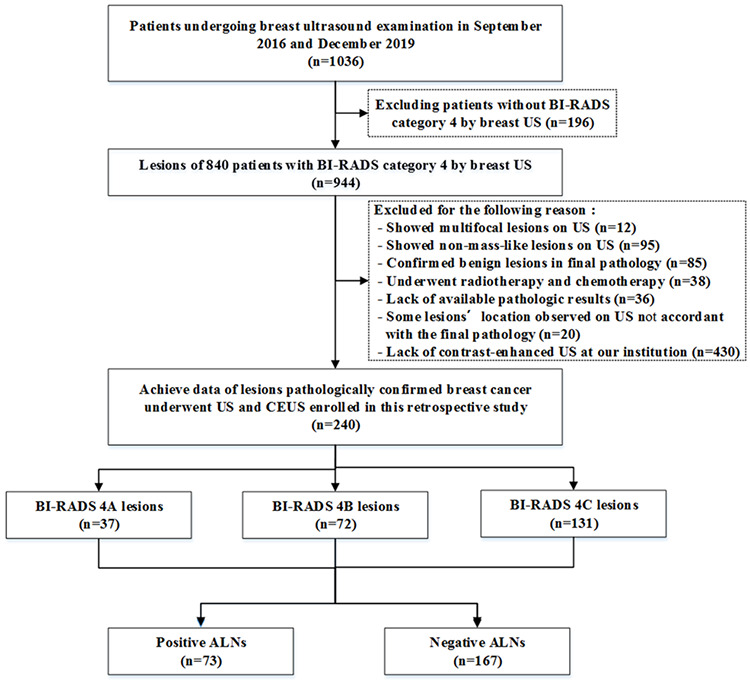
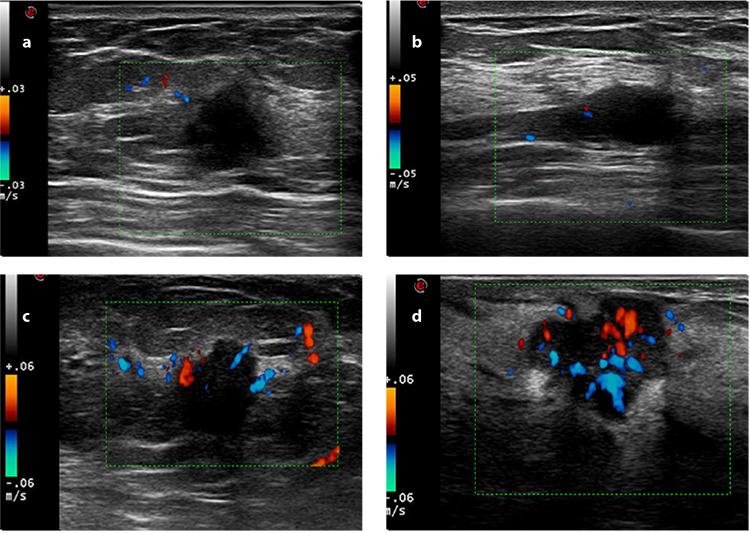
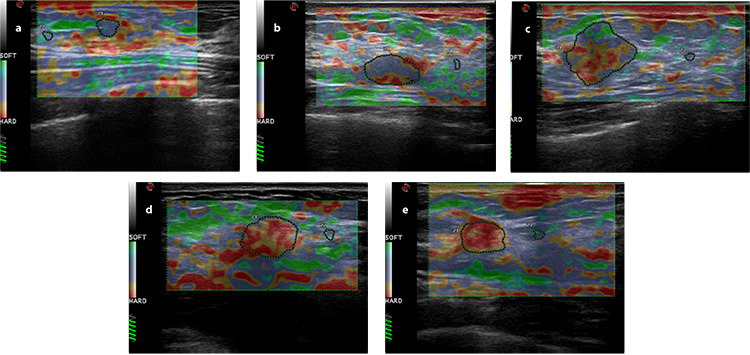
A total of 240 women with breast cancer who underwent preoperative conventional US, strain elastography, and CEUS between September 2016 and December 2019 were included. The multiple parameters of the primary tumor were obtained, and univariate and multivariate analyses were performed to predict positive ALNs. Then three prediction models (conventional US features, CEUS features, and the combined features) were developed, and the diagnostic performance was evaluated with receiver operating characteristic curves.
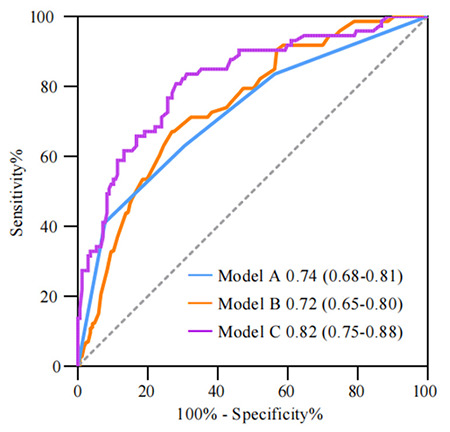
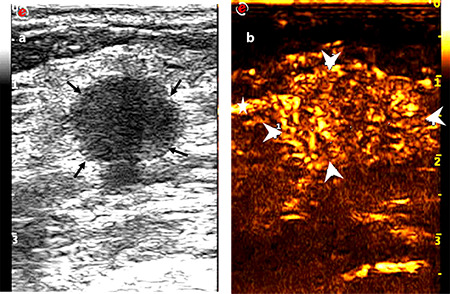
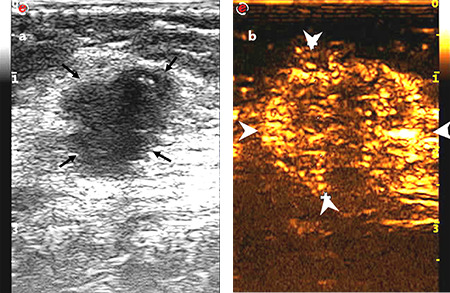
On conventional US, the traits of large size and the non-circumscribed margin of the primary tumor were marked as two independent predictors. On CEUS, the features of vessel perforation or distortion and the enhanced range of the primary tumor were marked as two independent predictors for positive ALNs. Three prediction models were then developed: model A (conventional US features), model B (CEUS features), and model C (model A plus B). Model C yielded the highest area under the curve (AUC) of 0.82 [95% confidence interval (CI), 0.75-0.88] compared with model A (AUC 0.74; 95% CI, 0.68-0.81; = 0.008) and model B (AUC 0.72; 95% CI, 0.65-0.80; < 0.001) as per the DeLong test.
CEUS, as a non-invasive examination technique, can be used to predict ALN metastasis. Combining conventional US and CEUS may produce favorable predictive accuracy for positive ALNs in BI-RADS category 4 breast cancer.
确定源于常规超声(US)和对比增强超声(CEUS)的原发肿瘤特征是否有助于预测经乳腺影像报告和数据系统(BI-RADS)分类为 4 类的乳腺癌患者的阳性腋窝淋巴结(ALN)。
共纳入 240 例于 2016 年 9 月至 2019 年 12 月期间接受术前常规 US、应变弹性成像和 CEUS 检查的乳腺癌患者。获得原发肿瘤的多个参数,并进行单因素和多因素分析以预测阳性 ALN。然后建立了三个预测模型(常规 US 特征、CEUS 特征和联合特征),并通过受试者工作特征曲线评估诊断性能。
在常规 US 上,原发肿瘤的大尺寸和非边界清晰的特征被标记为两个独立的预测因素。在 CEUS 上,血管穿孔或扭曲和原发肿瘤强化范围的特征被标记为阳性 ALN 的两个独立预测因素。然后建立了三个预测模型:模型 A(常规 US 特征)、模型 B(CEUS 特征)和模型 C(模型 A 加 B)。模型 C 的曲线下面积(AUC)最高,为 0.82 [95%置信区间(CI),0.75-0.88],与模型 A(AUC 为 0.74;95%CI,0.68-0.81; = 0.008)和模型 B(AUC 为 0.72;95%CI,0.65-0.80; < 0.001)相比,根据 DeLong 检验有统计学差异。
CEUS 作为一种非侵入性检查技术,可用于预测 ALN 转移。结合常规 US 和 CEUS 可能会提高 BI-RADS 4 类乳腺癌阳性 ALN 的预测准确性。