Emergency Department, University Hospital of Düsseldorf, Heinrich Heine University, Moorenstrasse 5, D-40225, Düsseldorf, Germany.
Department of Anaesthesiology and Intensive Care, ALB FILS Kliniken, Eichertstraße 3, 73035, Göppingen, Germany.
Scand J Trauma Resusc Emerg Med. 2023 Mar 30;31(1):14. doi: 10.1186/s13049-023-01079-9.
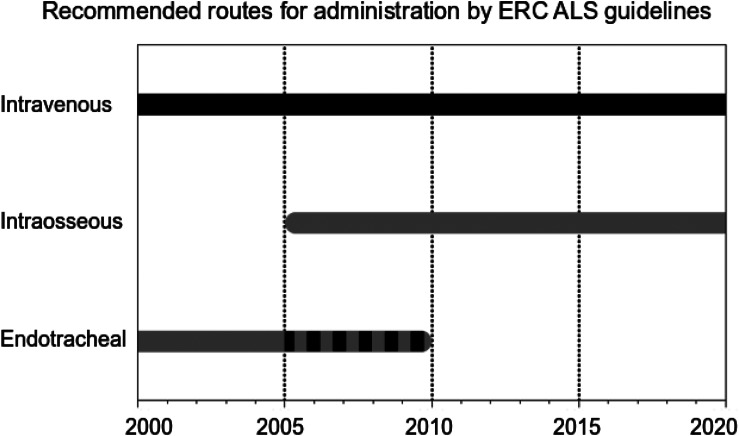
Over the past decades, international guidelines for cardiopulmonary resuscitation (CPR) have changed the recommendation for alternative routes for drug administration. Until now, evidence for the substantial superiority of one route with respect to treatment outcome after CPR has been lacking. The present study compares the effects of intravenous (IV), intraosseous (IO) and endotracheal (ET) adrenaline application during CPR in out-of-hospital cardiac arrest (OHCA) on clinical outcomes within the database of the German Resuscitation Registry (GRR).
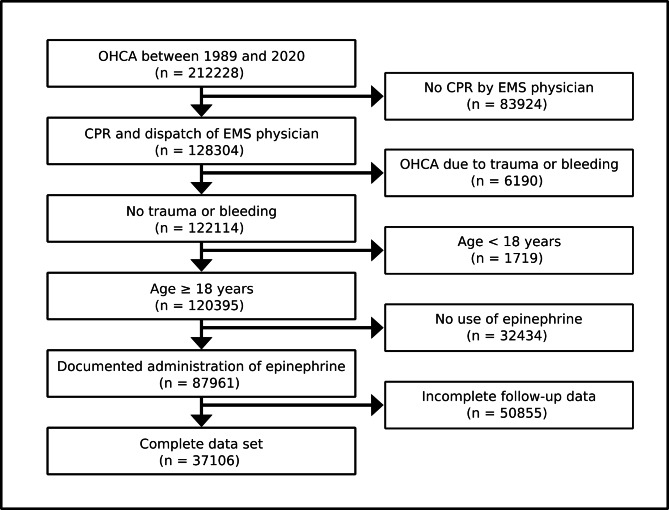
This registry analysis was based on the GRR cohort of 212,228 OHCA patients between 1989 and 2020. Inclusion criteria were: OHCA, application of adrenaline, and out-of-hospital CPR. Excluded from the study were patients younger than 18 years, those who had trauma or bleeding as suspected causes of cardiac arrest, and incomplete data sets. The clinical endpoint was hospital discharge with good neurological outcome [cerebral performance category (CPC) 1/2]. Four routes of adrenaline administration were compared: IV, IO, IO + IV, ET + IV. Group comparisons were done using matched-pair analysis and binary logistic regression.
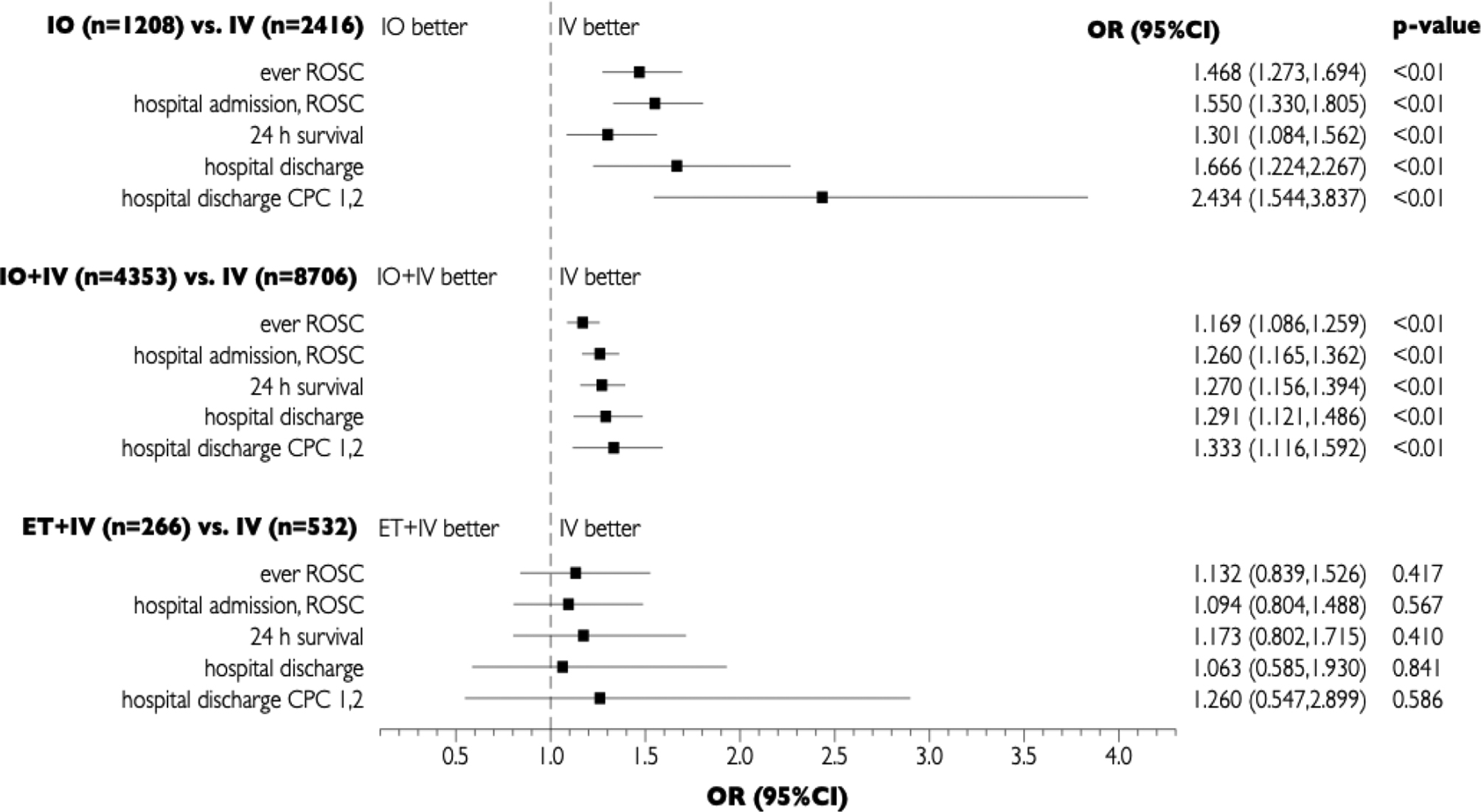
In matched-pair group comparisons of the primary clinical outcome hospital discharge with CPC 1/2, the IV group (n = 2416) showed better results compared to IO (n = 1208), [odds ratio (OR): 2.43, 95% confidence interval (CI): 1.54-3.84, p < 0.01] and when comparing IV (n = 8706) to IO + IV (n = 4353), [OR: 1.33, 95% CI: 1.12-1.59, p < 0.01]. In contrast, no significant difference was found between IV (n = 532) and ET + IV (n = 266), [OR: 1.26, 95% CI: 0.55-2.90, p = 0.59]. Concurrently, binary logistic regression yielded a highly significant effect of vascular access type (χ² = 67.744(3), p < 0.001) on hospital discharge with CPC1/2, with negative effects for IO (regression coefficient (r.c.) = - 0.766, p = 0.001) and IO + IV (r.c. = - 0.201, p = 0,028) and no significant effect for ET + IV (r.c. = 0.117, p = 0.770) compared to IV.
The GRR data, collected over a period of 31 years, seem to emphasize the relevance of an IV access during out-of-hospital CPR, in the event that adrenaline had to be administered. IO administration of adrenaline might be less effective. ET application, though removed in 2010 from international guidelines, could gain importance as an alternative route again.
在过去的几十年里,心肺复苏国际指南改变了药物给药的替代途径的推荐。到目前为止,还缺乏关于 CPR 后一种途径在治疗效果方面具有实质性优势的证据。本研究比较了在院外心脏骤停(OHCA)中 CPR 期间静脉内(IV)、骨内(IO)和气管内(ET)肾上腺素给药对德国复苏登记处(GRR)数据库中临床结果的影响。
本登记分析基于 1989 年至 2020 年期间 GRR 队列中 212,228 名 OHCA 患者。纳入标准为:OHCA、应用肾上腺素和院外 CPR。研究排除了年龄小于 18 岁、怀疑创伤或出血为心脏骤停原因以及数据不完整的患者。临床终点是出院时具有良好神经功能预后[脑功能分类(CPC)1/2]。比较了肾上腺素的四种给药途径:IV、IO、IO+IV、ET+IV。使用配对分析和二项逻辑回归比较组间比较。
在主要临床结局出院时 CPC1/2 的配对组比较中,IV 组(n=2416)与 IO 组(n=1208)相比,结果更好[比值比(OR):2.43,95%置信区间(CI):1.54-3.84,p<0.01],与 IV 组(n=8706)与 IO+IV 组(n=4353)相比,结果更好[OR:1.33,95%CI:1.12-1.59,p<0.01]。相比之下,IV 组(n=532)与 ET+IV 组(n=266)之间无显著差异[OR:1.26,95%CI:0.55-2.90,p=0.59]。同时,二项逻辑回归显示血管通路类型(χ²=67.744(3),p<0.001)对出院时 CPC1/2 具有高度显著影响,IO(回归系数(r.c.)=-0.766,p=0.001)和 IO+IV(r.c.=-0.201,p=0.028)的影响为负,而 ET+IV(r.c.=0.117,p=0.770)无显著影响与 IV 相比。
GRR 数据,在 31 年的时间跨度内收集,似乎强调了在院外 CPR 中给予肾上腺素时建立 IV 通路的重要性。IO 给予肾上腺素可能效果较差。虽然 ET 给药在 2010 年已从国际指南中删除,但它可能再次作为替代途径变得重要。