Institute for Genomics, Biocomputing and Biotechnology, Starkville, MS, USA.
HCT CO., LTD, Seoicheon-Ro 578 Beon-Gil, Majang-Myeon, Icheon, 17383, Korea.
Part Fibre Toxicol. 2023 Mar 31;20(1):9. doi: 10.1186/s12989-023-00515-z.
Toxicokinetics of nanomaterials, including studies on the absorption, distribution, metabolism, and elimination of nanomaterials, are essential in assessing their potential health effects. The fate of nanomaterials after inhalation exposure to multiple nanomaterials is not clearly understood.
Male Sprague-Dawley rats were exposed to similar sizes of silver nanoparticles (AgNPs, 10.86 nm) and gold nanoparticles (AuNPs, 10.82 nm) for 28 days (6-h/day, 5-days/week for four weeks) either with separate NP inhalation exposures or with combined co-exposure in a nose-only inhalation system. Mass concentrations sampled from the breathing zone were AuNP 19.34 ± 2.55 μg/m and AgNP 17.38 ± 1.88 μg/m for separate exposure and AuNP 8.20 μg/m and AgNP 8.99 μg/m for co-exposure. Lung retention and clearance were previously determined on day 1 (6-h) of exposure (E-1) and on post-exposure days 1, 7, and 28 (PEO-1, PEO-7, and PEO-28, respectively). In addition, the fate of nanoparticles, including translocation and elimination from the lung to the major organs, were determined during the post-exposure observation period.
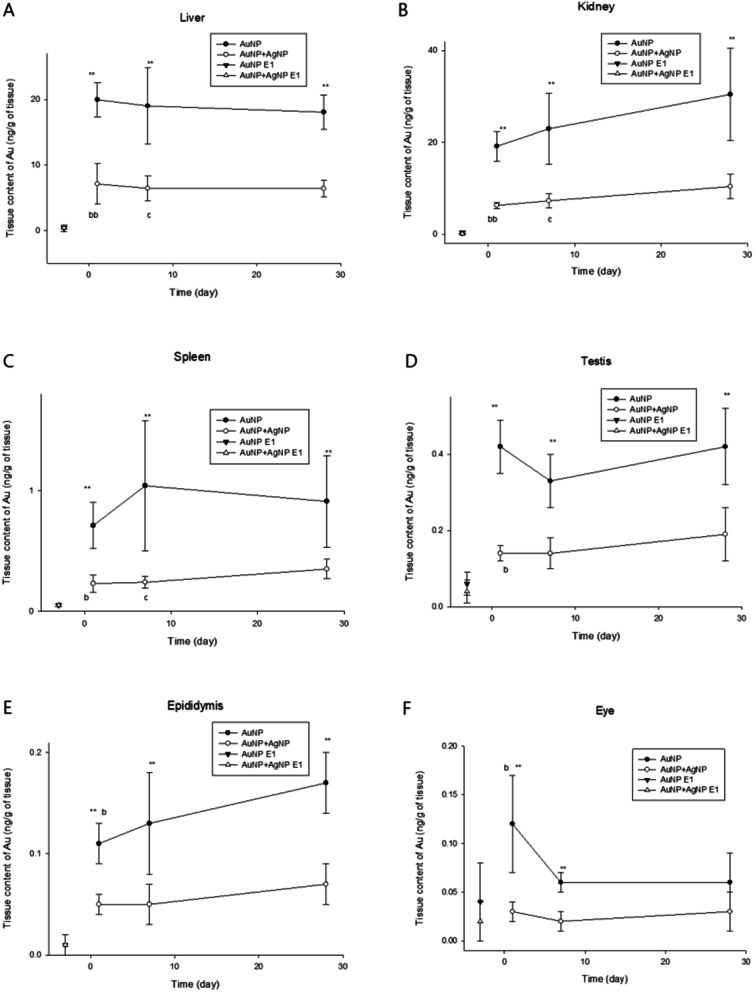
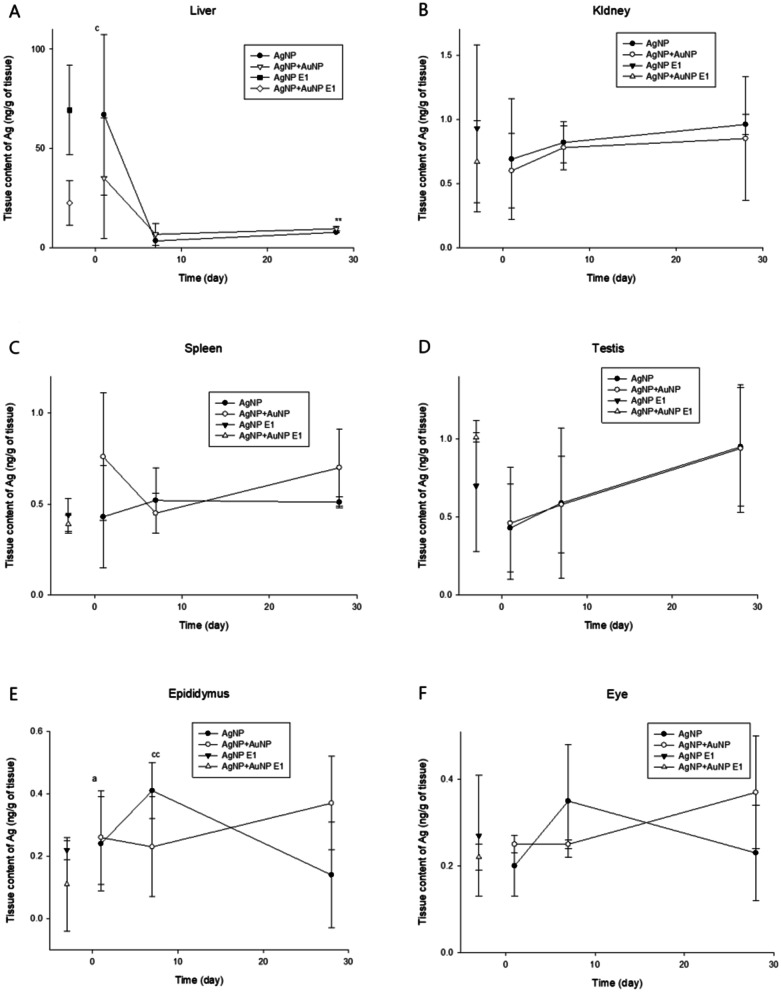
AuNP was translocated to the extrapulmonary organs, including the liver, kidney, spleen, testis, epididymis, olfactory bulb, hilar and brachial lymph nodes, and brain after subacute inhalation and showed biopersistence regardless of AuNP single exposure or AuNP + AgNP co-exposure, showing similar elimination half-time. In contrast, Ag was translocated to the tissues and rapidly eliminated from the tissues regardless of AuNP co-exposure. Ag was continually accumulated in the olfactory bulb and brain and persistent until PEO-28.
Our co-exposure study of AuNP and AgNP indicated that soluble AgNP and insoluble AuNP translocated differently, showing soluble AgNP could be dissolved into Ag ion to translocate to the extrapulmonary organs and rapidly removed from most organs except the brain and olfactory bulb. Insoluble AuNPs were continually translocated to the extrapulmonary organs, and they were not eliminated rapidly.
纳米材料的毒代动力学,包括对纳米材料的吸收、分布、代谢和消除的研究,对于评估其潜在健康影响至关重要。吸入暴露于多种纳米材料后纳米材料的命运尚不清楚。
雄性 Sprague-Dawley 大鼠分别或同时使用鼻吸入暴露系统吸入大小相似的银纳米颗粒(AgNPs,10.86nm)和金纳米颗粒(AuNPs,10.82nm),进行 28 天(6 小时/天,每周 5 天,共 4 周)的暴露。从呼吸区采集的质量浓度分别为单独暴露时的 AuNP 19.34±2.55μg/m 和 AgNP 17.38±1.88μg/m,以及共暴露时的 AuNP 8.20μg/m 和 AgNP 8.99μg/m。肺内滞留和清除率分别于暴露第 1 天(E-1)和暴露后第 1、7 和 28 天(PEO-1、PEO-7 和 PEO-28)进行了测定。此外,还在暴露后观察期内测定了纳米颗粒的命运,包括从肺向主要器官的转移和消除。
AuNP 在亚急性吸入后转移到肺外器官,包括肝、肾、脾、睾丸、附睾、嗅球、肺门和臂淋巴结以及脑,并表现出生物持久性,无论 AuNP 单独暴露还是 AuNP+AgNP 共暴露,均表现出相似的消除半衰期。相比之下,Ag 无论是否存在 AuNP 共暴露,都会转移到组织中并迅速从组织中消除。Ag 持续在嗅球和脑中积累,直到 PEO-28 仍存在。
我们对 AuNP 和 AgNP 的共暴露研究表明,可溶性 AgNP 和不溶性 AuNP 的转移方式不同,表明可溶性 AgNP 可溶解为 Ag 离子,转移到肺外器官,并迅速从大多数器官(脑和嗅球除外)中去除。不溶性 AuNPs 持续转移到肺外器官,且不能迅速消除。