Centre for Environmental Sciences, Hasselt University, Hasselt, Belgium.
Department of Public Health and Primary Care, Leuven University, Louvain, Belgium.
Environ Health. 2023 Mar 30;22(1):33. doi: 10.1186/s12940-023-00982-z.
Cognitive performances of schoolchildren have been adversely associated with both recent and chronic exposure to ambient air pollution at the residence. In addition, growing evidence indicates that exposure to green space is associated with a wide range of health benefits. Therefore, we aimed to investigate if surrounding green space at the residence improves cognitive performance of primary schoolchildren while taking into account air pollution exposure.
Cognitive performance tests were administered repeatedly to a total of 307 primary schoolchildren aged 9-12y, living in Flanders, Belgium (2012-2014). These tests covered three cognitive domains: attention (Stroop and Continuous Performance Tests), short-term memory (Digit Span Forward and Backward Tests), and visual information processing speed (Digit-Symbol and Pattern Comparison Tests). Green space exposure was estimated within several radii around their current residence (50 m to 2000 m), using a aerial photo-derived high-resolution (1 m) land cover map. Furthermore, air pollution exposure to PM and NO during the year before examination was modelled for the child's residence using a spatial-temporal interpolation method.
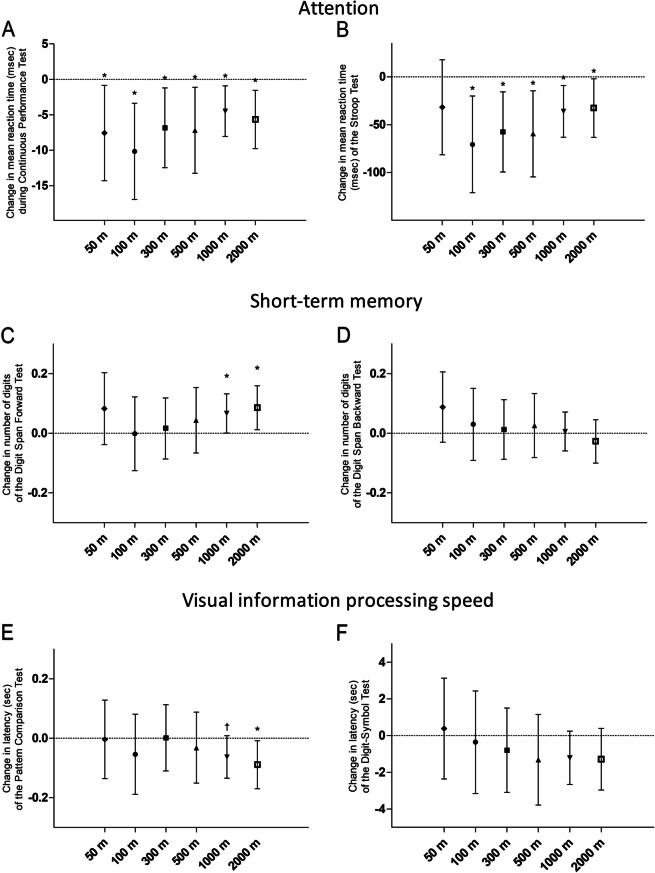
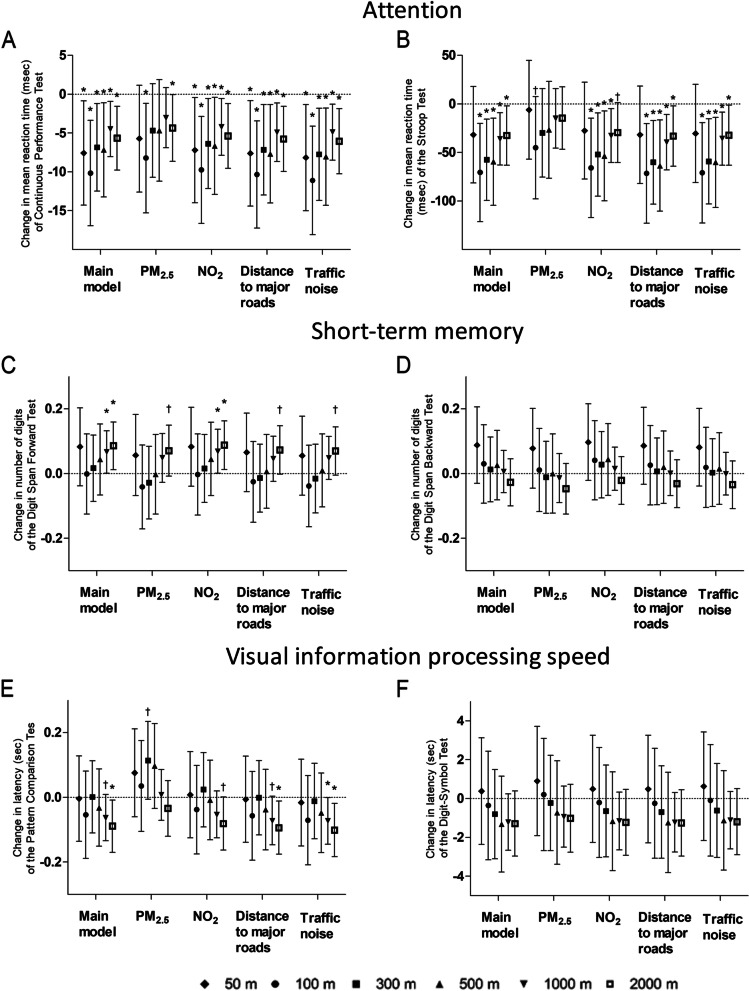
An improvement of the children's attention was found with more residential green space exposure independent of traffic-related air pollution. For an interquartile range increment (21%) of green space within 100 m of the residence, a significantly lower mean reaction time was observed independent of NO for both the sustained-selective (-9.74 ms, 95% CI: -16.6 to -2.9 ms, p = 0.006) and the selective attention outcomes (-65.90 ms, 95% CI: -117.0 to -14.8 ms, p = 0.01). Moreover, green space exposure within a large radius (2000 m) around the residence was significantly associated with a better performance in short-term memory (Digit-Span Forward Test) and a higher visual information processing speed (Pattern Comparison Test), taking into account traffic-related exposure. However, all associations were attenuated after taking into account long-term residential PM exposure.
Our panel study showed that exposure to residential surrounding green space was associated with better cognitive performances at 9-12 years of age, taking into account traffic-related air pollution exposure. These findings support the necessity to build attractive green spaces in the residential environment to promote healthy cognitive development in children.
最近的研究表明,儿童在居住地暴露于环境空气中的污染物与认知表现下降有关。此外,越来越多的证据表明,接触绿地与广泛的健康益处有关。因此,我们旨在调查儿童在居住地周围的绿地是否会改善认知表现,同时考虑到空气污染的暴露情况。
对 307 名 9-12 岁居住在比利时佛兰德的小学生进行了多次认知测试。这些测试涵盖了三个认知领域:注意力(Stroop 和连续性能测试)、短期记忆(数字跨度向前和向后测试)和视觉信息处理速度(数字符号和模式比较测试)。利用航空照片衍生的高分辨率(1 米)土地覆盖图,在儿童当前居住地的几个半径范围内(50 米至 2000 米)估算绿地暴露量。此外,使用时空插值方法对儿童居住地的 PM 和 NO 空气污染暴露量进行建模。
研究发现,儿童的注意力随着居住地附近绿地面积的增加而提高,而与交通相关的空气污染无关。与居住地 100 米内的绿地增加一个四分位距(21%)相比,在不考虑 NO 的情况下,选择性注意(-9.74 毫秒,95%置信区间:-16.6 至-2.9 毫秒,p=0.006)和持续选择性注意(-65.90 毫秒,95%置信区间:-117.0 至-14.8 毫秒,p=0.01)的平均反应时间明显更短。此外,考虑到交通相关的暴露,居住地周围较大半径(2000 米)内的绿地暴露与短期记忆(数字跨度向前测试)和视觉信息处理速度(模式比较测试)的表现更好显著相关。然而,所有关联在考虑长期居住的 PM 暴露后都减弱了。
本队列研究表明,考虑到交通相关的空气污染暴露,儿童在居住地周围的绿地暴露与 9-12 岁时的认知表现更好有关。这些发现支持了在居住环境中建造有吸引力的绿地的必要性,以促进儿童的健康认知发展。