Fekih-Romdhane Feten, Jiang Chen, Obeid Sahar, Malaeb Diana, Chammas Nancy, Fawaz Mirna, Soufia Michel, Meng Runtang, Hallit Souheil
The Tunisian Center of Early Intervention in Psychosis, Department of Psychiatry "Ibn Omrane", Razi Hospital, 2010, Manouba, Tunisia.
Faculty of Medicine of Tunis, Tunis El Manar University, Tunis, Tunisia.
J Eat Disord. 2023 Apr 1;11(1):53. doi: 10.1186/s40337-023-00782-3.
There is a growing attention on intuitive eating (IE) styles in the Western world that has not yet reached Arab countries, which is likely due to the lack of psychometrically sound measures of the IE construct for Arabic-speaking people. The current study aims to examine the psychometric properties of an Arabic translation of the most widely used measure of IE-the Intuitive Eating Scale-2 (IES-2), in an Arabic-speaking community population from Lebanon.
Two samples of Arabic-speaking community adults from Lebanon (sample 1: n = 359, 59.9% females, age 22.75 ± 7.04 years; sample 2: n = 444, 72.7% females, age 27.25 ± 9.53 years) were recruited through online convenience sampling. The translation and back-translation method was applied to the IES-2 for linguistic validation. Factorial validity was investigated using an Exploratory Factor Analysis & Confirmatory Factor Analysis strategy. Composite reliability and sex invariance were examined. We also tested convergent and criterion-related validity through correlations with other theoretically plausible constructs.
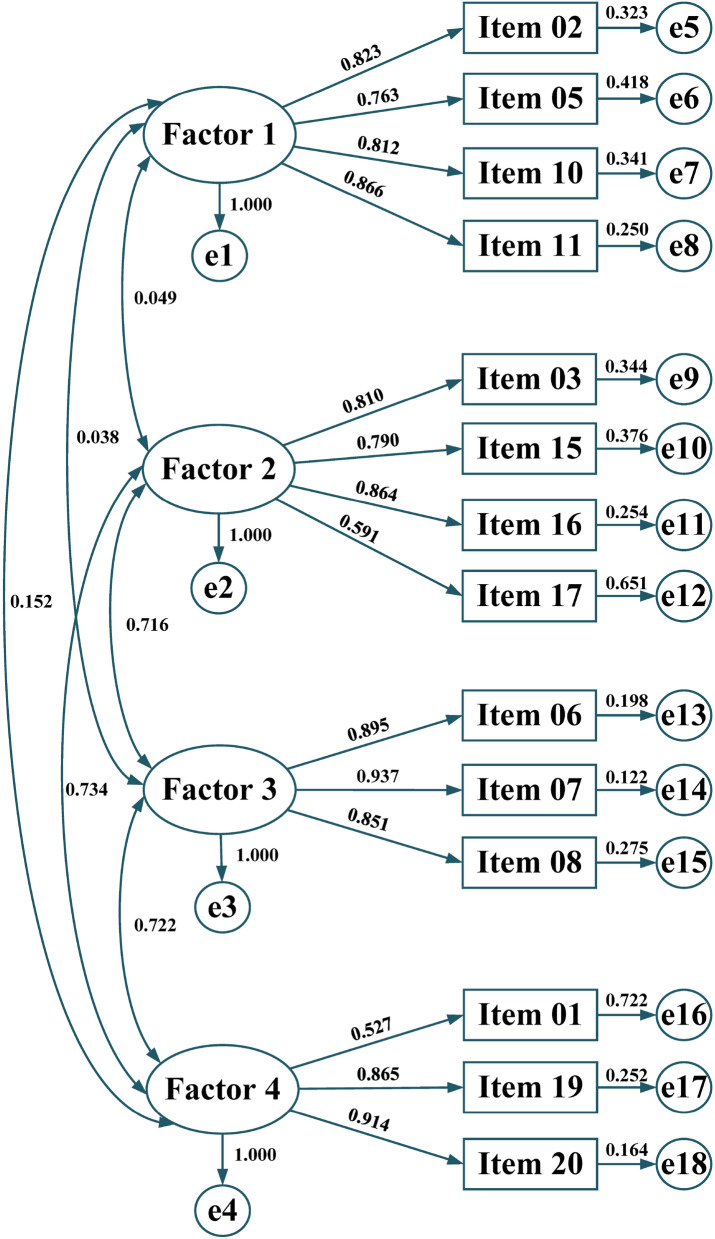
Nine out of the original 23 items were removed because they either loaded below 0.40 and/or cross-loaded too highly on multiple factors. This resulted in four domains (Unconditional Permission to Eat, Eating for Physical Rather than Emotional Reasons, Reliance on Hunger and Satiety Cues, and Body-Food Choice Congruence) and 14 items retained. Internal reliability estimates were excellent, with McDonald's ω values ranging from 0.828 to 0.923 for the four factors. Multigroup analysis established configural, thresholds, metric, scalar, strict invariance across gender. Finally, higher IES-2 total scores were significantly correlated with lower body dissatisfaction scores and more positive eating attitudes, thus attesting to convergent and criterion-related validity of the scale.
The current findings provide preliminary evidence for the appropriate psychometric qualities of the Arabic 14-item, four-factor structure IES-2; thereby supporting its use at least among Arabic-speaking community adults.
西方世界对直觉饮食(IE)方式的关注日益增加,但阿拉伯国家尚未如此,这可能是由于缺乏针对讲阿拉伯语人群的、心理测量学上可靠的IE构念测量方法。本研究旨在检验在黎巴嫩讲阿拉伯语的社区人群中,最广泛使用的IE测量工具——直觉饮食量表-2(IES-2)阿拉伯语翻译版的心理测量特性。
通过在线便利抽样招募了两个来自黎巴嫩讲阿拉伯语的社区成年样本(样本1:n = 359,59.9%为女性,年龄22.75 ± 7.04岁;样本2:n = 444,72.7%为女性,年龄27.25 ± 9.53岁)。对IES-2应用翻译和回译方法进行语言验证。使用探索性因素分析和验证性因素分析策略研究因素效度。检验了组合信度和性别不变性。我们还通过与其他理论上合理的构念的相关性测试了收敛效度和效标关联效度。
原始的23个项目中有9个被删除,因为它们要么载荷低于0.40,和/或在多个因素上交叉载荷过高。这导致保留了四个维度(无条件进食许可、为身体而非情感原因进食、依赖饥饿和饱腹感线索以及身体 - 食物选择一致性)和14个项目。内部信度估计良好,四个因素的麦克唐纳ω值范围为0.828至0.923。多组分析确定了跨性别在构型、阈值、度量、标量、严格不变性方面的情况。最后,较高的IES-2总分与较低的身体不满意得分和更积极的饮食态度显著相关,从而证明了该量表的收敛效度和效标关联效度。
当前研究结果为阿拉伯语14项、四因素结构的IES-2的适当心理测量质量提供了初步证据;从而支持至少在讲阿拉伯语的社区成年人中使用该量表。