
水痘带状疱疹病毒感染黏膜相关恒定T细胞。
Varicella Zoster Virus infects mucosal associated Invariant T cells.
作者信息
Purohit Shivam K, Corbett Alexandra J, Slobedman Barry, Abendroth Allison
机构信息
Infection, Immunity and Inflammation, School of Medical Sciences, Faculty of Medicine and Health, Charles Perkins Centre, University of Sydney, Sydney, NSW, Australia.
Department of Microbiology and Immunology, The University of Melbourne, at The Peter Doherty Institute for Infection and Immunity, Melbourne, VIC, Australia.
出版信息
Front Immunol. 2023 Mar 17;14:1121714. doi: 10.3389/fimmu.2023.1121714. eCollection 2023.
INTRODUCTION
Mucosal Associated Invariant T (MAIT) cells are innate-like T cells that respond to conserved pathogen-derived vitamin B metabolites presented by the MHC class I related-1 molecule (MR1) antigen presentation pathway. Whilst viruses do not synthesize these metabolites, we have reported that varicella zoster virus (VZV) profoundly suppresses MR1 expression, implicating this virus in manipulation of the MR1:MAIT cell axis. During primary infection, the lymphotropism of VZV is likely to be instrumental in hematogenous dissemination of virus to gain access to cutaneous sites where it clinically manifests as varicella (chickenpox). However, MAIT cells, which are found in the blood and at mucosal and other organ sites, have yet to be examined in the context of VZV infection. The goal of this study was to examine any direct impact of VZV on MAIT cells.
METHODS
Using flow cytometry, we interrogated whether primary blood derived MAIT cells are permissive to infection by VZV whilst further analysing differential levels of infection between various MAIT cell subpopulations. Changes in cell surface extravasation, skin homing, activation and proliferation markers after VZV infection of MAIT cells was also assessed via flow cytometry. Finally the capacity of MAIT cells to transfer infectious virus was tested through an infectious center assay and imaged via fluorescence microscopy.
RESULTS
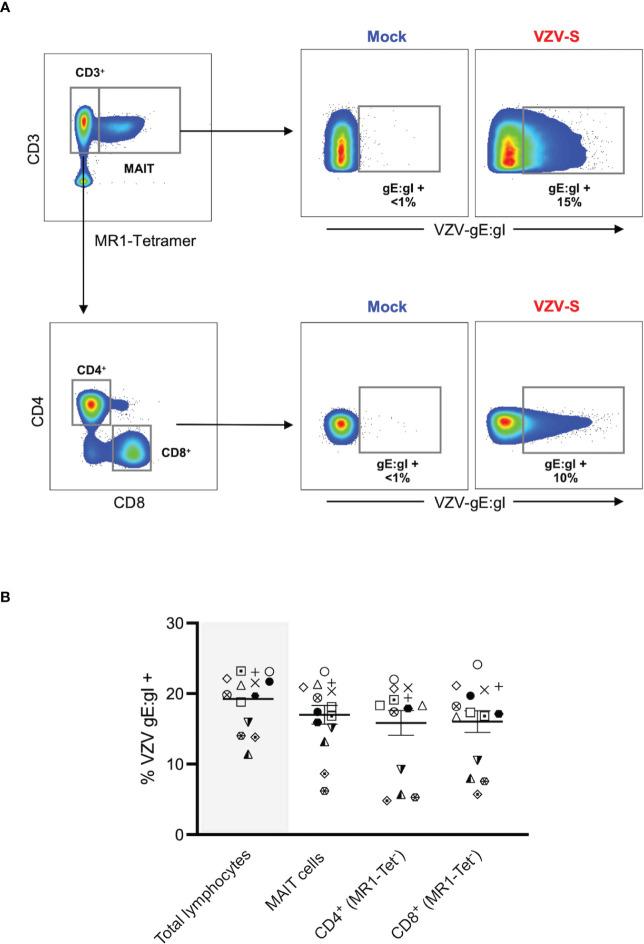
We identify primary blood-derived MAIT cells as being permissive to VZV infection. A consequence of VZV infection of MAIT cells was their capacity to transfer infectious virus to other permissive cells, consistent with MAIT cells supporting productive infection. When subgrouping MAIT cells by their co- expression of a variety cell surface markers, there was a higher proportion of VZV infected MAIT cells co-expressing CD4+ and CD4+/CD8+ MAIT cells compared to the more phenotypically dominant CD8+ MAIT cells, whereas infection was not associated with differences in co-expression of CD56 (MAIT cell subset with enhanced responsiveness to innate cytokine stimulation), CD27 (co-stimulatory) or PD-1 (immune checkpoint). Infected MAIT cells retained high expression of CCR2, CCR5, CCR6, CLA and CCR4, indicating a potentially intact capacity for transendothelial migration, extravasation and trafficking to skin sites. Infected MAIT cells also displayed increased expression of CD69 (early activation) and CD71 (proliferation) markers.
DISCUSSION
These data identify MAIT cells as being permissive to VZV infection and identify impacts of such infection on co- expressed functional markers.
引言
黏膜相关恒定T(MAIT)细胞是一类固有样T细胞,可对由主要组织相容性复合体I类相关分子1(MR1)抗原呈递途径呈递的保守病原体衍生的维生素B代谢产物作出反应。虽然病毒不会合成这些代谢产物,但我们报道过水痘带状疱疹病毒(VZV)可显著抑制MR1表达,提示该病毒参与了对MR1:MAIT细胞轴的调控。在初次感染期间,VZV的嗜淋巴细胞性可能有助于病毒通过血行播散至皮肤部位,临床上表现为水痘(带状疱疹)。然而,存在于血液以及黏膜和其他器官部位的MAIT细胞,尚未在VZV感染的背景下进行研究。本研究的目的是检测VZV对MAIT细胞的任何直接影响。
方法
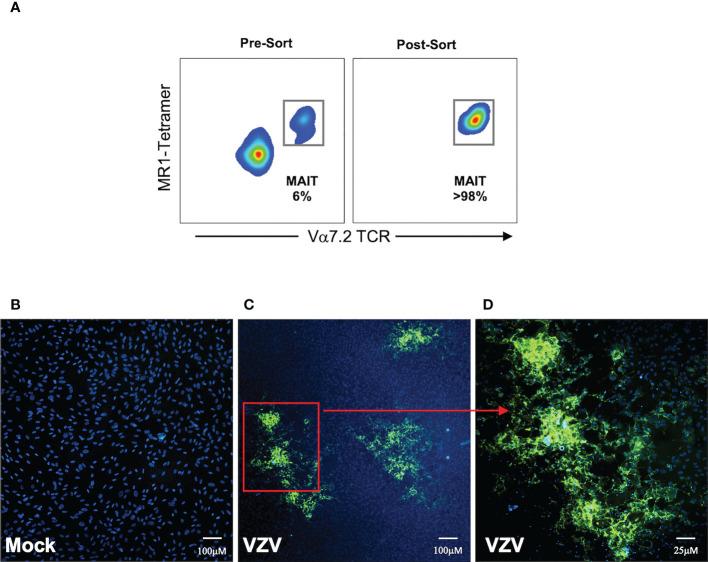
我们使用流式细胞术,探究源自外周血的原代MAIT细胞是否允许VZV感染,同时进一步分析不同MAIT细胞亚群之间的感染差异水平。通过流式细胞术还评估了MAIT细胞感染VZV后细胞表面渗出、皮肤归巢、激活和增殖标志物的变化。最后,通过感染中心试验测试MAIT细胞传递感染性病毒的能力,并通过荧光显微镜成像。
结果
我们确定源自外周血的原代MAIT细胞允许VZV感染。MAIT细胞感染VZV的一个结果是它们有能力将感染性病毒传递给其他易感细胞,这与MAIT细胞支持有效感染一致。当根据多种细胞表面标志物的共表达对MAIT细胞进行亚群划分时,与表型上占主导的CD8 + MAIT细胞相比,共表达CD4 +和CD4 + / CD8 +的MAIT细胞中VZV感染的比例更高,而感染与CD56(对固有细胞因子刺激反应增强的MAIT细胞亚群)、CD27(共刺激分子)或PD-1(免疫检查点)的共表达差异无关。受感染的MAIT细胞保留了CCR2、CCR5、CCR6、CLA和CCR4的高表达,表明其跨内皮迁移、渗出和向皮肤部位运输的能力可能保持完整。受感染的MAIT细胞还显示出CD69(早期激活)和CD71(增殖)标志物的表达增加。
讨论
这些数据确定MAIT细胞允许VZV感染,并确定了这种感染对共表达功能标志物的影响。


 Zotero 插件