Perosa Valentina, Rotta Johanna, Yakupov Renat, Kuijf Hugo J, Schreiber Frank, Oltmer Jan T, Mattern Hendrik, Heinze Hans-Jochen, Düzel Emrah, Schreiber Stefanie
J. Philip Kistler Stroke Research Center, Massachusetts General Hospital, Boston, MA, United States.
Department of Neurology, Otto-von-Guericke University, Magdeburg, Germany.
Front Neurol. 2023 Mar 15;14:1112312. doi: 10.3389/fneur.2023.1112312. eCollection 2023.
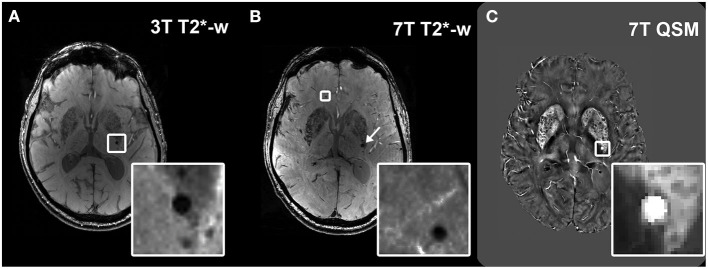
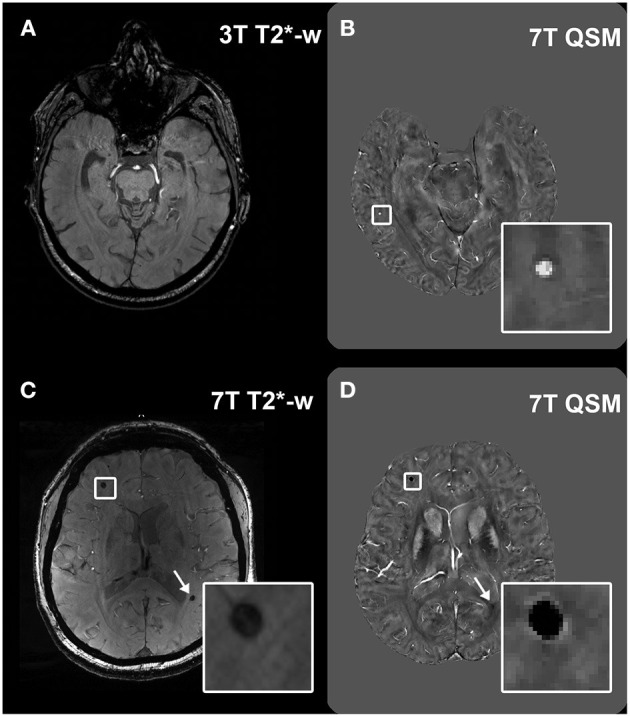
Cerebral microbleeds (MBs) are a hallmark of cerebral small vessel disease (CSVD) and can be found on T2-weighted sequences on MRI. Quantitative susceptibility mapping (QSM) is a postprocessing method that also enables MBs identification and furthermore allows to differentiate them from calcifications.
We explored the implications of using QSM at submillimeter resolution for MBs detection in CSVD.
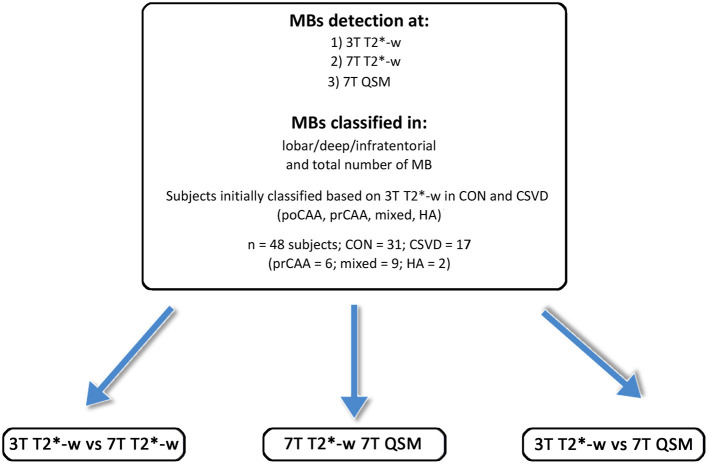
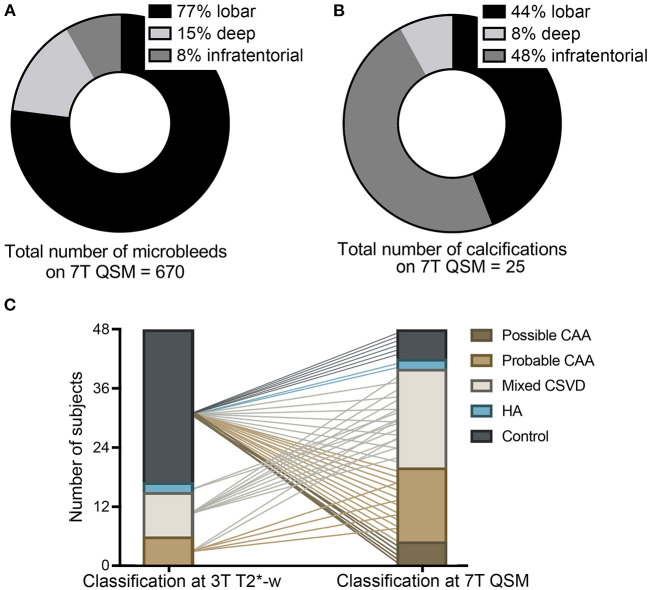
Both 3 and 7 Tesla (T) MRI were performed in elderly participants without MBs and patients with CSVD. MBs were quantified on T2-weighted imaging and QSM. Differences in the number of MBs were assessed, and subjects were classified in CSVD subgroups or controls both on 3T T2-weighted imaging and 7T QSM.
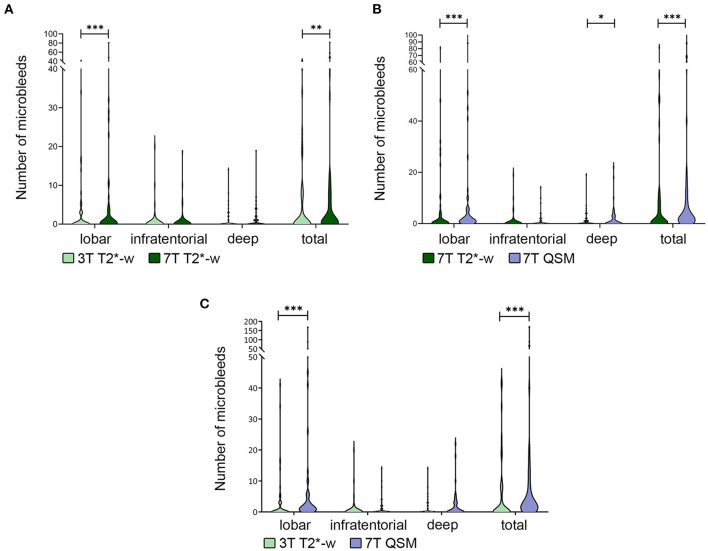
48 participants [mean age (SD) 70.9 (8.8) years, 48% females] were included: 31 were healthy controls, 6 probable cerebral amyloid angiopathy (CAA), 9 mixed CSVD, and 2 were hypertensive arteriopathy [HA] patients. After accounting for the higher number of MBs detected at 7T QSM (Median = Mdn; Mdn = 2.5; Mdn = 0; = 4.90; < 0.001) and false positive MBs (6.1% calcifications), most healthy controls (80.6%) demonstrated at least one MB and more MBs were discovered in the CSVD group.
Our observations suggest that QSM at submillimeter resolution improves the detection of MBs in the elderly human brain. A higher prevalence of MBs than so far known in healthy elderly was revealed.
脑微出血(MBs)是脑小血管病(CSVD)的一个标志,可在MRI的T2加权序列上发现。定量磁化率成像(QSM)是一种后处理方法,它也能够识别MBs,并且还能将它们与钙化区分开来。
我们探讨了使用亚毫米分辨率的QSM检测CSVD中MBs的意义。
对无MBs的老年参与者和CSVD患者进行了3特斯拉(T)和7T MRI检查。在T2加权成像和QSM上对MBs进行定量。评估MBs数量的差异,并在3T T2加权成像和7T QSM上对受试者进行CSVD亚组或对照组分类。
纳入了48名参与者[平均年龄(标准差)70.9(8.8)岁,48%为女性]:31名是健康对照,6名可能患有脑淀粉样血管病(CAA),9名患有混合性CSVD,2名是高血压性动脉病[HA]患者。在考虑到7T QSM检测到的MBs数量较多(中位数 = Mdn;Mdn = 2.5;Mdn = 0;P = 4.90;P < 0.001)以及假阳性MBs(6.1%为钙化)后,大多数健康对照(80.6%)显示至少有一个MB,并且在CSVD组中发现了更多的MBs。
我们的观察结果表明,亚毫米分辨率的QSM可提高对老年人脑内MBs的检测。揭示了健康老年人中MBs的患病率高于迄今所知。