Dhanda Geetika, Acharya Yash, Haldar Jayanta
Antimicrobial Research Laboratory, New Chemistry Unit and School of Advanced Materials, Jawaharlal Nehru Centre for Advanced Scientific Research (JNCASR), Jakkur, Bengaluru 560064, Karnataka, India.
ACS Omega. 2023 Mar 14;8(12):10757-10783. doi: 10.1021/acsomega.3c00312. eCollection 2023 Mar 28.
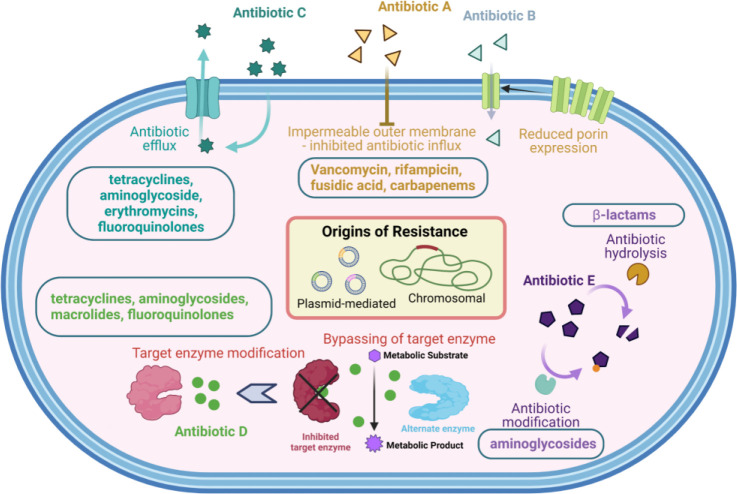
The problem of antibiotic resistance is on the rise, with multidrug-resistant strains emerging even to the last resort antibiotics. The drug discovery process is often stalled by stringent cut-offs required for effective drug design. In such a scenario, it is prudent to delve into the varying mechanisms of resistance to existing antibiotics and target them to improve antibiotic efficacy. Nonantibiotic compounds called antibiotic adjuvants which target bacterial resistance can be used in combination with obsolete drugs for an improved therapeutic regime. The field of "antibiotic adjuvants" has gained significant traction in recent years where mechanisms other than β-lactamase inhibition have been explored. This review discusses the multitude of acquired and inherent resistance mechanisms employed by bacteria to resist antibiotic action. The major focus of this review is how to target these resistance mechanisms by the use of antibiotic adjuvants. Different types of direct acting and indirect resistance breakers are discussed including enzyme inhibitors, efflux pump inhibitors, inhibitors of teichoic acid synthesis, and other cellular processes. The multifaceted class of membrane-targeting compounds with poly pharmacological effects and the potential of host immune-modulating compounds have also been reviewed. We conclude with providing insights about the existing challenges preventing clinical translation of different classes of adjuvants, especially membrane-perturbing compounds, and a framework about the possible directions which can be pursued to fill this gap. Antibiotic-adjuvant combinatorial therapy indeed has immense potential to be used as an upcoming orthogonal strategy to conventional antibiotic discovery.
抗生素耐药性问题日益严重,甚至对最后一道防线的抗生素也出现了多重耐药菌株。药物发现过程常常因有效药物设计所需的严格筛选标准而停滞不前。在这种情况下,深入研究对现有抗生素的不同耐药机制并将其作为靶点来提高抗生素疗效是明智之举。一类名为抗生素佐剂的非抗生素化合物可靶向细菌耐药性,与过时药物联合使用以改善治疗方案。近年来,“抗生素佐剂”领域获得了显著关注,人们对除β-内酰胺酶抑制以外的机制进行了探索。本综述讨论了细菌用于抵抗抗生素作用的多种获得性和固有耐药机制。本综述的主要重点是如何通过使用抗生素佐剂来靶向这些耐药机制。讨论了不同类型的直接作用和间接耐药破坏剂,包括酶抑制剂、外排泵抑制剂、磷壁酸合成抑制剂和其他细胞过程。还综述了具有多药理学效应的多面类膜靶向化合物以及宿主免疫调节化合物的潜力。我们最后深入探讨了阻碍不同类佐剂(尤其是膜扰动化合物)临床转化的现有挑战,以及填补这一空白可能采取的方向框架。抗生素-佐剂联合疗法确实具有巨大潜力,可作为传统抗生素发现的一种新兴正交策略。