Community Children's Therapies, Barts Health NHS Trust, London, UK
Research Department of Primary Care & Population Health, University College London, London, UK.
BMJ Paediatr Open. 2023 Apr;7(1). doi: 10.1136/bmjpo-2023-001866.
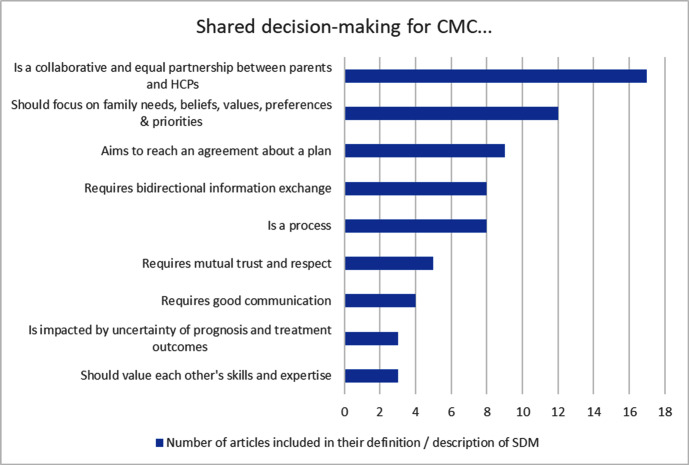
Children with medical complexity is an increasing population whose parents and healthcare providers face multiple decisions. Shared decision-making is a process where patients, their families and healthcare providers collaborate to make decisions based on clinical evidence and informed preferences of the family. Shared decision-making has benefits for the child, family and healthcare providers, including improved parental understanding of the child's difficulties, increased participation, improved coping skills and more efficient healthcare use. It is, however, poorly implemented.
A scoping review was conducted to explore shared decision-making for children with medical complexity in community health services, including how shared decision-making is defined in research, how it is implemented, including barriers and facilitators and recommendations for research. Six databases were systematically searched for papers published in English up to May 2022: Medline, CINAHL, EMBASE, PsycINFO, PubMed, Cochrane Database of Systematic Reviews and sources of grey literature. The review is reported according to the Preferred Reporting Items for Scoping Reviews.
Thirty sources met the inclusion criteria. Most factors can either be a facilitator or barrier to shared decision-making depending on the context. Two significant barriers to shared decision-making in this population include uncertainty about the child's diagnosis, prognosis, and treatment options and the presence of hierarchy and power imbalance during clinical encounters with healthcare providers. Further influencing factors include continuity of care, the availability of accurate, accessible, adequate, and balanced information and the interpersonal and communication skills of parents and healthcare providers.
Uncertainty about diagnosis, prognosis and treatment outcomes for children with medical complexity are additional challenges to the known barriers and facilitators to shared decision-making in community health services. Effective implementation of shared decision-making requires advancement of the evidence base for children with medical complexity, reducing power imbalance in clinical encounters, improving continuity of care, and improving the availability and accessibility of information resources.
患有复杂疾病的儿童数量不断增加,其父母和医疗保健提供者面临着多项决策。共同决策是一个患者、其家庭和医疗保健提供者共同合作,根据临床证据和家庭的知情偏好做出决策的过程。共同决策对儿童、家庭和医疗保健提供者都有好处,包括提高父母对儿童困难的理解、增加参与度、提高应对技能和更有效地利用医疗保健。然而,它的实施效果不佳。
进行了一项范围综述,以探讨在社区卫生服务中对患有复杂疾病的儿童进行共同决策的情况,包括研究中如何定义共同决策、如何实施,包括障碍和促进因素,以及对研究的建议。系统地在六个数据库中搜索了截至 2022 年 5 月以英文发表的论文:Medline、CINAHL、EMBASE、PsycINFO、PubMed、Cochrane 系统评价数据库和灰色文献来源。该综述是根据《范围综述首选报告项目》报告的。
有 30 个来源符合纳入标准。大多数因素都可以成为共同决策的促进因素或障碍,具体取决于具体情况。在该人群中,共同决策的两个重大障碍包括对儿童诊断、预后和治疗方案的不确定性,以及在与医疗保健提供者的临床接触中存在的等级制度和权力失衡。进一步的影响因素包括连续性护理、准确、可及、充分和平衡信息的可用性以及父母和医疗保健提供者的人际交往和沟通技巧。
患有复杂疾病的儿童的诊断、预后和治疗结果的不确定性是社区卫生服务中共同决策已知障碍和促进因素之外的额外挑战。有效实施共同决策需要为患有复杂疾病的儿童推进证据基础,减少临床接触中的权力失衡,改善连续性护理,并改善信息资源的可用性和可及性。