Yiyue Yang, Kaiqi Gu, Rujie Wang, Honghong Liu, Xu Ming, Yingxue Feng, Yijing Peng, Yu Chen, Yuanyuan Ji, Jing Ma, Dongxiao Li, Yue Lu, Jing Li
Department of Psychiatry, The First Affiliated Hospital of Chongqing Medical University, Chongqing, 400016, China.
Sleeping and Psychosomatic Center, Dazu District People's Hospital, Chongqing, 402360, China.
Heliyon. 2023 Apr;9(4):e15051. doi: 10.1016/j.heliyon.2023.e15051. Epub 2023 Mar 30.
Although current studies have identified sleep disorders as an independent risk factor for suicide, the relationship between sleep disorders and suicide risk has not been well established. This study explored whether anxiety and depressive symptoms are used as mediators to participate in the impact of sleep quality on suicide risk.
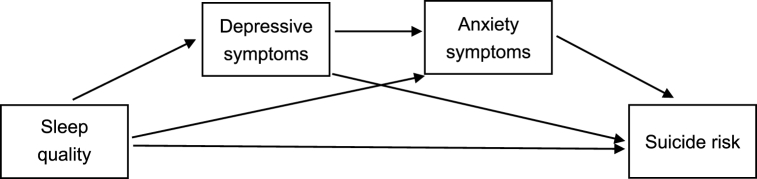
This is a cross-sectional study. We administered a psychological questionnaire to the participants, using a combination of self-assessment and psychiatrist assessment.Sleep quality, suicide risk, level of anxiety and depressive symptoms were assessed by PSQI, NGASR, SAS and SDS.The study subjects were 391 hospitalized COVID-19 patients from Wuhan hospitals. We used model 6 in the PROCESS (version 3.5) plug-in of SPSS software to conduct mediation test with sleep quality as the independent variable, suicide risk as the dependent variable, level of anxiety and depressive symptoms as intermediate variables.
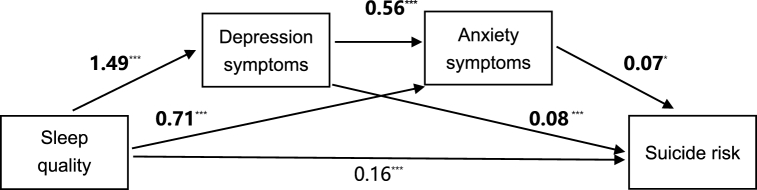
The severity of anxiety and depressive symptoms and the risk of suicide in the sleep disorder group (63.15 ± 13.71, 59.85 ± 13.38, 6.52 ± 3.67) were higher than those in the non-sleep disorder group (49.83 ± 13.14, 44.87 ± 10.19, 2.87 ± 3.26) (P < 0.001). The mediation model works well, The total indirect effect was 0.22 (95%CI = [0.17, 0.28]), and the direct effect was 0.16 (95%CI = [0.08, 0.24]).
This study used a self-assessment scale.
Anxiety and depressive symptoms played a chain mediating role between sleep quality and suicide risk.
尽管目前的研究已将睡眠障碍确定为自杀的独立危险因素,但睡眠障碍与自杀风险之间的关系尚未完全明确。本研究探讨焦虑和抑郁症状是否作为中介因素参与睡眠质量对自杀风险的影响。
这是一项横断面研究。我们通过自我评估和精神科医生评估相结合的方式,对参与者进行心理问卷调查。采用匹兹堡睡眠质量指数(PSQI)、非精神科住院患者自杀风险评估量表(NGASR)、焦虑自评量表(SAS)和抑郁自评量表(SDS)分别评估睡眠质量、自杀风险、焦虑水平和抑郁症状。研究对象为来自武汉医院的391例住院COVID-19患者。我们使用SPSS软件的PROCESS(版本3.5)插件中的模型6,以睡眠质量为自变量,自杀风险为因变量,焦虑水平和抑郁症状水平为中介变量进行中介检验。
睡眠障碍组的焦虑和抑郁症状严重程度及自杀风险(63.15±13.71,59.85±13.38,6.52±3.67)高于非睡眠障碍组(49.83±13.14,44.87±10.19,2.87±3.26)(P<0.001)。中介模型效果良好,总间接效应为0.22(95%CI=[0.17,0.28]),直接效应为0.16(95%CI=[0.08,0.24])。
本研究使用的是自我评估量表。
焦虑和抑郁症状在睡眠质量和自杀风险之间起连锁中介作用。