Department of Neurology and Suzhou Clinical Research Center of Neurological Disease, The Second Affiliated Hospital of Soochow University, Suzhou, 215004, People's Republic of China.
Clin Interv Aging. 2023 Mar 28;18:523-531. doi: 10.2147/CIA.S404082. eCollection 2023.
Acute ischemic stroke (AIS), caused by occlusion of large vessel, is a serious life-threatening disease. This study aimed to comprehensively investigate the association of 14 common and readily available circulating biomarkers with the 90-day modified Rankin Scale (mRS) score in patients undergoing mechanical thrombectomy (MT).
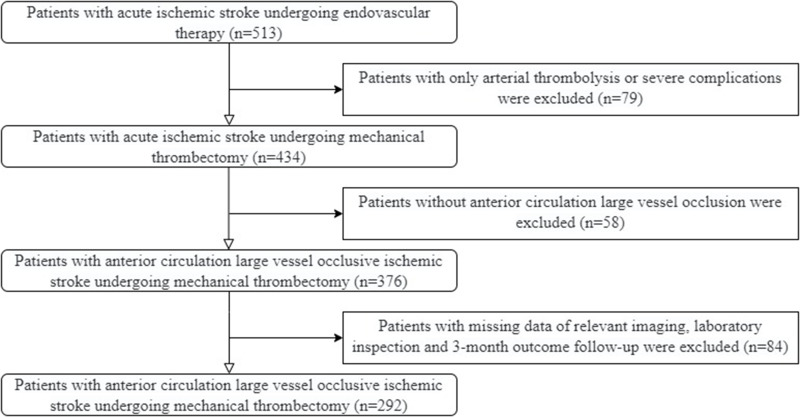
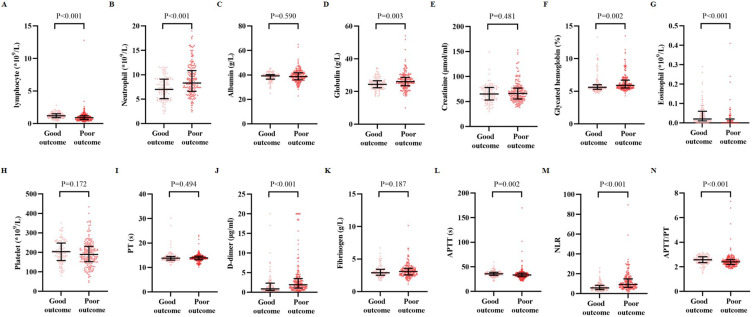
This study included patients with anterior circulation large vessel occlusive stroke treated with MT from 05/2017 to 12/2021. Baseline comparisons of poor outcome were performed among enrolled patients. Factors that may be associated with the mRS score were assessed using correlation analysis. Univariate and multivariate logistic regression analyses were used to evaluate the predictive value of circulating biomarkers and poor outcome.
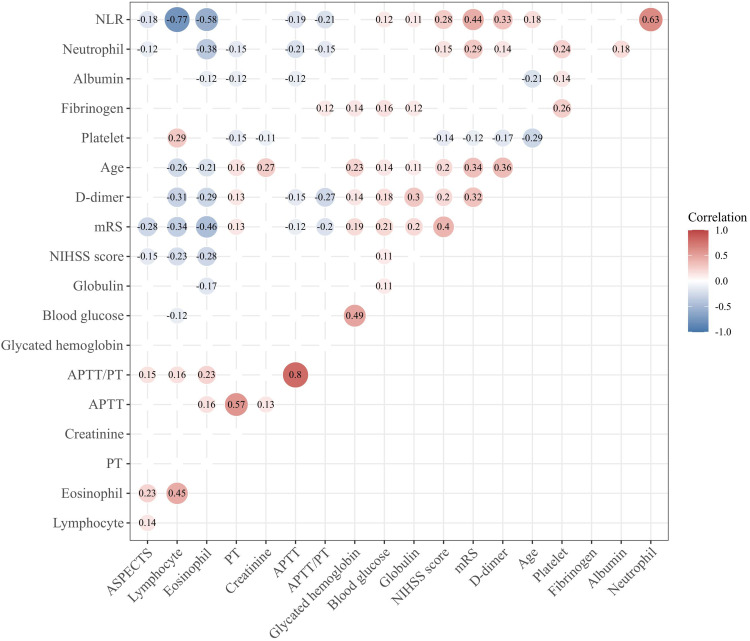
The mRS score has a strong correlation with neutrophil to lymphocyte ratio (NLR) and eosinophil levels (all r>0.4 in absolute value and all P<0.001) in addition to a high correlation with National Institute of Health Stroke Scale (NIHSS) score (r=0.40, P<0.001). There was also a high correlation between NLR and eosinophil (r=-0.58, P<0.001). In the multivariate regression analysis, only neutrophil (adjusted OR=1.301, 95% CI: 1.155-1.465, P<0.001), eosinophil (adjusted OR<0.001, 95% CI: <0.001-0.016, P<0.001), and NLR (adjusted OR=1.158, 95% CI: 1.082-1.241, P<0.001) were independently associated with poor outcome.
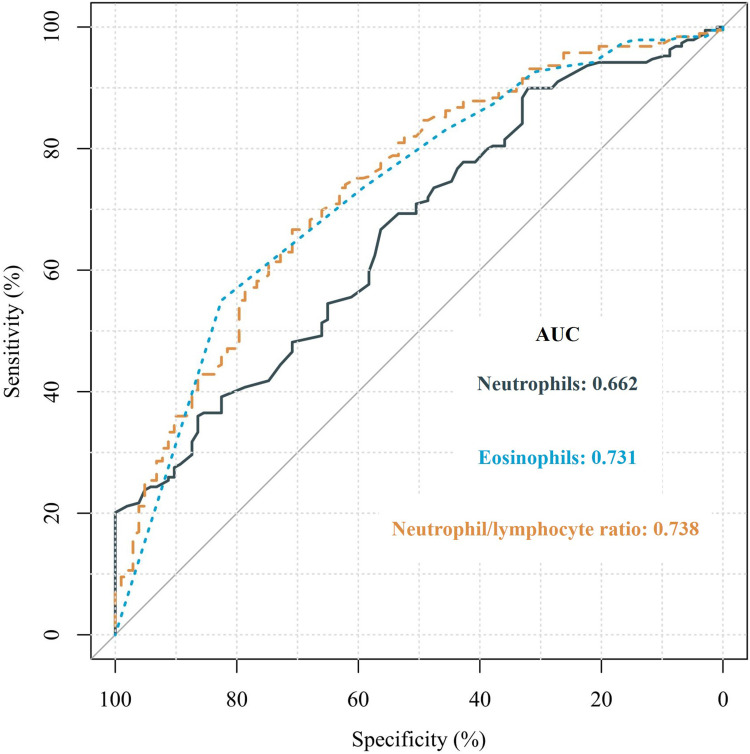
This study evaluated a series of circulating biomarkers and found that neutrophil, eosinophil, and NLR independently predicted poor outcome after MT in AIS patients. There was a significant negative correlation between eosinophil and NLR levels.
急性缺血性脑卒中(AIS)是一种由大血管阻塞引起的严重危及生命的疾病。本研究旨在全面研究 14 种常见且易于获得的循环生物标志物与接受机械血栓切除术(MT)的患者 90 天改良 Rankin 量表(mRS)评分之间的关系。
本研究纳入了 2017 年 5 月至 2021 年 12 月期间接受 MT 治疗的前循环大血管闭塞性脑卒中患者。对入组患者进行不良预后的基线比较。采用相关性分析评估可能与 mRS 评分相关的因素。采用单变量和多变量逻辑回归分析评估循环生物标志物和不良预后的预测价值。
mRS 评分与中性粒细胞与淋巴细胞比值(NLR)和嗜酸性粒细胞水平具有很强的相关性(绝对值均>0.4,均 P<0.001),并且与国立卫生研究院卒中量表(NIHSS)评分也具有很强的相关性(r=0.40,P<0.001)。NLR 与嗜酸性粒细胞之间也存在高度相关性(r=-0.58,P<0.001)。在多变量回归分析中,只有中性粒细胞(调整后的 OR=1.301,95%CI:1.155-1.465,P<0.001)、嗜酸性粒细胞(调整后的 OR<0.001,95%CI:<0.001-0.016,P<0.001)和 NLR(调整后的 OR=1.158,95%CI:1.082-1.241,P<0.001)与不良预后独立相关。
本研究评估了一系列循环生物标志物,发现中性粒细胞、嗜酸性粒细胞和 NLR 独立预测 AIS 患者 MT 后不良预后。嗜酸性粒细胞和 NLR 水平之间存在显著的负相关关系。