Jonaitis Erin M, Janelidze Shorena, Cody Karly A, Langhough Rebecca, Du Lianlian, Chin Nathaniel A, Mattsson-Carlgren Niklas, Hogan Kirk J, Christian Bradley T, Betthauser Tobey J, Hansson Oskar, Johnson Sterling C
Wisconsin Alzheimer's Institute, School of Medicine and Public Health, University of Wisconsin-Madison, Madison, WI 53726, USA.
Wisconsin Alzheimer's Disease Research Center, School of Medicine and Public Health, University of Wisconsin-Madison, Madison, WI 53792, USA.
Brain Commun. 2023 Mar 6;5(2):fcad057. doi: 10.1093/braincomms/fcad057. eCollection 2023.
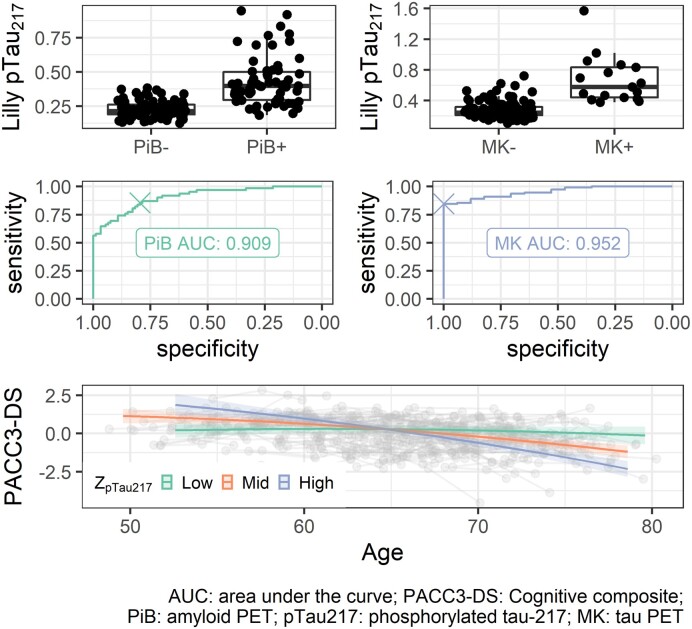
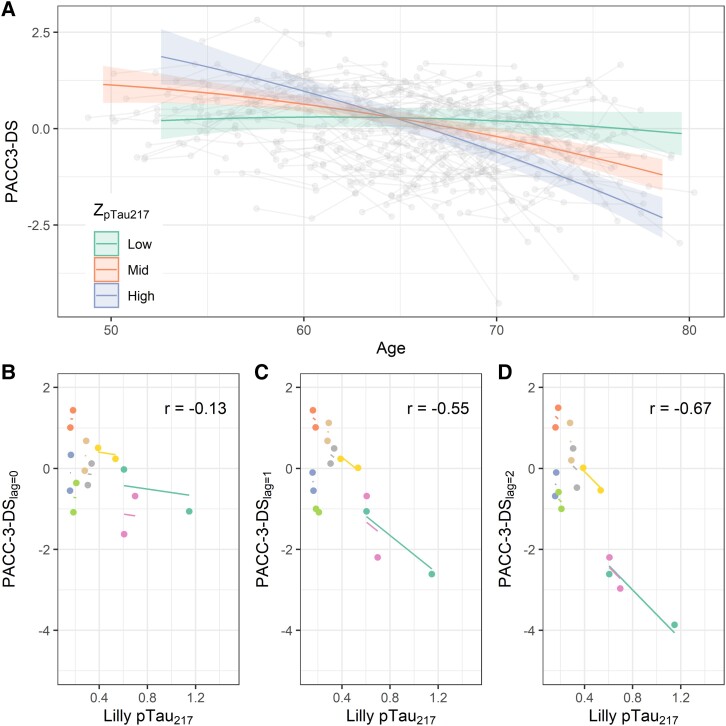
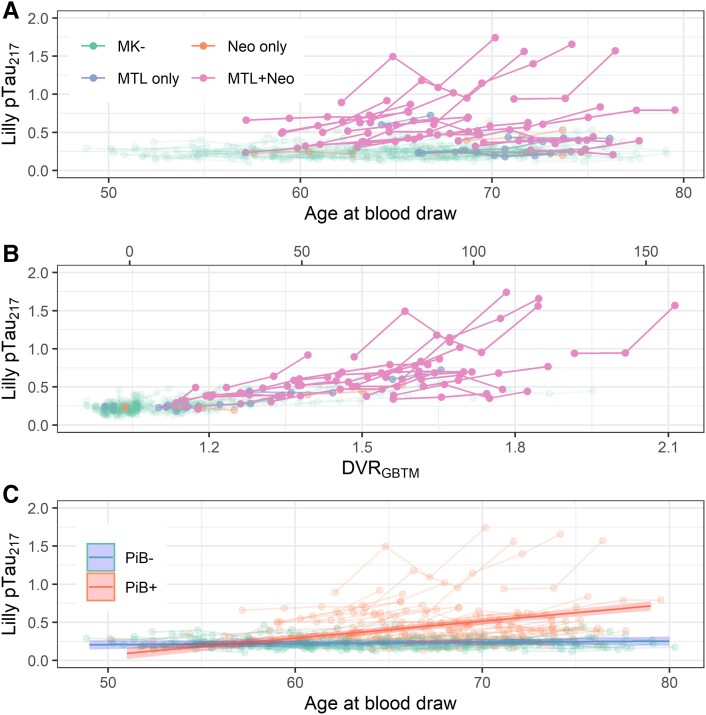
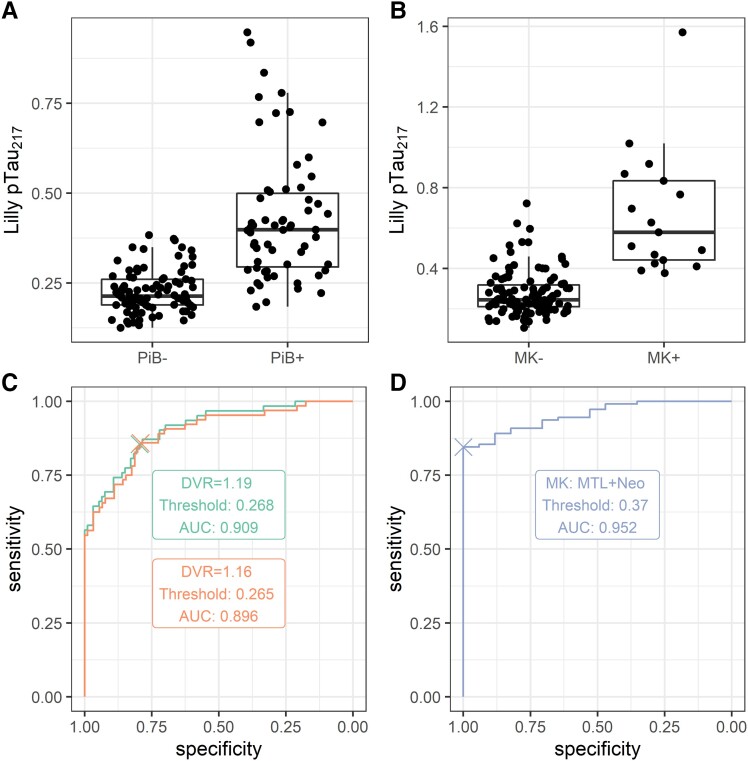
An accurate blood test for Alzheimer's disease that is sensitive to preclinical proteinopathy and cognitive decline has clear implications for early detection and secondary prevention. We assessed the performance of plasma phosphorylated tau 217 ( ) against brain PET markers of amyloid [ -labelled Pittsburgh compound B (PiB)] and tau ( MK-6240) and its utility for predicting longitudinal cognition. Samples were analysed from a subset of participants with up to 8 years follow-up in the Wisconsin Registry for Alzheimer's Prevention (WRAP; 2001-present; plasma 2011-present), a longitudinal cohort study of adults from midlife, enriched for parental history of Alzheimer's disease. Participants were a convenience sample who volunteered for at least one PiB scan, had usable banked plasma and were cognitively unimpaired at first plasma collection. Study personnel who interacted with participants or samples were blind to amyloid status. We used mixed effects models and receiver-operator characteristic curves to assess concordance between plasma and PET biomarkers of Alzheimer's disease and mixed effects models to understand the ability of plasma to predict longitudinal performance on WRAP's preclinical Alzheimer's cognitive composite (PACC-3). The primary analysis included 165 people (108 women; mean age = 62.9 6.06; 160 still enrolled; 2 deceased; 3 discontinued). Plasma was strongly related to PET-based estimates of concurrent brain amyloid ( = 0.83 (0.75, 0.90), < 0.001). Concordance was high between plasma and both amyloid PET (area under the curve = 0.91, specificity = 0.80, sensitivity = 0.85, positive predictive value = 0.58, negative predictive value = 0.94) and tau PET (area under the curve = 0.95, specificity = 1, sensitivity = 0.85, positive predictive value = 1, negative predictive value = 0.98). Higher baseline levels were associated with worse cognitive trajectories ( = -0.07 (-0.09, -0.06), < 0.001). In a convenience sample of unimpaired adults, plasma levels correlate well with concurrent brain Alzheimer's disease pathophysiology and with prospective cognitive performance. These data indicate that this marker can detect disease before clinical signs and thus may disambiguate presymptomatic Alzheimer's disease from normal cognitive ageing.
一种对临床前蛋白病变和认知衰退敏感的阿尔茨海默病精确血液检测,对于早期检测和二级预防具有明确意义。我们评估了血浆磷酸化tau 217( )相对于脑PET淀粉样蛋白[ -标记的匹兹堡化合物B(PiB)]和tau( MK - 6240)标记物的性能,以及其预测纵向认知的效用。从威斯康星州阿尔茨海默病预防登记处(WRAP;2001年至今;血浆样本从2011年开始)中选取了一部分随访时间长达8年的参与者进行样本分析,WRAP是一项针对中年成年人的纵向队列研究,这些成年人中阿尔茨海默病家族史丰富。参与者是一个便利样本,他们自愿接受至少一次PiB扫描,有可用的储存血浆,并且在首次采集血浆时认知功能未受损。与参与者或样本接触的研究人员对淀粉样蛋白状态不知情。我们使用混合效应模型和受试者工作特征曲线来评估血浆 与阿尔茨海默病PET生物标志物之间的一致性,并使用混合效应模型来了解血浆 预测WRAP临床前阿尔茨海默病认知综合指标(PACC - 3)纵向表现的能力。主要分析纳入了165人(108名女性;平均年龄 = 62.9 ± 6.06;160人仍在研究中;2人死亡;3人退出)。血浆 与基于PET的同期脑淀粉样蛋白估计值密切相关( = 0.83(0.75,0.90), < 0.001)。血浆 与淀粉样蛋白PET(曲线下面积 = 0.91,特异性 = 0.80,敏感性 = 0.85,阳性预测值 = 0.58,阴性预测值 = 0.94)和tau PET(曲线下面积 = 0.95,特异性 = 1,敏感性 = 0.85,阳性预测值 = 1,阴性预测值 = 0.98)之间的一致性都很高。较高的基线 水平与较差的认知轨迹相关( = -0.07(-0.09,-0.06), < 0.001)。在一个认知未受损的成年人便利样本中,血浆 水平与同期脑阿尔茨海默病病理生理学以及前瞻性认知表现密切相关。这些数据表明,该标志物可以在临床症状出现之前检测到疾病,因此可能将症状前阿尔茨海默病与正常认知衰老区分开来。