Parkinson's Disease Clinic, Office of the Clinical Director, National Institute of Neurological Disorders and Stroke, NIH, 7D37 10 Center Dr, Bethesda, MD, USA.
Neurodegenerative Diseases Research Unit, National Institute of Neurological Disorders and Stroke, NIH, Bethesda, MD, USA.
BMC Neurol. 2023 Apr 4;23(1):143. doi: 10.1186/s12883-023-03188-5.
Deep brain stimulation (DBS) is a well-established treatment option for select patients with Parkinson's Disease (PD). However, response to DBS varies, therefore, the ability to predict who will have better outcomes can aid patient selection. Some PD-related monogenic mutations have been reported among factors that influence response to DBS. However, monogenic disease accounts for only a minority of patients with PD. The polygenic risk score (PRS) is an indication of cumulative genetic risk for disease. The PRS in PD has also been correlated with age of onset and symptom progression, but it is unknown whether correlations exist between PRS and DBS response. Here, we performed a pilot study to look for any such correlation.
We performed a retrospective analysis of 33 PD patients from the NIH PD Clinic and 13 patients from the Parkinson's Progression Markers Initiative database who had genetic testing and underwent bilateral subthalamic nucleus DBS surgery and clinical follow-up. A PD-specific PRS was calculated for all 46 patients based on the 90 susceptibility variants identified in the latest PD genome-wide association study. We tested associations between PRS and pre- and post-surgery motor and cognitive measures using multiple regression analysis for up to two years after surgery.
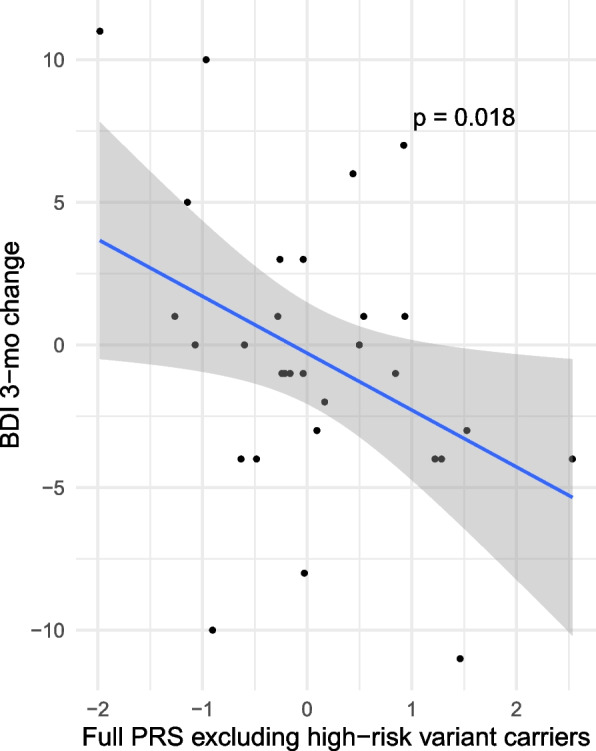
Changes in scores on the Beck Depression Inventory (BDI) were not correlated with PRS when derived from all susceptibility variants, however, when removing pathogenic and high-risk carriers from the calculation, higher PRS was significantly associated with greater reduction in BDI score at 3 months and with similar trend 24 months after DBS. PRS was not a significant predictor of Unified Parkinson's Disease Rating Scale, Dementia Rating Scale, or phenomic and semantic fluency outcomes at 3- and 24-months after DBS surgery.
This exploratory study suggests that PRS may predict degree of improvement in depressive symptoms after DBS, though was not predictive of motor and other cognitive outcomes after DBS. Additionally, PRS may be most relevant in predicting DBS outcomes in patients lacking pathogenic or high-risk PD variants. However, this was a small preliminary study and response to DBS treatment is multifactorial, therefore, more standardized high-powered studies are needed.
深部脑刺激(DBS)是治疗特定帕金森病(PD)患者的一种成熟的治疗选择。然而,DBS 的反应因人而异,因此,能够预测谁会有更好的效果可以帮助患者选择。一些与 PD 相关的单基因突变已被报道是影响 DBS 反应的因素之一。然而,单基因疾病仅占 PD 患者的少数。多基因风险评分(PRS)是疾病累积遗传风险的指标。PD 的 PRS 也与发病年龄和症状进展相关,但尚不清楚 PRS 是否与 DBS 反应之间存在相关性。在这里,我们进行了一项初步研究来寻找任何相关性。
我们对来自 NIH PD 诊所的 33 名 PD 患者和来自帕金森进展标志物倡议数据库的 13 名患者进行了回顾性分析,这些患者进行了基因检测,并接受了双侧丘脑底核 DBS 手术和临床随访。根据最新的 PD 全基因组关联研究中确定的 90 个易感性变异,为所有 46 名患者计算了 PD 特异性 PRS。我们使用多元回归分析测试了 PRS 与手术前后运动和认知测量之间的关联,随访时间最长可达手术后两年。
从所有易感性变异中计算出的贝克抑郁量表(BDI)评分的变化与 PRS 无关,然而,当从计算中去除致病性和高风险携带者时,较高的 PRS 与 DBS 后 3 个月 BDI 评分的显著降低以及 24 个月后类似的趋势显著相关。PRS 不是 DBS 手术后 3 个月和 24 个月时统一帕金森病评定量表、痴呆评定量表或表型和语义流畅性结果的显著预测因子。
这项探索性研究表明,PRS 可能预测 DBS 后抑郁症状改善的程度,尽管它不能预测 DBS 后运动和其他认知结果。此外,PRS 可能在预测缺乏致病性或高风险 PD 变异的患者的 DBS 结果方面最为相关。然而,这是一项小型初步研究,DBS 治疗的反应是多因素的,因此,需要更多标准化的高功率研究。