Department of Psychiatry & Mental Health and South African Medical Council Research Unit on Risk and Resilience in Mental Disorders, University of Cape Town and Groote Schuur Hospital, Cape Town, South Africa.
Department of Psychology, Yale University, New Haven, CT, USA.
BMC Psychiatry. 2023 Apr 4;23(1):226. doi: 10.1186/s12888-023-04605-2.
Posttraumatic stress disorder (PTSD) is associated with significant morbidity, but efficacious pharmacotherapy and psychotherapy are available. Data from the World Mental Health Surveys were used to investigate extent and predictors of treatment coverage for PTSD in high-income countries (HICs) as well as in low- and middle-income countries (LMICs).
Seventeen surveys were conducted across 15 countries (9 HICs, 6 LMICs) by the World Health Organization (WHO) World Mental Health Surveys. Of 35,012 respondents, 914 met DSM-IV criteria for 12-month PTSD. Components of treatment coverage analyzed were: (a) any mental health service utilization; (b) adequate pharmacotherapy; (c) adequate psychotherapy; and (d) effective treatment coverage. Regression models investigated predictors of treatment coverage.
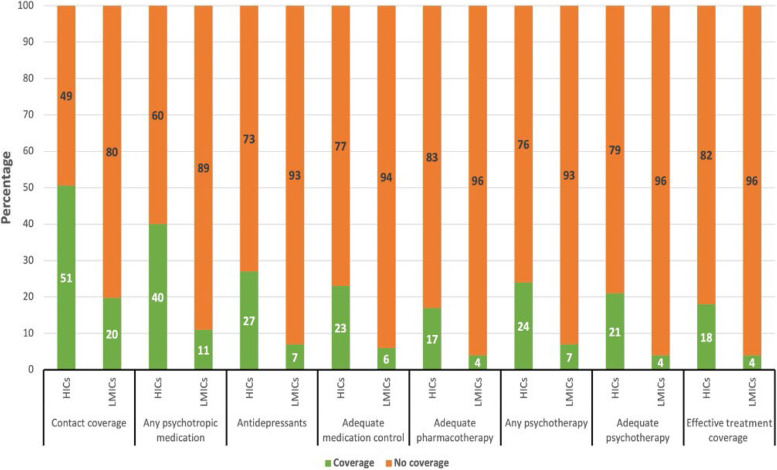
12-month PTSD prevalence in trauma exposed individuals was 1.49 (S.E., 0.08). A total of 43.0% (S.E., 2.2) received any mental health services, with fewer receiving adequate pharmacotherapy (13.5%), adequate psychotherapy (17.2%), or effective treatment coverage (14.4%), and with all components of treatment coverage lower in LMICs than HICs. In a multivariable model having insurance (OR = 2.31, 95 CI 1.17, 4.57) and severity of symptoms (OR = .35, 95% CI 0.18, 0.70) were predictive of effective treatment coverage.
There is a clear need to improve pharmacotherapy and psychotherapy coverage for PTSD, particularly in those with mild symptoms, and especially in LMICs. Universal health care insurance can be expected to increase effective treatment coverage and therefore improve outcomes.
创伤后应激障碍(PTSD)与显著的发病率有关,但有效的药物治疗和心理治疗是可用的。利用来自世界心理健康调查的数据,研究了高收入国家(HIC)和中低收入国家(LMIC)中 PTSD 的治疗覆盖率及其预测因素。
世界卫生组织(WHO)的世界心理健康调查在 15 个国家进行了 17 项调查(9 个 HIC,6 个 LMIC)。在 35012 名受访者中,有 914 名符合 DSM-IV 创伤后 12 个月 PTSD 的标准。分析了治疗覆盖率的组成部分:(a)任何心理健康服务的利用;(b)充分的药物治疗;(c)充分的心理治疗;(d)有效的治疗覆盖率。回归模型研究了治疗覆盖率的预测因素。
暴露于创伤的个体中,12 个月 PTSD 的患病率为 1.49(标准误差,0.08)。共有 43.0%(标准误差,2.2)接受了任何心理健康服务,但接受充分药物治疗(13.5%)、充分心理治疗(17.2%)或有效治疗覆盖率(14.4%)的比例较低,所有治疗覆盖率的组成部分在 LMIC 都低于 HIC。在多变量模型中,有保险(OR=2.31,95%置信区间 1.17,4.57)和症状严重程度(OR=0.35,95%置信区间 0.18,0.70)是有效治疗覆盖率的预测因素。
显然需要改善 PTSD 的药物治疗和心理治疗覆盖率,特别是在症状较轻的患者中,尤其是在 LMIC 中。全民健康保险有望提高有效治疗覆盖率,从而改善结果。