Tampere Institute for Advanced Study, Faculty of Medicine and Health Technology, Tampere University, Tampere, Finland.
Department of Biological and Environmental Science, University of Jyväskylä, Jyväskylä, Finland.
J Math Biol. 2023 Apr 5;86(5):68. doi: 10.1007/s00285-023-01903-x.
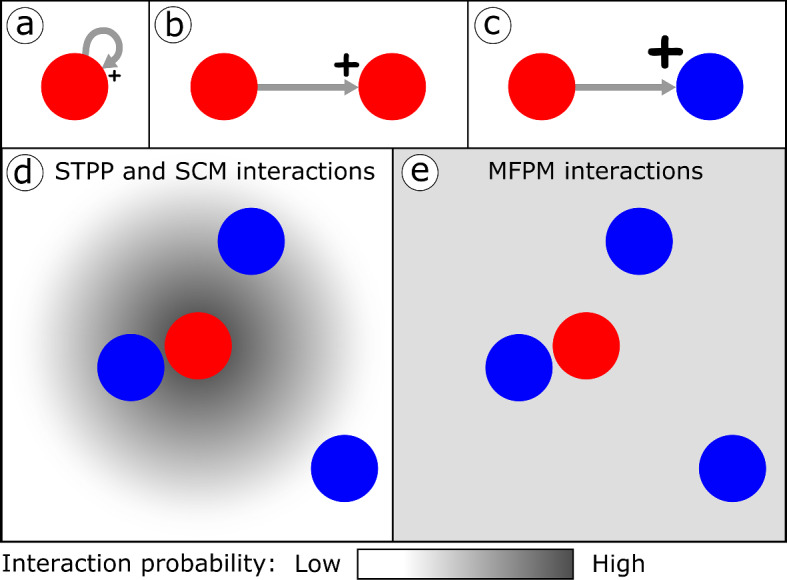
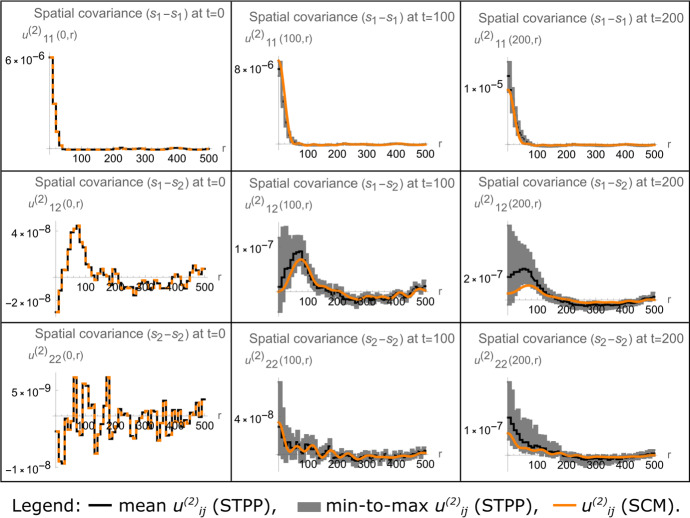
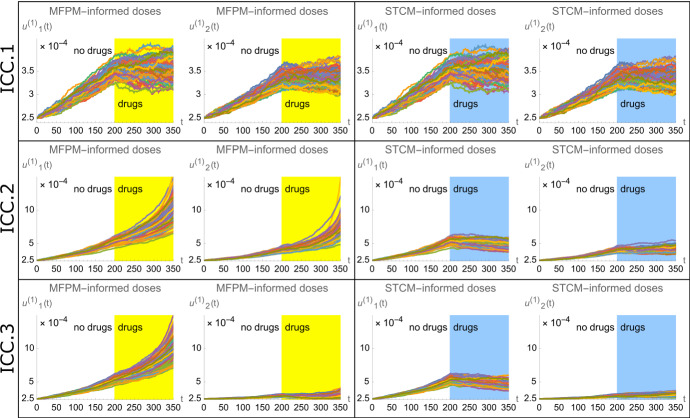
Theoretical and applied cancer studies that use individual-based models (IBMs) have been limited by the lack of a mathematical formulation that enables rigorous analysis of these models. However, spatial cumulant models (SCMs), which have arisen from theoretical ecology, describe population dynamics generated by a specific family of IBMs, namely spatio-temporal point processes (STPPs). SCMs are spatially resolved population models formulated by a system of differential equations that approximate the dynamics of two STPP-generated summary statistics: first-order spatial cumulants (densities), and second-order spatial cumulants (spatial covariances). We exemplify how SCMs can be used in mathematical oncology by modelling theoretical cancer cell populations comprising interacting growth factor-producing and non-producing cells. To formulate model equations, we use computational tools that enable the generation of STPPs, SCMs and mean-field population models (MFPMs) from user-defined model descriptions (Cornell et al. Nat Commun 10:4716, 2019). To calculate and compare STPP, SCM and MFPM-generated summary statistics, we develop an application-agnostic computational pipeline. Our results demonstrate that SCMs can capture STPP-generated population density dynamics, even when MFPMs fail to do so. From both MFPM and SCM equations, we derive treatment-induced death rates required to achieve non-growing cell populations. When testing these treatment strategies in STPP-generated cell populations, our results demonstrate that SCM-informed strategies outperform MFPM-informed strategies in terms of inhibiting population growths. We thus demonstrate that SCMs provide a new framework in which to study cell-cell interactions, and can be used to describe and perturb STPP-generated cell population dynamics. We, therefore, argue that SCMs can be used to increase IBMs' applicability in cancer research.
理论和应用癌症研究使用基于个体的模型 (IBMs) 一直受到缺乏能够对这些模型进行严格分析的数学公式的限制。然而,源于理论生态学的空间累积量模型 (SCMs) 描述了由特定 IBM 家族生成的种群动态,即时空点过程 (STPPs)。SCMs 是通过一组微分方程来构建的具有空间分辨率的种群模型,这些方程近似于由两个 STPP 生成的摘要统计量的动态:一阶空间累积量(密度)和二阶空间累积量(空间协方差)。我们通过对包含相互作用的生长因子产生细胞和非产生细胞的理论癌细胞群体进行建模,举例说明了 SCM 如何在数学肿瘤学中得到应用。为了构建模型方程,我们使用计算工具来生成 STPP、SCM 和平均场种群模型(MFPM),这些工具可以从用户定义的模型描述中生成(Cornell 等人,Nat Commun 10:4716, 2019)。为了计算和比较 STPP、SCM 和 MFPM 生成的摘要统计量,我们开发了一个与应用无关的计算流程。我们的结果表明,即使在 MFPM 无法做到的情况下,SCM 也可以捕捉到 STPP 生成的种群密度动态。从 MFPM 和 SCM 方程中,我们推导出了实现非生长细胞群体所需的治疗诱导死亡率。在 STPP 生成的细胞群体中测试这些治疗策略时,我们的结果表明,在抑制种群生长方面,SCM 提供的策略优于 MFPM 提供的策略。因此,我们证明了 SCM 为研究细胞间相互作用提供了一个新的框架,并且可以用来描述和干扰 STPP 生成的细胞群体动态。因此,我们认为 SCM 可以提高 IBM 在癌症研究中的适用性。