Department of Neurology, Medical University of Innsbruck, Anichstraße 35, 6020, Innsbruck, Austria.
VASCage, Research Center on Vascular Ageing and Stroke, Anichstraße 5a, 6020, Innsbruck, Austria.
Sci Rep. 2023 Apr 5;13(1):5587. doi: 10.1038/s41598-023-32586-5.
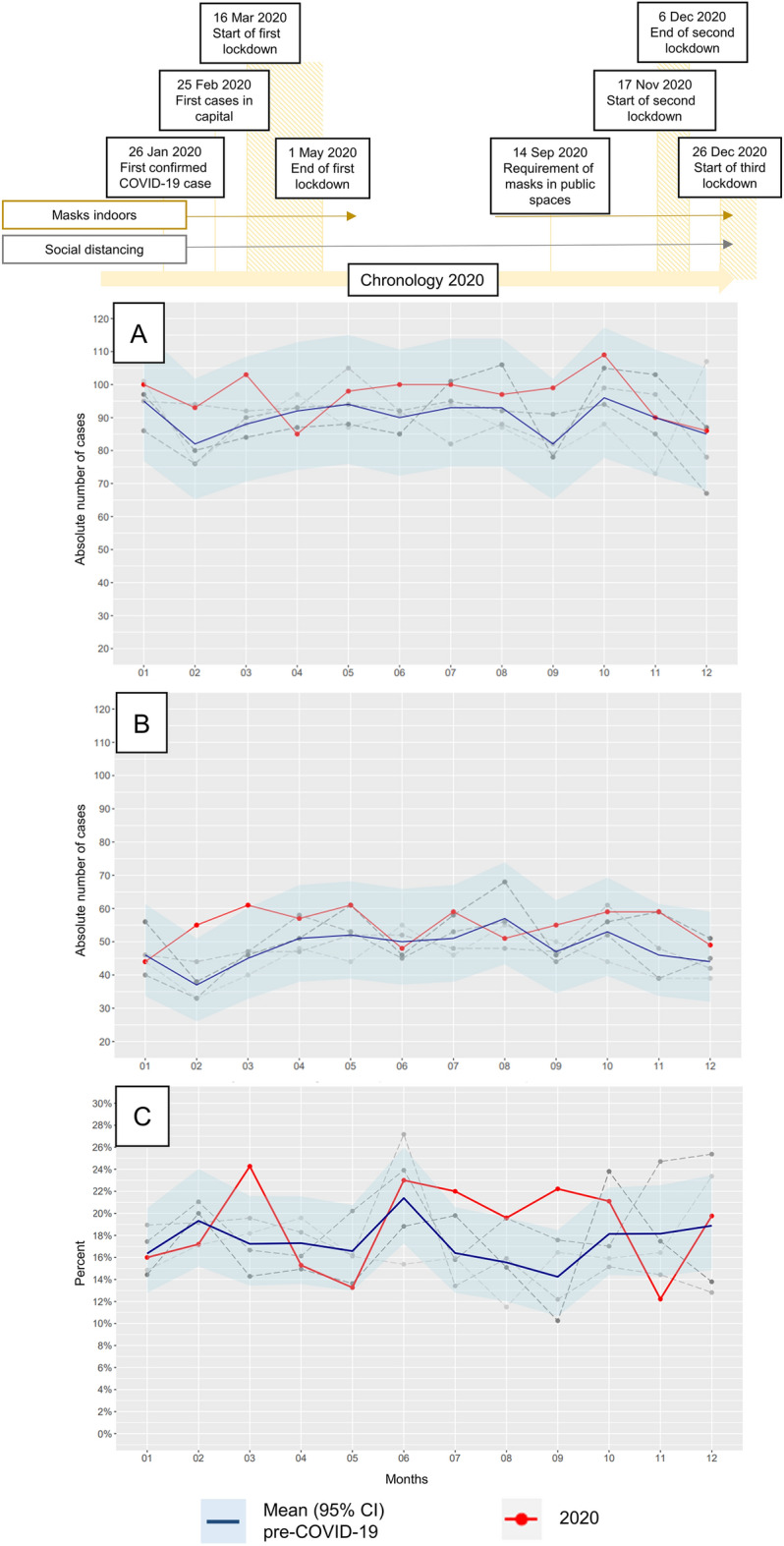
The aim of our study was to assess whether a well-established federal state-wide Stroke Care Pathway delivering high quality stroke care can cope with the COVID-19 pandemic and associated measures to contain the virus spread. The retrospective analysis is based on a prospective, quality-controlled, population-based registry of all stroke patients in the Tyrol, a federal state of Austria and one of the early hot-spots of COVID-19 in Europe. Patient characteristics, pre-hospital management, intra-hospital management and post-hospital were analysed. All residents of the Tyrol suffering ischemic stroke in 2020 (n = 1160) and four pre-COVID-19 years (n = 4321) were evaluated. In 2020, the annual number of stroke patients was the highest in this population-based registry. When local hospitals were overwhelmed with SARS-CoV-2-patients, stroke subjects were temporarily allocated to the comprehensive stroke centre. Stroke severity, quality metrics of stroke management, serious complications, and post-stroke mortality did not differ between 2020 and the four comparator years. Notably, iv. thrombolysis-rate was similar (19.9% versus 17.4%, P = 0.25) and endovascular stroke treatment even better (5.9% versus 3.9%, P = 0.003) but resources for in-patient rehabilitation were limited (25.8% versus 29.8%, P = 0.009). Concluding, a well-established Stroke Care Pathway was able to maintain high-quality acute stroke care even when challenged by a global pandemic.
我们的研究目的是评估一个既定的、覆盖全联邦州的卒中护理路径,该路径提供高质量的卒中护理,是否能够应对 COVID-19 大流行以及相关的病毒传播控制措施。回顾性分析基于前瞻性、质量控制、基于人群的蒂罗尔卒中登记处的所有卒中患者,该登记处是奥地利联邦州之一,也是欧洲 COVID-19 的早期热点之一。分析了患者特征、院前管理、院内管理和院后管理。评估了 2020 年(n=1160)和四个 COVID-19 前年份(n=4321)所有在蒂罗尔州患有缺血性卒中的居民。在这个基于人群的登记处,2020 年的卒中患者数量达到了历史最高水平。当地医院因 SARS-CoV-2 患者而不堪重负时,卒中患者会被暂时分配到综合卒中中心。2020 年与四个对照年份相比,卒中严重程度、卒中管理质量指标、严重并发症和卒中后死亡率没有差异。值得注意的是,静脉内溶栓的比例相似(19.9%比 17.4%,P=0.25),血管内治疗甚至更好(5.9%比 3.9%,P=0.003),但住院康复资源有限(25.8%比 29.8%,P=0.009)。结论,即使面临全球大流行的挑战,既定的卒中护理路径仍能够维持高质量的急性卒中护理。