Department of Radiology, The Second Affiliated Hospital of Fujian Medical University, No. 34 Zhongshan Bei Road, Licheng District, Quanzhou, Fujian, China.
Department of Radiology, Zhongshan Hospital, Fudan University, No. 180 Fenglin Road, Xuhui District, Shanghai, 200032, China.
BMC Med Imaging. 2023 Apr 6;23(1):50. doi: 10.1186/s12880-023-01008-3.
The purpose of this study was to evaluate the CT and MRI findings, clinicopathologic features, and differential diagnosis of Sclerosing angiomatoid nodular transformation (SANT).
Seven men and seven women with pathological diagnoses of SANT were included in this retrospect study. Patients underwent at least one radiological examination before surgery. The number, shape, margin, size, attenuation, signal intensity, homogeneity, and enhancing pattern of the lesion were evaluated by two abdominal radiologists independently. Immunohistochemistry reports were available for 11 patients. The immunoreactivity to the vascular markers CD8, CD31, and CD34 was assessed.
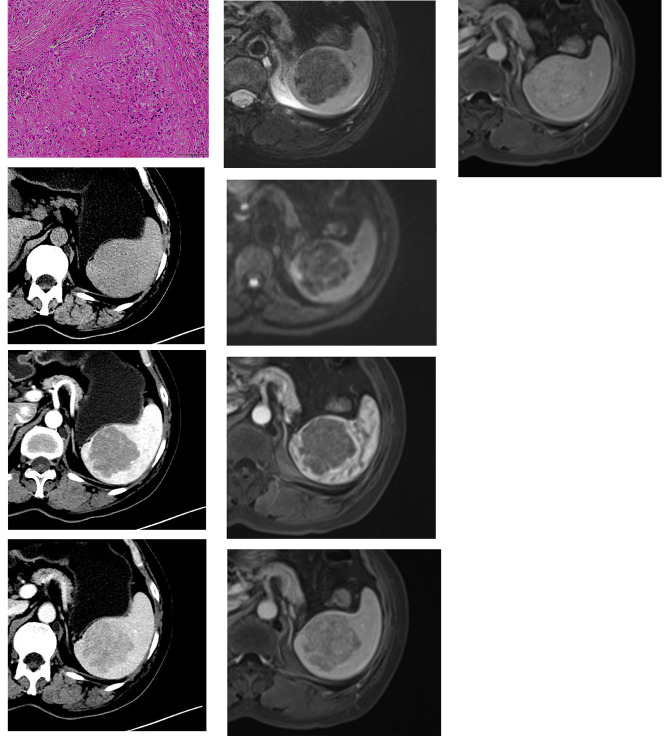
The 14 SANT patients (7 men, 7 women; mean age, 43.5 years; age range, 24-56 years) presented with a single lesion and showed no specific clinical symptoms. Among 14 patients, 12 patients underwent MR scan, 5 patients underwent CT scan and 3 patients underwent PET-CT. On CT, all 5 lesions showed hypodensity on non-contrast images and spoke-wheel enhancing pattern after contrast administration, and calcification was observed. On T2WI, 10 cases(83.3%)showed hypointensity and 2 cases (16.7%) showed hyperintensity with central hypointensity. On T1WI, 10 cases (83.3%) were isointense and 2 cases (16.7%) were slightly hypointense. 10 cases (83.3%) showed hypointensity on DWI and 2 cases (16.7%) showed slightly hyperintensity on DWI. After contrast administration, all 12 lesions showed progressive enhancement. 18 F-fluorodeoxyglucose (FDG) uptake in the tumor was seen in all three cases that underwent PET-CT. The maximum standardized uptake value (SUVmax) was 4.5, 5.1, and 3.8 respectively.
Apart from the progressive spoke-wheel enhancing pattern, DWI and ADC findings will add value to the diagnosis of SANT.
本研究旨在评估硬化性血管样结节转化(SANT)的 CT 和 MRI 表现、临床病理特征及鉴别诊断。
本回顾性研究纳入了 7 名男性和 7 名女性病理诊断为 SANT 的患者。患者在术前均至少进行了 1 次影像学检查。由 2 名腹部放射科医生独立评估病变的数量、形状、边界、大小、衰减、信号强度、均匀性和增强模式。11 例患者的免疫组化报告可用,评估了其对血管标志物 CD8、CD31 和 CD34 的免疫反应性。
14 例 SANT 患者(7 名男性,7 名女性;平均年龄 43.5 岁;年龄范围 24-56 岁)表现为单个病灶,无特异性临床症状。14 例患者中,12 例行 MR 扫描,5 例行 CT 扫描,3 例行 PET-CT 扫描。CT 上,所有 5 个病灶在非增强图像上呈低信号,增强后呈辐轮样强化,且可见钙化。T2WI 上,10 例(83.3%)呈低信号,2 例(16.7%)呈中心低信号的高信号。T1WI 上,10 例(83.3%)为等信号,2 例(16.7%)为稍低信号。10 例(83.3%)DWI 呈低信号,2 例(16.7%)DWI 呈稍高信号。增强后,所有 12 个病灶均呈渐进性强化。3 例行 PET-CT 检查的患者均可见肿瘤 18F-氟脱氧葡萄糖(FDG)摄取,最大标准化摄取值(SUVmax)分别为 4.5、5.1 和 3.8。
除渐进性辐轮样强化模式外,DWI 和 ADC 表现将有助于 SANT 的诊断。