Ophthalmic Plastic Surgery Services, KAR Campus, L V Prasad Eye Institute, Hyderabad, Telangana, India; Institute of Functional and Clinical Anatomy, Friedrich Alexander University Erlangen-Nuremberg, Erlangen, Germany.
The Cornea Institute, KAR Campus, L V Prasad Eye Institute, Hyderabad, Telangana, India.
Indian J Ophthalmol. 2023 Apr;71(4):1090-1098. doi: 10.4103/IJO.IJO_2622_22.
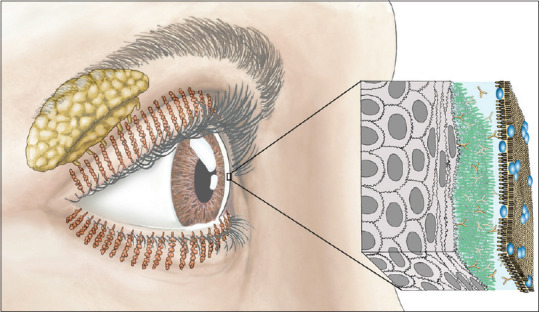
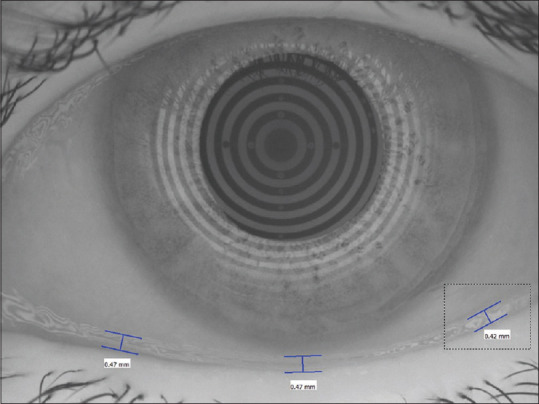
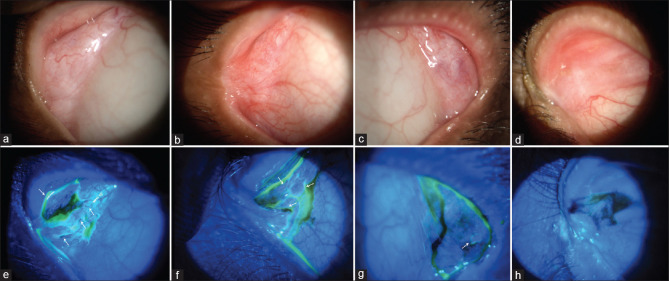
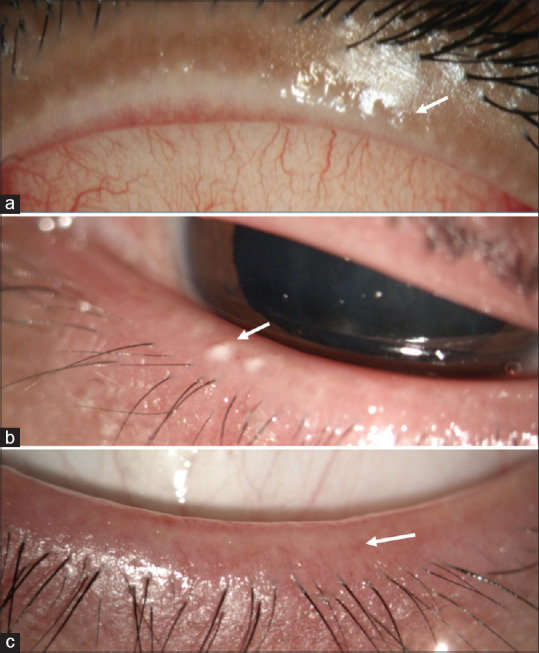
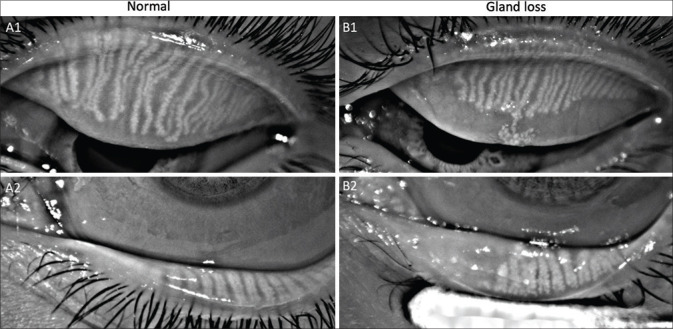
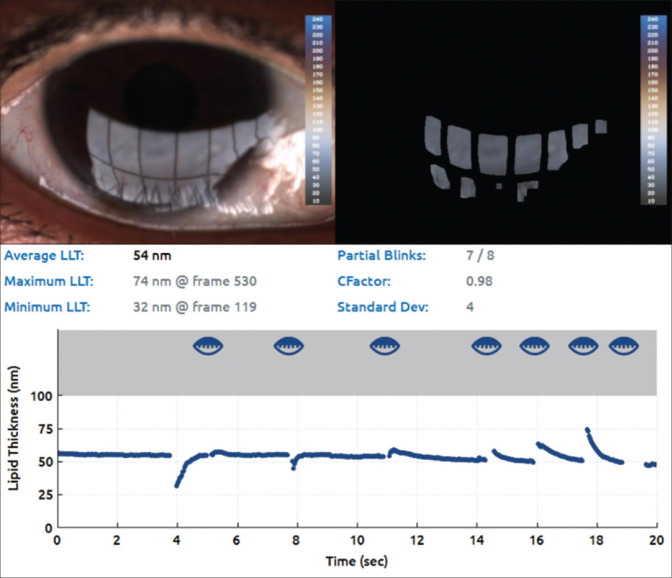
Lacrimal and meibomian glands contribute to the aqueous and lipid components of tear film, respectively. Their evaluation remains central to diagnosing and managing dry eye disease (DED). The review discusses the differences and reliability of various diagnostic tests and commercially available devices used for DED diagnosis. Slit-lamp-based techniques are direct palpebral lobe and tear flow assessment, Schirmer test, meibum quality and expressibility, and evaluation of tear meniscus height. Non-invasive tear meniscus height (TMH), tear break-up time (TBUT), lipid layer thickness (LLT), and meibography are machine-based diagnostic tests. The structure-function correlation of the tear-producing glands gives more comprehensive details than either information alone. Many devices are available in the market, which make DED diagnosis an easy feat, but the tests should be interpreted keeping in mind the intra-observer and inter-observer repeatability. Also, the tear film displays a huge variability as per the environmental conditions and impact of blinking. Hence, the examiner should be well versed with the techniques and repeat the test two to three times to obtain an average reading, which is more reliable. The recommended sequence of tests for diagnosing DED is a dry eye questionnaire, TMH, LLT, NIBUT (FBUT if non-invasive test is unavailable but should be performed after osmolarity), tear osmolarity, meibography, and ocular surface staining. Invasive tests such as Schirmer should be performed after the non-invasive tear film diagnostic testing.
泪腺和睑板腺分别为泪膜的水相和脂质成分做出贡献。它们的评估仍然是诊断和管理干眼的核心。本文讨论了用于干眼诊断的各种诊断测试和市售设备之间的差异和可靠性。基于裂隙灯的技术包括直接睑板评估和泪液流量评估、泪液分泌试验、泪膜脂质层质量和可挤出性以及泪膜弯月高评估。非侵入性泪膜弯月高(TMH)、泪膜破裂时间(TBUT)、脂质层厚度(LLT)和睑板腺照相术是基于机器的诊断测试。产泪腺的结构-功能相关性比单独的信息提供更全面的细节。市场上有许多设备可用于诊断干眼,但应考虑观察者内和观察者间的重复性来解释这些测试。此外,泪膜根据环境条件和眨眼的影响显示出巨大的可变性。因此,检查者应该精通这些技术,并重复测试两到三次以获得更可靠的平均值。诊断干眼的推荐测试顺序是干眼问卷、TMH、LLT、NIBUT(如果无法进行非侵入性测试,则进行 FBUT,但应在渗透压测试后进行)、泪液渗透压、睑板腺照相术和眼表面染色。侵入性测试如 Schirmer 应在非侵入性泪膜诊断测试后进行。