Department of Tumor Genetics and Biology, Graduate School of Medical Sciences, Faculty of Life Sciences, Kumamoto University, Kumamoto, Japan.
Department of Biochemistry, Faculty of Medicine, Khon Kaen University, Khon Kaen, Thailand.
Cancer Sci. 2023 Aug;114(8):3230-3246. doi: 10.1111/cas.15812. Epub 2023 Apr 20.
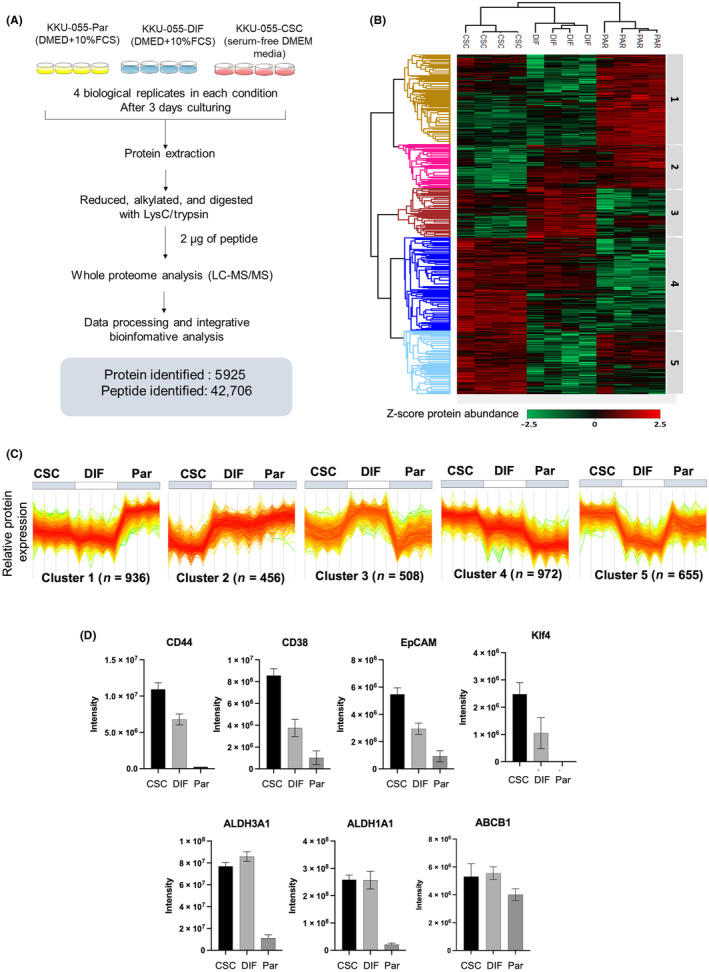
Cholangiocarcinoma (CCA) is an aggressive malignant tumor of bile duct epithelia. Recent evidence suggests the impact of cancer stem cells (CSC) on the therapeutic resistance of CCA; however, the knowledge of CSC in CCA is limited due to the lack of a CSC model. In this study, we successfully established a stable sphere-forming CCA stem-like cell, KKU-055-CSC, from the original CCA cell line, KKU-055. The KKU-055-CSC exhibits CSC characteristics, including: (1) the ability to grow stably and withstand continuous passage for a long period of culture in the stem cell medium, (2) high expression of stem cell markers, (3) low responsiveness to standard chemotherapy drugs, (4) multilineage differentiation, and (5) faster and constant expansive tumor formation in xenograft mouse models. To identify the CCA-CSC-associated pathway, we have undertaken a global proteomics and functional cluster/network analysis. Proteomics identified the 5925 proteins in total, and the significantly upregulated proteins in CSC compared with FCS-induced differentiated CSC and its parental cells were extracted. Network analysis revealed that high mobility group A1 (HMGA1) and Aurora A signaling through the signal transducer and activator of transcription 3 pathways were enriched in KKU-055-CSC. Knockdown of HMGA1 in KKU-055-CSC suppressed the expression of stem cell markers, induced the differentiation followed by cell proliferation, and enhanced sensitivity to chemotherapy drugs including Aurora A inhibitors. In silico analysis indicated that the expression of HMGA1 was correlated with Aurora A expressions and poor survival of CCA patients. In conclusion, we have established a unique CCA stem-like cell model and identified the HMGA1-Aurora A signaling as an important pathway for CSC-CCA.
胆管癌(CCA)是一种侵袭性的胆管上皮恶性肿瘤。最近的证据表明,癌症干细胞(CSC)对 CCA 的治疗抵抗有影响;然而,由于缺乏 CSC 模型,对 CCA 中 CSC 的认识是有限的。在这项研究中,我们成功地从原始的 CCA 细胞系 KKU-055 中建立了一个稳定的球体形成的 CCA 干细胞样细胞,KKU-055-CSC。KKU-055-CSC 表现出 CSC 的特征,包括:(1)能够在干细胞培养基中稳定生长并耐受长时间的连续传代培养,(2)高水平表达干细胞标志物,(3)对标准化疗药物的低反应性,(4)多谱系分化,以及(5)在异种移植小鼠模型中更快和持续的肿瘤形成。为了确定与 CCA-CSC 相关的途径,我们进行了全局蛋白质组学和功能聚类/网络分析。蛋白质组学总共鉴定了 5925 种蛋白质,并且从 CSC 中提取了与 FCS 诱导的分化 CSC 及其亲本细胞相比显著上调的蛋白质。网络分析表明,高迁移率族蛋白 A1(HMGA1)和 Aurora A 信号通过信号转导和转录激活因子 3 途径在 KKU-055-CSC 中富集。在 KKU-055-CSC 中敲低 HMGA1 抑制了干细胞标志物的表达,诱导了随后的细胞增殖分化,并增强了对包括 Aurora A 抑制剂在内的化疗药物的敏感性。计算机分析表明,HMGA1 的表达与 Aurora A 的表达和 CCA 患者的不良生存相关。总之,我们建立了一个独特的 CCA 干细胞样细胞模型,并确定了 HMGA1-Aurora A 信号作为 CSC-CCA 的一个重要途径。