Department of Cardiology, First Affiliated Hospital of Medical School, Xi'an Jiaotong University, No.277, Yanta West Road, Xi'an, 710061, Shaanxi, China.
Key Laboratory of Molecular Cardiology of Shaanxi Province, Xi'an, China.
BMC Endocr Disord. 2023 Apr 7;23(1):78. doi: 10.1186/s12902-023-01330-5.
The new visceral adiposity index (NVAI) was superior to previous obesity indices in predicting cardiovascular diseases among Asians. Nevertheless, the utility of the NVAI for predicting chronic kidney disease is still unclear. The objective of this research was to explore the relationship between the NVAI and subclinical renal damage (SRD) and to investigate whether the NVAI outperforms other common obesity indices in predicting SRD in the Chinese population.
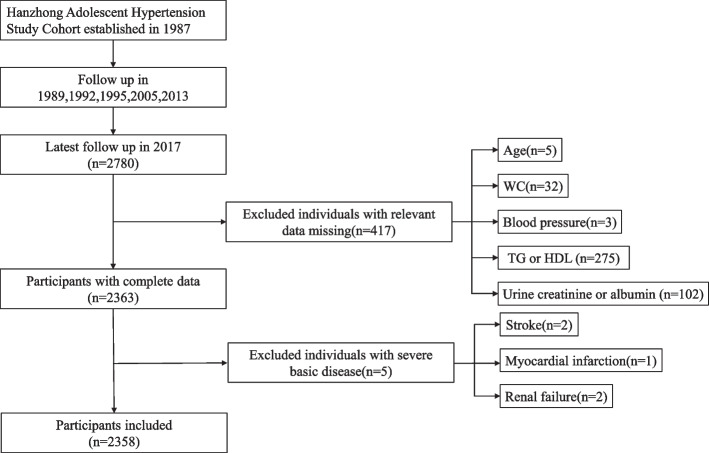
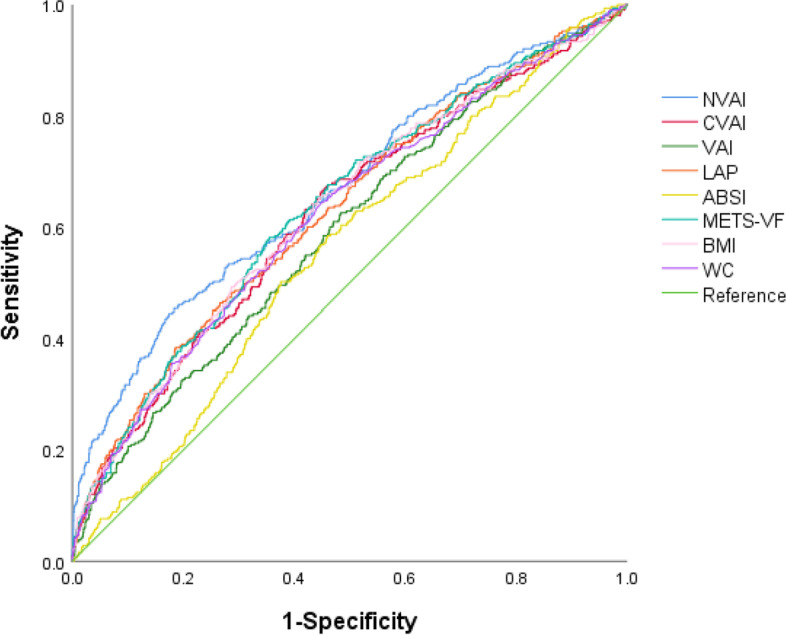
Participants in this cross-sectional study were from the Hanzhong Adolescent Hypertension Cohort. The NVAI and seven other common obesity indices were calculated, including body mass index, waist circumference, lipid accumulation product, visceral adiposity index, Chinese visceral adiposity index, a body shape index and metabolic score for visceral fat. Logistic regression models revealed the association between NVAI and SRD. The odds ratio (OR) and the 95% confidence interval (CI) were calculated to show the association between the two variables. The predictive power of eight obesity indices for SRD was evaluated through the receiver operating characteristic curve and area under the curve (AUC). In addition, the net reclassification index (NRI) and integrated discrimination improvement (IDI) were also applied to compare the incremental predictive value for SRD of different obesity indices.
The median age of the 2358 subjects was 42.00 years. Across NVAI tertiles, the prevalence of SRD was 7.25%, 11.21%, and 21.60%, respectively. After adjusting for confounders, a high level of NVAI remained a risk factor for SRD. The ORs of the middle and top NVAI tertiles for SRD were 1.920 (95% CI: 1.322, 2.787) and 4.129 (95% CI: 2.750, 6.202), respectively. The AUC of the NVAI was 0.666 (95% CI: 0.647, 0.685), which was significantly larger than the AUC of any of the other obesity indicators. Moreover, the NRI and IDI were significantly improved when NVAI was added to the basic model for predicting SRD. Among eight obesity indices, NVAI had the highest NRI (0.392; 95% CI: 0.280, 0.503), and its IDI (0.021; 95% CI: 0.014, 0.027) was second only to that of the body mass index (0.023; 95% CI: 0.014, 0.032).
NVAI is independently and positively associated with SRD. Among the eight obesity indices, the NVAI shows the strongest predictive power for SRD in the Chinese population. The NVAI may be useful as an effective warning indicator of chronic kidney disease in Chinese adults.
新的内脏脂肪指数(NVAI)在预测亚洲人群心血管疾病方面优于以前的肥胖指数。然而,NVAI 预测慢性肾脏病的效用仍不清楚。本研究旨在探讨 NVAI 与亚临床肾脏损伤(SRD)之间的关系,并探讨 NVAI 是否优于其他常见肥胖指数在中国人群中预测 SRD。
本横断面研究的参与者来自汉中青少年高血压队列。计算了 NVAI 和其他七种常见肥胖指数,包括体重指数、腰围、脂质蓄积产物、内脏脂肪指数、中国内脏脂肪指数、身体形状指数和内脏脂肪代谢评分。Logistic 回归模型揭示了 NVAI 与 SRD 之间的关联。计算了比值比(OR)和 95%置信区间(CI),以显示两个变量之间的关联。通过接收者操作特征曲线和曲线下面积(AUC)评估了 8 种肥胖指数对 SRD 的预测能力。此外,还应用净重新分类指数(NRI)和综合判别改善(IDI)来比较不同肥胖指数对 SRD 预测价值的增量。
2358 名受试者的中位年龄为 42.00 岁。在 NVAI 三分位数中,SRD 的患病率分别为 7.25%、11.21%和 21.60%。在调整混杂因素后,高水平的 NVAI 仍然是 SRD 的一个危险因素。中间和顶部 NVAI 三分位数的 SRD 的 OR 分别为 1.920(95%CI:1.322, 2.787)和 4.129(95%CI:2.750, 6.202)。NVAI 的 AUC 为 0.666(95%CI:0.647, 0.685),明显大于任何其他肥胖指标的 AUC。此外,当将 NVAI 添加到基本模型中预测 SRD 时,NRI 和 IDI 显著提高。在 8 种肥胖指数中,NVAI 的 NRI 最高(0.392;95%CI:0.280, 0.503),其 IDI(0.021;95%CI:0.014, 0.027)仅次于体重指数(0.023;95%CI:0.014, 0.032)。
NVAI 与 SRD 独立呈正相关。在这 8 种肥胖指数中,NVAI 在中国人群中对 SRD 具有最强的预测能力。NVAI 可能是中国成年人慢性肾脏病的有效预警指标。