Geng Xueran, Guo Dongdong, Bau Tergun, Lei Jiayu, Xu Lijing, Cheng Yanfen, Feng Cuiping, Meng Junlong, Chang Mingchang
College of Food Science and Engineering, Shanxi Agricultural University, Taigu, Shanxi 030801, China.
Shanxi Key Laboratory of Edible Fungi for Loess Plateau, Taigu, Shanxi 030801, China.
Food Chem X. 2023 Mar 15;18:100644. doi: 10.1016/j.fochx.2023.100644. eCollection 2023 Jun 30.
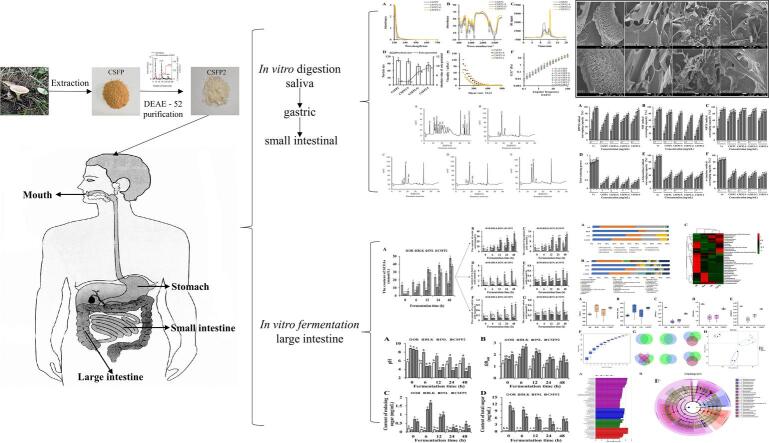
The aim of this study was to establish a human digestion model to explore the degradation characteristics of a novel high-purity polysaccharide from (CSFP2). The results showed that the content of reducing sugars ( ) of CSFP2 increased from 0.13 to 0.23 mg/mL, the molecular weight () of CSFP2 decreased significantly during the saliva-gastrointestinal digestion. The constituent monosaccharides of CSFP2, including galactose, glucose, and mannose, were stable during digestion, but their molar ratios were changed from 0.023: 0.737: 0.234 to 0.496: 0.478: 0.027. The surface of CSFP2 changes from a rough flaky structure to a scattered flocculent or rod-shaped structure after the gastrointestinal digestion. However, the apparent viscosity of CSFP2 was overall stable during digestion. Moreover, CSFP2 still maintains its strong antioxidant capacity after saliva-gastrointestinal digestion. The results showed that CSFP2 can be partially decomposed during digestion. Meanwhile, some physico-chemical properties of the fermentation broth containing CSFP2 changed significantly after gut microbiota fermentation. For example, the pH value (from 8.46 to 4.72) decreased significantly ( < 0.05) after 48 h of fermentation. the value increased first and then decreased (from 2.00 to 2.68 to 1.32) during 48-h fermentation. In addition, CSFP2 could also increase the amounts of short-chain fatty acids (SCFAs) (from 5.5 to 37.15 mmol/L) during fermentation (in particular, acetic acid, propionic acid, and butyric acid). Furthermore, the relative abundances of , , , , , , , and at genus level were markedly increased with the intervention of CSFP2. These results provided a theoretical basis for the further development of functional foods related to CSFP2.
本研究旨在建立一种人体消化模型,以探究一种新型高纯度多糖(CSFP2)的降解特性。结果表明,CSFP2的还原糖含量( )从0.13增加至0.23 mg/mL,在唾液-胃肠消化过程中,CSFP2的分子量( )显著降低。CSFP2的组成单糖,包括半乳糖、葡萄糖和甘露糖,在消化过程中保持稳定,但其摩尔比从0.023:0.737:0.234变为0.496:0.478:0.027。胃肠消化后,CSFP2的表面从粗糙的片状结构变为分散的絮状或棒状结构。然而,CSFP2的表观粘度在消化过程中总体保持稳定。此外,CSFP2在唾液-胃肠消化后仍保持较强的抗氧化能力。结果表明,CSFP2在消化过程中可被部分分解。同时,含有CSFP2的发酵液在肠道微生物群发酵后,其一些理化性质发生了显著变化。例如,发酵48小时后,pH值(从8.46降至4.72)显著降低( < 0.05)。在48小时的发酵过程中, 值先升高后降低(从2.00至2.68再至1.32)。此外,CSFP2在发酵过程中还可增加短链脂肪酸(SCFAs)的含量(从5.5增至37.15 mmol/L)(特别是乙酸、丙酸和丁酸)。此外,在CSFP2的干预下属水平上 、 、 、 、 、 、 和 的相对丰度显著增加。这些结果为与CSFP2相关的功能性食品的进一步开发提供了理论依据。