Center for Biotechnology, Khalifa University of Science and Technology, Abu Dhabi, United Arab Emirates.
Department of Biomedical Engineering, College of Engineering, Khalifa University of Science and Technology, Abu Dhabi, United Arab Emirates.
Front Endocrinol (Lausanne). 2023 Mar 23;14:1143067. doi: 10.3389/fendo.2023.1143067. eCollection 2023.
Type 2 diabetes mellitus (T2DM) is a chronic, metabolic disorder in which concomitant insulin resistance and β-cell impairment lead to hyperglycemia, influenced by genetic and environmental factors. T2DM is associated with long-term complications that have contributed to the burden of morbidity and mortality worldwide. The objective of this manuscript is to conduct an Exome-Wide Association Study (EWAS) on T2DM Emirati individuals to improve our understanding on diabetes-related complications to improve early diagnostic methods and treatment strategies.
This cross-sectional study recruited 310 Emirati participants that were stratified according to their medically diagnosed diabetes-related complications: diabetic retinopathy, diabetic neuropathy, diabetic nephropathy, and cardiovascular complications. The Illumina's Infinium Exome-24 array was used and 39,840 SNPs remained for analysis after quality control.
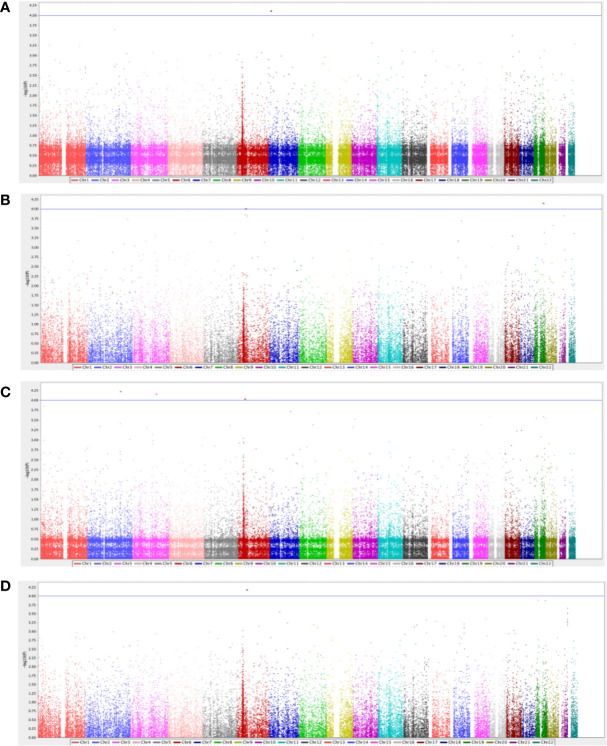
The analysis revealed the associations of various genes with each complication category: 1) diabetic retinopathy was associated to gene in locus 22q13.33 (SNP rs9616915; p=5.18 x10), gene in locus 19q13.43 (SNP rs7252603; p=7.55 x10), and gene in locus 12p13.33 (SNPs rs715146, rs1044950, rs113147414, rs34730825; p=7.62 x10); 2) diabetic neuropathy was associated to gene in locus 4q23 (SNP rs4148883; p=1.23 x10), gene in locus 2q35 (SNP rs17235409; p=1.85 x10), and gene in locus 20q13.12 (SNP rs2072788; p=2.68 x10); 3) diabetic nephropathy was associated to gene in locus 7q31.1 (SNP rs1799999; p=1.91 x10), gene in locus 19p13.2 (SNP rs140861589; p=2.80 x10), and gene in locus 20p13 (SNP rs6076550; p=2.86 x10); and 4) cardiovascular complications was associated to gene in locus 21q22.3 (SNPs rs7279204, rs6518289, rs2839227, rs2839223; p=2.18 x10,3.04 x10,4.51 x10,5.22 x10 respectively), gene in locus 7p11.2 (SNP rs146350220; p=2.77 x10), and gene in locus 15q25.2 (SNP rs72750868; p=4.47 x10).
We have identified susceptibility loci associated with each category of T2DM-related complications in the Emirati population. Given that only 16% of the markers from the Illumina's Infinium Exome chip passed quality control assessment, this demonstrates that multiple variants were, either, monomorphic in the Arab population or were not genotyped due to the use of a Euro-centric EWAS array that limits the possibility of including targeted ethnic-specific SNPs. Our results suggest the alarming possibility that lack of representation in reference panels could inhibit discovery of functionally important loci associated to T2DM complications. Further effort must be conducted to improve the representation of diverse populations in genotyping and sequencing studies.
2 型糖尿病(T2DM)是一种慢性代谢性疾病,其特征是同时存在胰岛素抵抗和β细胞功能障碍导致高血糖,受遗传和环境因素的影响。T2DM 与长期并发症有关,这些并发症导致了全球发病率和死亡率的负担。本手稿的目的是对阿联酋 2 型糖尿病患者进行外显子组全基因组关联研究(EWAS),以提高我们对糖尿病相关并发症的认识,从而改善早期诊断方法和治疗策略。
这项横断面研究招募了 310 名根据其医学诊断的糖尿病相关并发症分层的阿联酋参与者:糖尿病视网膜病变、糖尿病神经病变、糖尿病肾病和心血管并发症。使用 Illumina 的 Infinium Exome-24 阵列,经过质量控制后,有 39840 个 SNP 可供分析。
分析显示,各种基因与每种并发症类别相关:1)糖尿病视网膜病变与 22q13.33 基因座中的 基因(SNP rs9616915;p=5.18 x10)、19q13.43 基因座中的 基因(SNP rs7252603;p=7.55 x10)和 12p13.33 基因座中的 基因(SNP rs715146、rs1044950、rs113147414、rs34730825;p=7.62 x10)相关;2)糖尿病神经病变与 4q23 基因座中的 基因(SNP rs4148883;p=1.23 x10)、2q35 基因座中的 基因(SNP rs17235409;p=1.85 x10)和 20q13.12 基因座中的 基因(SNP rs2072788;p=2.68 x10)相关;3)糖尿病肾病与 7q31.1 基因座中的 基因(SNP rs1799999;p=1.91 x10)、19p13.2 基因座中的 基因(SNP rs140861589;p=2.80 x10)和 20p13 基因座中的 基因(SNP rs6076550;p=2.86 x10)相关;4)心血管并发症与 21q22.3 基因座中的 基因(SNP rs7279204、rs6518289、rs2839227、rs2839223;p=2.18 x10、3.04 x10、4.51 x10、5.22 x10)、7p11.2 基因座中的 基因(SNP rs146350220;p=2.77 x10)和 15q25.2 基因座中的 基因(SNP rs72750868;p=4.47 x10)相关。
我们已经确定了与阿联酋人群中 2 型糖尿病相关并发症的每个类别相关的易感基因座。鉴于 Illumina 的 Infinium Exome 芯片的标记中只有 16%通过了质量控制评估,这表明,要么是阿拉伯人群中的多个变体是单态的,要么是由于使用了限制包括靶向特定族裔 SNPs 的以欧洲为中心的 EWAS 阵列而未进行基因分型。我们的结果表明,缺乏代表性可能会抑制与 2 型糖尿病并发症相关的功能重要基因座的发现,这令人震惊。必须进一步努力改善不同人群在基因分型和测序研究中的代表性。