Galvain Thibaut, Bosut Melek Pinar, Jamous Nadine, Ben Mansour Nadia
Health Economics and Market Access, Johnson & Johnson Medical NV, Diegem, Belgium.
National Institute of Health, Tunis, Tunisia.
Diabetes Metab Syndr Obes. 2023 Apr 1;16:935-945. doi: 10.2147/DMSO.S385110. eCollection 2023.
Obesity is a growing global issue with evidence linking it to an increase in loss of disease-free years, reduced quality of life, increased mortality, and additional economic burden. This study sought to establish the cost-effectiveness of gastric bypass and sleeve gastrectomy, compared to conventional therapy in patients with obesity, from a Tunisian healthcare payor perspective.
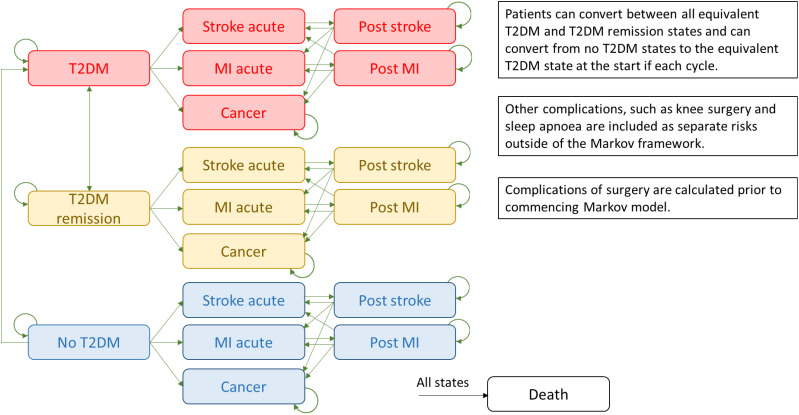
A Markov model compared lifetime costs and outcomes of bariatric surgery with conventional treatment among patients with body mass index (BMI) ≥ 40 kg/m, BMI ≥ 35 kg/m with obesity-related co-morbidities (Group 1), or BMI ≥ 35 kg/m with type 2 diabetes mellitus (T2DM) (Group 2). Inputs were sourced from the Tunisian Health Examination Survey, local clinician data and literature sources. Health states were associated with different cost and utility decrements. Changes in body mass index, systolic blood pressure, lipid ratio and diabetes remission rates were modelled on a yearly basis. The incremental cost-effectiveness ratio (ICER), quality-adjusted life years (QALYs) and net monetary benefit (NMB) were key outcomes. Sensitivity and scenario analyses were performed to test the model's robustness.
The model showed that the benefits of bariatric surgery were favorable compared to conventional treatment, with an ICER of 1844 TND/QALY in Group 1 patients and 2413 TND/QALY in Group 2 patients. Bariatric surgery resulted in a QALY gain of 3.26 per patient in Group 1 and a gain of 1.77 per patient in Group 2. At a willingness to pay threshold of 31,379 TND/QALY, the incremental NMB was 96,251 TND and 51,123 TND for Group 1 and Group 2, respectively.
From the Tunisian healthcare payor perspective, bariatric surgery is cost-effective for patients with obesity and those with T2DM and obesity-related comorbidities. These findings may have impact on future decision-making on funding and reimbursement of bariatric surgery in Tunisia.
肥胖是一个日益严重的全球性问题,有证据表明它与无病年限减少、生活质量下降、死亡率增加以及额外的经济负担有关。本研究旨在从突尼斯医疗保健支付方的角度,确定与肥胖患者的传统治疗相比,胃旁路手术和袖状胃切除术的成本效益。
采用马尔可夫模型比较体重指数(BMI)≥40kg/m、BMI≥35kg/m且伴有肥胖相关合并症的患者(第1组)或BMI≥35kg/m且患有2型糖尿病(T2DM)的患者(第2组)接受减肥手术与传统治疗的终身成本和结局。数据来源于突尼斯健康检查调查、当地临床医生数据和文献资料。健康状态与不同的成本和效用下降相关。每年对体重指数、收缩压、血脂比率和糖尿病缓解率的变化进行建模。增量成本效益比(ICER)、质量调整生命年(QALY)和净货币效益(NMB)是关键结果。进行敏感性和情景分析以检验模型的稳健性。
模型显示,与传统治疗相比,减肥手术具有优势效益,第1组患者的ICER为1844突尼斯第纳尔/QALY,第2组患者为2413突尼斯第纳尔/QALY。减肥手术使第1组每位患者的QALY增加3.26,第2组每位患者增加1.77。在支付意愿阈值为31379突尼斯第纳尔/QALY时,第1组和第2组的增量NMB分别为96251突尼斯第纳尔和51123突尼斯第纳尔。
从突尼斯医疗保健支付方的角度来看,减肥手术对于肥胖患者以及患有T2DM和肥胖相关合并症的患者具有成本效益。这些发现可能会对突尼斯未来减肥手术的资金投入和报销决策产生影响。