Yang Ding, Wang Zixu, Chen Yaoxing, Guo Qingyun, Dong Yulan
College of Veterinary Medicine, China Agricultural University, Beijing 100193, China.
Milu conservation research unit, Beijing Milu Ecological Research Center, Beijing 100163, China.
Comput Struct Biotechnol J. 2023 Mar 25;21:2215-2227. doi: 10.1016/j.csbj.2023.03.017. eCollection 2023.
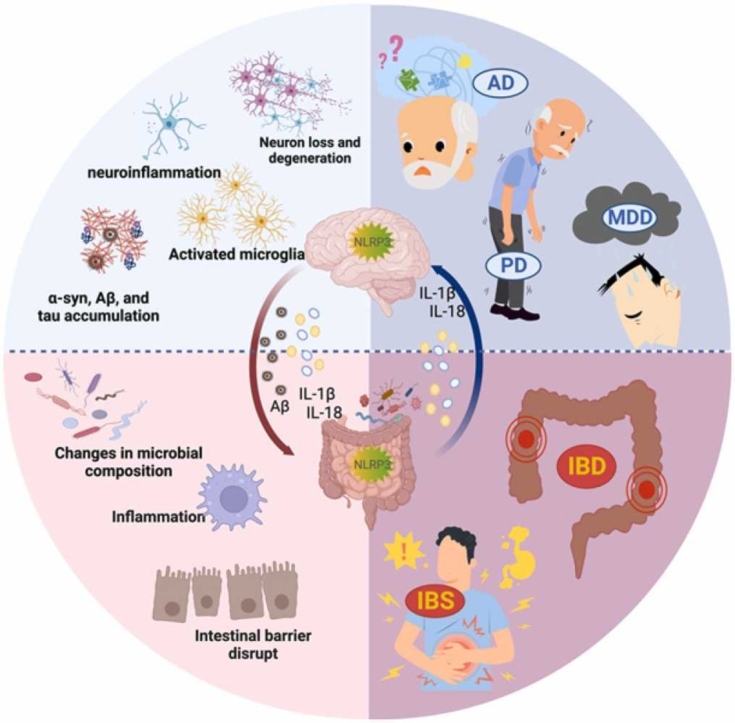
The role of the gut-brain axis in maintaining the brain's and gut's homeostasis has been gradually recognized in recent years. The connection between the gut and the brain takes center stage. In this scenario, the nucleotide-binding oligomerization domain leucine-rich repeat and pyrin domain-containing protein 3 (NLRP3) inflammasome promotes inflammatory cell recruitment. It plays a crucial role in coordinating host physiology and immunity. Recent evidence shows how vital the gut-brain axis is for maintaining brain and gut homeostasis. However, more research is needed to determine the precise causal link between changed gut microbiota structure and NLRP3 activation in pathogenic circumstances. This review examines the connection between gut microbiota and the NLRP3 inflammasome. We describe how both dynamically vary in clinical cases and the external factors affecting both. Finally, we suggest that the crosstalk between the gut microbiota and NLRP3 is involved in signaling in the gut-brain axis, which may be a potential pathological mechanism for CNS diseases and intestinal disorders.
近年来,肠-脑轴在维持大脑和肠道内环境稳定中的作用已逐渐得到认可。肠道与大脑之间的联系成为了焦点。在这种情况下,富含亮氨酸重复序列和吡啉结构域的核苷酸结合寡聚化结构域蛋白3(NLRP3)炎性小体促进炎症细胞募集。它在协调宿主生理和免疫方面发挥着关键作用。最近的证据表明肠-脑轴对于维持大脑和肠道内环境稳定至关重要。然而,需要更多研究来确定在致病情况下肠道微生物群结构变化与NLRP3激活之间的确切因果联系。本综述探讨了肠道微生物群与NLRP3炎性小体之间的联系。我们描述了两者在临床病例中的动态变化以及影响它们的外部因素。最后,我们认为肠道微生物群与NLRP3之间的相互作用参与了肠-脑轴中的信号传导,这可能是中枢神经系统疾病和肠道疾病的潜在病理机制。