Battelle Memorial Institute, Columbus, Ohio, USA.
Microbiol Spectr. 2023 Jun 15;11(3):e0416022. doi: 10.1128/spectrum.04160-22. Epub 2023 Apr 11.
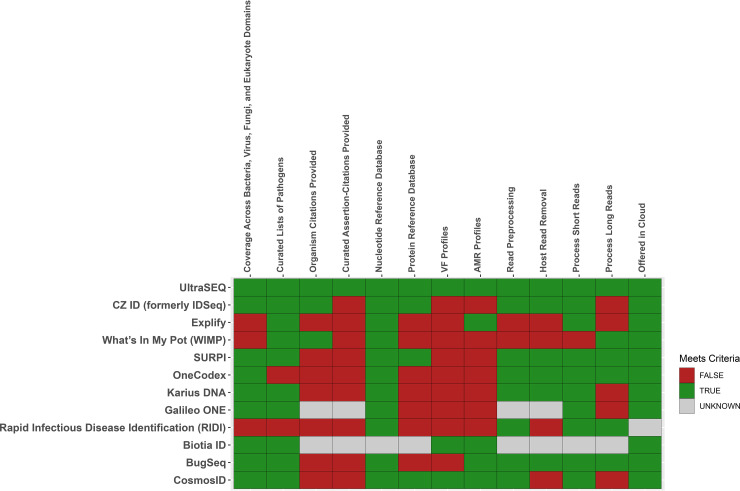
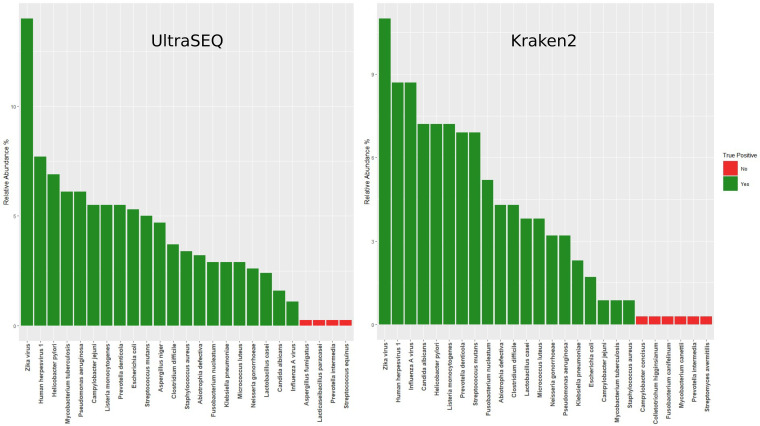
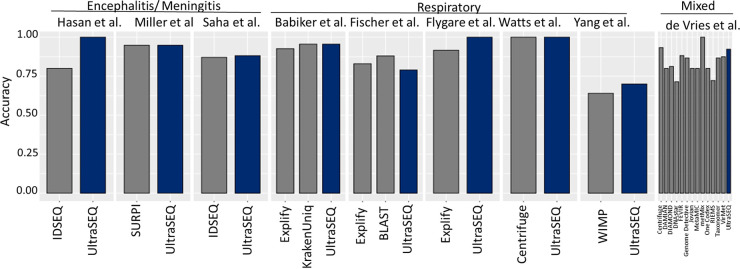
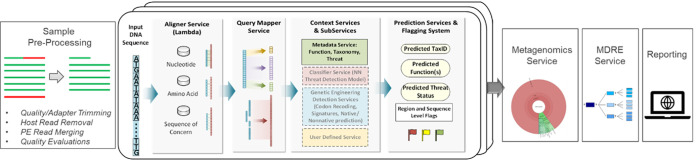
Applied metagenomics is a powerful emerging capability enabling the untargeted detection of pathogens, and its application in clinical diagnostics promises to alleviate the limitations of current targeted assays. While metagenomics offers a hypothesis-free approach to identify any pathogen, including unculturable and potentially novel pathogens, its application in clinical diagnostics has so far been limited by workflow-specific requirements, computational constraints, and lengthy expert review requirements. To address these challenges, we developed UltraSEQ, a first-of-its-kind accurate and scalable metagenomic bioinformatic tool for potential clinical diagnostics and biosurveillance utility. Here, we present the results of the evaluation of our novel UltraSEQ pipeline using an -synthesized metagenome, mock microbial community data sets, and publicly available clinical data sets from samples of different infection types, including both short-read and long-read sequencing data. Our results show that UltraSEQ successfully detected all expected species across the tree of life in the sample and detected all 10 bacterial and fungal species in the mock microbial community data set. For clinical data sets, even without requiring data set-specific configuration setting changes, background sample subtraction, or prior sample information, UltraSEQ achieved an overall accuracy of 91%. Furthermore, as an initial demonstration with a limited patient sample set, we show UltraSEQ's ability to provide antibiotic resistance and virulence factor genotypes that are consistent with phenotypic results. Taken together, the above-described results demonstrate that the UltraSEQ platform offers a transformative approach for microbial and metagenomic sample characterization, employing a biologically informed detection logic, deep metadata, and a flexible system architecture for the classification and characterization of taxonomic origin, gene function, and user-defined functions, including disease-causing infections. Traditional clinical microbiology-based diagnostic tests rely on targeted methods that can detect only one to a few preselected organisms or slow, culture-based methods. Although widely used today, these methods have several limitations, resulting in rates of cases of an unknown etiology of infection of >50% for several disease types. Massive developments in sequencing technologies have made it possible to apply metagenomic methods to clinical diagnostics, but current offerings are limited to a specific disease type or sequencer workflow and/or require laboratory-specific controls. The limitations associated with current clinical metagenomic offerings result from the fact that the backend bioinformatic pipelines are optimized for the specific parameters described above, resulting in an excess of unmaintained, redundant, and niche tools that lack standardization and explainable outputs. In this paper, we demonstrate that UltraSEQ uses a novel, information-based approach that enables accurate, evidence-based predictions for diagnosis as well as the functional characterization of a sample.
应用宏基因组学是一种强大的新兴能力,可实现对病原体的非靶向检测,其在临床诊断中的应用有望缓解当前靶向检测方法的局限性。宏基因组学提供了一种无需假设即可识别任何病原体的方法,包括无法培养和潜在的新型病原体,但它在临床诊断中的应用迄今为止受到工作流程特定要求、计算限制和冗长的专家审查要求的限制。为了解决这些挑战,我们开发了 UltraSEQ,这是一种用于潜在临床诊断和生物监测应用的首创、准确且可扩展的宏基因组生物信息学工具。在这里,我们展示了使用合成宏基因组、模拟微生物群落数据集以及来自不同感染类型样本的公开可用临床数据集评估我们新型 UltraSEQ 管道的结果,包括短读长和长读长测序数据。我们的结果表明,UltraSEQ 成功地在样本中检测到了生命之树上的所有预期物种,并在模拟微生物群落数据集中检测到了所有 10 种细菌和真菌物种。对于临床数据集,即使不需要数据集特定的配置更改、背景样本扣除或事先的样本信息,UltraSEQ 也实现了 91%的总体准确性。此外,作为对有限患者样本集的初步演示,我们展示了 UltraSEQ 提供抗生素耐药性和毒力因子基因型的能力,这些基因型与表型结果一致。综上所述,上述结果表明,UltraSEQ 平台为微生物和宏基因组样本表征提供了一种变革性方法,采用生物信息学检测逻辑、深入的元数据和灵活的系统架构,用于分类和表征分类起源、基因功能和用户定义的功能,包括致病感染。传统的基于临床微生物学的诊断测试依赖于靶向方法,只能检测一个到几个预先选择的生物体或缓慢的、基于培养的方法。尽管这些方法今天被广泛使用,但它们有几个局限性,导致几种疾病类型的感染病因不明的病例率超过 50%。测序技术的巨大发展使得将宏基因组方法应用于临床诊断成为可能,但目前的产品仅限于特定的疾病类型或测序器工作流程,并且/或者需要实验室特定的对照。当前临床宏基因组产品的局限性源于后端生物信息学管道针对上述特定参数进行了优化的事实,导致了过多未维护、冗余和利基工具,这些工具缺乏标准化和可解释的输出。在本文中,我们证明了 UltraSEQ 使用一种新颖的基于信息的方法,能够为诊断以及样本的功能表征提供准确、基于证据的预测。