Venture Strategies for Health & Development/OASIS, Berkeley, CA, USA.
Bixby Center for Population, Health & Sustainability, School of Public Health, University of California, Berkeley, CA, USA.
Reprod Health. 2023 Apr 11;20(Suppl 1):58. doi: 10.1186/s12978-023-01574-3.
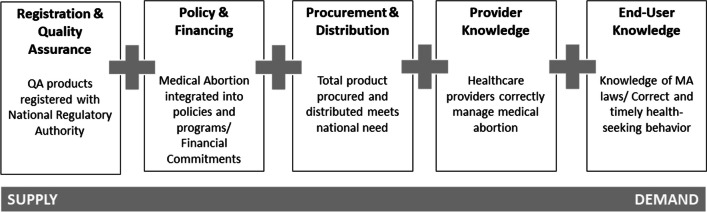
In recent years a growing number of manufacturers and medical abortion products have entered country markets and health systems, with varying degrees of quality and accessibility. An interplay of factors including pharmaceutical regulations, abortion laws, government policies and service delivery guidelines and provider's knowledge and practices influence the availability of medical abortion medicines. We assessed the availability of medical abortion in eight countries to increase understanding among policymakers of the need to improve availability and affordability of quality-assured medical abortion products at regional and national levels.
Using a national assessment protocol and an availability framework, we assessed the availability of medical abortion medicines in Bangladesh, Liberia, Malawi, Nepal, Nigeria, Rwanda, Sierra Leone and South Africa between September 2019 and January 2020.
Registration of abortion medicines-misoprostol or a combination of mifepristone and misoprostol-was established in all countries assessed, except Rwanda. Mifepristone and misoprostol regimen for medical abortion was identified on the national essential medicines list/standard treatment guidelines for South Africa as well as in specific abortion care service and delivery guidelines for Bangladesh, Nepal, Nigeria, and Rwanda. In Liberia, Malawi, and Sierra Leone-countries with highly restrictive abortion laws and no abortion service delivery guidelines or training curricula-no government-supported training on medical abortion for public sector providers had occurred. Instead, training on medical abortion was either limited in scope to select private sector providers and pharmacists or prohibited. Community awareness activities on medical abortion have been limited in scope across the countries assessed and where abortion is broadly legal, most women do not know that it is an option.
Understanding the factors that influence the availability of medical abortion medicines is important to support policymakers improve availability of these medicines. The landscape assessments documented that medical abortion commodities can be uniquely impacted by the laws, policies, values, and degree of restrictions placed on service delivery programs. Results of the assessments can guide actions to improve access.
近年来,越来越多的制造商和医疗流产产品进入国家市场和卫生系统,其质量和可及性各不相同。包括药品监管、堕胎法、政府政策和服务提供准则以及提供者的知识和实践在内的一系列因素,影响着医疗流产药物的供应。我们评估了八个国家的医疗流产供应情况,以增进决策者对在区域和国家各级提高有质量保证的医疗流产产品供应和可负担性的必要性的理解。
使用国家评估方案和供应框架,我们评估了孟加拉国、利比里亚、马拉维、尼泊尔、尼日利亚、卢旺达、塞拉利昂和南非 2019 年 9 月至 2020 年 1 月期间的医疗流产药物供应情况。
除卢旺达外,所有评估国家都已登记了堕胎药物——米非司酮或米非司酮与米索前列醇的联合用药。南非的国家基本药物清单/标准治疗指南以及孟加拉国、尼泊尔、尼日利亚和卢旺达的特定流产护理服务和提供准则都确定了米非司酮和米索前列醇方案用于医疗流产。在利比里亚、马拉维和塞拉利昂——这些国家的堕胎法非常严格,没有堕胎服务提供准则或培训课程——也没有针对公共部门提供者开展政府支持的医疗流产培训。相反,医疗流产培训要么仅限于选择的私营部门提供者和药剂师,要么被禁止。在评估的国家中,医疗流产的社区宣传活动范围有限,而且在堕胎较为合法的国家,大多数妇女不知道这是一种选择。
了解影响医疗流产药物供应的因素对于支持决策者改善这些药物的供应非常重要。这些评估的结果表明,医疗流产商品可能会受到法律、政策、价值观以及对服务提供方案的限制程度的独特影响。评估结果可以指导改善获取途径的行动。