Disease Intervention and Prevention Program, Texas Biomedical Research Institute, San Antonio, TX 78227, USA.
Host-Pathogen Interaction Program, Texas Biomedical Research Institute, San Antonio, TX 78227, USA.
Cells. 2023 Mar 23;12(7):987. doi: 10.3390/cells12070987.
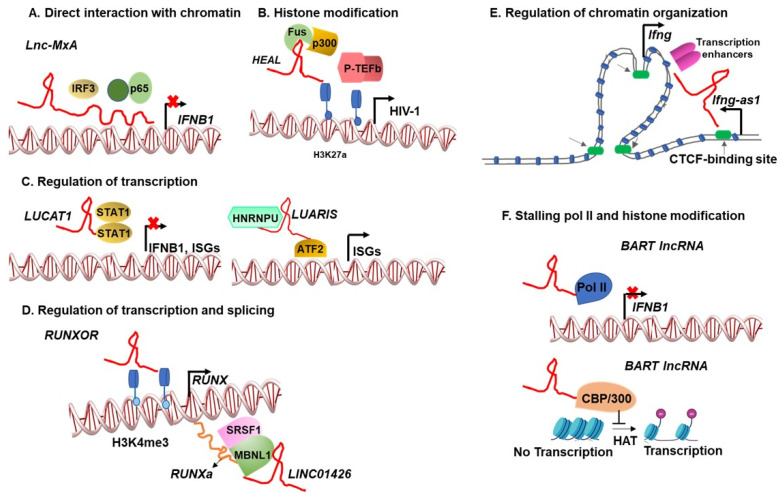
Long noncoding RNAs (lncRNAs) are transcripts measuring >200 bp in length and devoid of protein-coding potential. LncRNAs exceed the number of protein-coding mRNAs and regulate cellular, developmental, and immune pathways through diverse molecular mechanisms. In recent years, lncRNAs have emerged as epigenetic regulators with prominent roles in health and disease. Many lncRNAs, either host or virus-encoded, have been implicated in critical cellular defense processes, such as cytokine and antiviral gene expression, the regulation of cell signaling pathways, and the activation of transcription factors. In addition, cellular and viral lncRNAs regulate virus gene expression. Viral infections and associated immune responses alter the expression of host lncRNAs regulating immune responses, host metabolism, and viral replication. The influence of lncRNAs on the pathogenesis and outcomes of viral infections is being widely explored because virus-induced lncRNAs can serve as diagnostic and therapeutic targets. Future studies should focus on thoroughly characterizing lncRNA expressions in virus-infected primary cells, investigating their role in disease prognosis, and developing biologically relevant animal or organoid models to determine their suitability for specific therapeutic targeting. Many cellular and viral lncRNAs localize in the nucleus and epigenetically modulate viral transcription, latency, and host responses to infection. In this review, we provide an overview of the role of nuclear lncRNAs in the pathogenesis and outcomes of viral infections, such as the Influenza A virus, Sendai Virus, Respiratory Syncytial Virus, Hepatitis C virus, Human Immunodeficiency Virus, and Herpes Simplex Virus. We also address significant advances and barriers in characterizing lncRNA function and explore the potential of lncRNAs as therapeutic targets.
长链非编码 RNA(lncRNA)是长度大于 200 个核苷酸且无蛋白编码潜能的转录本。lncRNA 的数量超过了蛋白编码 mRNA 的数量,并通过多种分子机制调节细胞、发育和免疫途径。近年来,lncRNA 已成为表观遗传调节剂,在健康和疾病中发挥着重要作用。许多 lncRNA,无论是宿主编码的还是病毒编码的,都与关键的细胞防御过程有关,如细胞因子和抗病毒基因的表达、细胞信号通路的调节以及转录因子的激活。此外,细胞和病毒 lncRNA 调节病毒基因的表达。病毒感染和相关免疫反应改变了调节免疫反应、宿主代谢和病毒复制的宿主 lncRNA 的表达。lncRNA 对病毒感染发病机制和结果的影响正在被广泛探索,因为病毒诱导的 lncRNA 可以作为诊断和治疗靶点。未来的研究应集中在彻底描述病毒感染原代细胞中的 lncRNA 表达,研究它们在疾病预后中的作用,并开发具有生物学相关性的动物或类器官模型,以确定它们是否适合特定的治疗靶向。许多细胞和病毒 lncRNA 定位于细胞核内,并通过表观遗传修饰调节病毒转录、潜伏期和宿主对感染的反应。在这篇综述中,我们概述了核 lncRNA 在病毒感染发病机制和结果中的作用,如甲型流感病毒、仙台病毒、呼吸道合胞病毒、丙型肝炎病毒、人类免疫缺陷病毒和单纯疱疹病毒。我们还讨论了描述 lncRNA 功能的重要进展和障碍,并探讨了 lncRNA 作为治疗靶点的潜力。