• 文献检索
  • 文档翻译
  • 深度研究
  • 学术资讯
  • Suppr Zotero 插件Zotero 插件
  • 邀请有礼
  • 套餐&价格
  • 历史记录
应用&插件
Suppr Zotero 插件Zotero 插件浏览器插件Mac 客户端Windows 客户端微信小程序
定价
高级版会员购买积分包购买API积分包
服务
文献检索文档翻译深度研究API 文档MCP 服务
关于我们
关于 Suppr公司介绍联系我们用户协议隐私条款
关注我们

Suppr 超能文献

核心技术专利:CN118964589B侵权必究
粤ICP备2023148730 号-1Suppr @ 2026

文献检索

告别复杂PubMed语法,用中文像聊天一样搜索,搜遍4000万医学文献。AI智能推荐,让科研检索更轻松。

立即免费搜索

文件翻译

保留排版,准确专业,支持PDF/Word/PPT等文件格式,支持 12+语言互译。

免费翻译文档

深度研究

AI帮你快速写综述,25分钟生成高质量综述,智能提取关键信息,辅助科研写作。

立即免费体验

危重症儿童血培养使用的决定因素:一项多中心定性研究

Determinants of Blood Culture Use in Critically Ill Children: A Multicenter Qualitative Study.

作者信息

Woods-Hill Charlotte Z, Nelson Maria N, Eriksen Whitney, Rendle Katharine A, Beidas Rinad S, Bonafide Christopher P, Brajcich Michelle R, Milstone Aaron M, Shea Judy A

机构信息

Division of Critical Care Medicine, The Children's Hospital of Philadelphia, University of Pennsylvania Perelman School of Medicine, Philadelphia, Pa.

Leonard Davis Institute of Health Economics, University of Pennsylvania, Philadelphia Pa.

出版信息

Pediatr Qual Saf. 2023 Apr 10;8(2):e647. doi: 10.1097/pq9.0000000000000647. eCollection 2023 Mar-Apr.

DOI:10.1097/pq9.0000000000000647
PMID:37051407
原文链接:https://pmc.ncbi.nlm.nih.gov/articles/PMC10085482/
Abstract

UNLABELLED

Blood cultures are fundamental in diagnosing and treating sepsis in the pediatric intensive care unit (PICU), but practices vary widely. Overuse can lead to false positive results and unnecessary antibiotics. Specific factors underlying decisions about blood culture use and overuse are unknown. Therefore, we aimed to identify perceived determinants of blood culture use in the PICU.

METHODS

We conducted semistructured interviews of clinicians (M.D., D.O., R.N., N.P., P.A.) from 6 PICUs who had participated in a quality improvement collaborative about blood culture practices. We developed interview questions by combining elements of the Consolidated Framework for Implementation Research and behavioral economics. We conducted telephone interviews, open-coded the transcripts, and used modified content analysis to determine key themes and mapped themes to elements of Consolidated Framework for Implementation Research and behavioral economics.

RESULTS

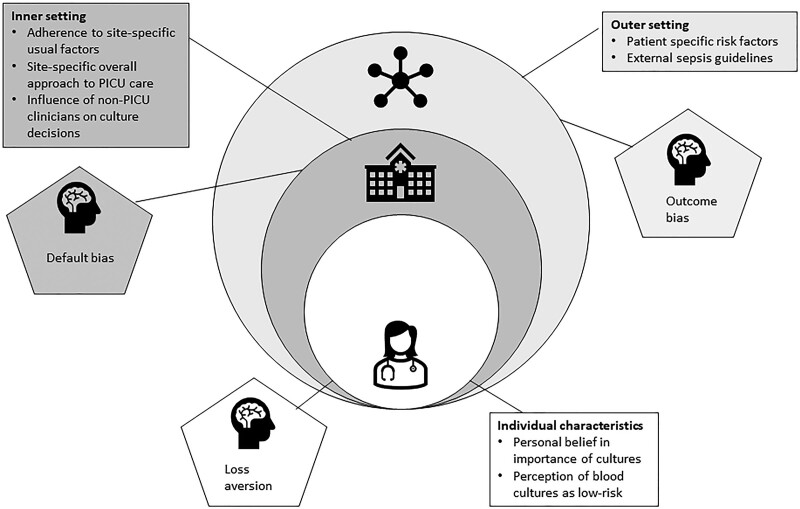
We reached thematic saturation in 24 interviews. Seven core themes emerged across 3 Consolidated Framework for Implementation Research domains: individual characteristics [personal belief in the importance of blood cultures, the perception that blood cultures are a low-risk test]; inner setting [adherence to site-specific usual practices, site-specific overall approach to PICU care (collaborative versus hierarchical), influence of non-PICU clinicians on blood culture decisions]; and outer setting [patient-specific risk factors, sepsis guidelines]. In addition, outcome bias, default bias, and loss aversion emerged as salient behavioral economics concepts.

CONCLUSIONS

Determinants of blood culture use include individual clinician characteristics, inner setting, and outer setting, as well as default bias, outcome bias, and loss aversion. These determinants will now inform the development of candidate strategies to optimize culture practices.

摘要

未标注

血培养在儿科重症监护病房(PICU)中对脓毒症的诊断和治疗至关重要,但操作方法差异很大。过度使用会导致假阳性结果和不必要的抗生素使用。关于血培养使用和过度使用决策的具体因素尚不清楚。因此,我们旨在确定PICU中血培养使用的感知决定因素。

方法

我们对来自6个PICU的临床医生(医学博士、医学博士、注册护士、执业护士、医师助理)进行了半结构化访谈,这些医生参与了一项关于血培养操作的质量改进合作项目。我们通过结合实施研究综合框架和行为经济学的要素来制定访谈问题。我们进行了电话访谈,对访谈记录进行开放编码,并使用改进的内容分析来确定关键主题,并将主题映射到实施研究综合框架和行为经济学的要素上。

结果

我们在24次访谈中达到了主题饱和。在实施研究综合框架的3个领域中出现了7个核心主题:个体特征[对血培养重要性的个人信念,认为血培养是低风险检查的观念];内部环境[遵守特定地点的常规做法,特定地点的PICU护理总体方法(协作与分层),非PICU临床医生对血培养决策的影响];以及外部环境[患者特定的风险因素,脓毒症指南]。此外,结果偏差、默认偏差和损失厌恶作为突出的行为经济学概念出现。

结论

血培养使用的决定因素包括个体临床医生特征、内部环境和外部环境,以及默认偏差、结果偏差和损失厌恶。这些决定因素现在将为优化培养操作的候选策略的制定提供信息。
https://cdn.ncbi.nlm.nih.gov/pmc/blobs/904d/10085482/96a1b546b3e1/pqs-8-e647-g001.jpg

相似文献

1
Determinants of Blood Culture Use in Critically Ill Children: A Multicenter Qualitative Study.危重症儿童血培养使用的决定因素:一项多中心定性研究
Pediatr Qual Saf. 2023 Apr 10;8(2):e647. doi: 10.1097/pq9.0000000000000647. eCollection 2023 Mar-Apr.
2
Association of Diagnostic Stewardship for Blood Cultures in Critically Ill Children With Culture Rates, Antibiotic Use, and Patient Outcomes: Results of the Bright STAR Collaborative.诊断性血液培养管理对危重症儿童的影响:与培养率、抗生素使用和患者结局的关联:BRIGHT STAR 协作研究结果。
JAMA Pediatr. 2022 Jul 1;176(7):690-698. doi: 10.1001/jamapediatrics.2022.1024.
3
Mixed-methods process evaluation of a respiratory-culture diagnostic stewardship intervention.混合方法的呼吸培养诊断管理干预措施的过程评价。
Infect Control Hosp Epidemiol. 2023 Feb;44(2):191-199. doi: 10.1017/ice.2022.299. Epub 2023 Jan 3.
4
Diagnostic stewardship for blood cultures in the pediatric intensive care unit: lessons in implementation from the BrighT STAR Collaborative.儿科重症监护病房血培养的诊断管理:来自BrighT STAR协作组的实施经验教训。
Antimicrob Steward Healthc Epidemiol. 2024 Sep 25;4(1):e148. doi: 10.1017/ash.2024.416. eCollection 2024.
5
Facilitators and barriers to the implementation of new critical care practices during COVID-19: a multicenter qualitative study using the Consolidated Framework for Implementation Research (CFIR).在 COVID-19 期间实施新的重症监护实践的促进因素和障碍:使用整合实施研究框架(CFIR)的多中心定性研究。
BMC Health Serv Res. 2023 Mar 20;23(1):272. doi: 10.1186/s12913-023-09209-w.
6
The future of Cochrane Neonatal.考克兰新生儿协作网的未来。
Early Hum Dev. 2020 Nov;150:105191. doi: 10.1016/j.earlhumdev.2020.105191. Epub 2020 Sep 12.
7
Implementation of clinical practice changes in the PICU: a qualitative study using and refining the iPARIHS framework.儿科重症监护病房临床实践变革的实施:应用和完善 iPARIHS 框架的定性研究。
Implement Sci. 2021 Jan 28;16(1):15. doi: 10.1186/s13012-021-01080-9.
8
Culture Ordering for Patients with New-onset Fever: A Survey of Pediatric Intensive Care Unit Clinician Practices.新发发热患儿的培养检查医嘱:儿科重症监护病房临床医生实践调查
Pediatr Qual Saf. 2021 Aug 26;6(5):e463. doi: 10.1097/pq9.0000000000000463. eCollection 2021 Sep-Oct.
9
Folic acid supplementation and malaria susceptibility and severity among people taking antifolate antimalarial drugs in endemic areas.在流行地区,服用抗叶酸抗疟药物的人群中,叶酸补充剂与疟疾易感性和严重程度的关系。
Cochrane Database Syst Rev. 2022 Feb 1;2(2022):CD014217. doi: 10.1002/14651858.CD014217.
10
Impressions of Early Mobilization of Critically Ill Children-Clinician, Patient, and Family Perspectives.危重症患儿早期活动的体会——临床医生、患者和家属的观点。
Pediatr Crit Care Med. 2018 Jul;19(7):e350-e357. doi: 10.1097/PCC.0000000000001547.

引用本文的文献

1
Diagnostic stewardship for blood cultures in the pediatric intensive care unit: lessons in implementation from the BrighT STAR Collaborative.儿科重症监护病房血培养的诊断管理:来自BrighT STAR协作组的实施经验教训。
Antimicrob Steward Healthc Epidemiol. 2024 Sep 25;4(1):e148. doi: 10.1017/ash.2024.416. eCollection 2024.

本文引用的文献

1
Association of Diagnostic Stewardship for Blood Cultures in Critically Ill Children With Culture Rates, Antibiotic Use, and Patient Outcomes: Results of the Bright STAR Collaborative.诊断性血液培养管理对危重症儿童的影响:与培养率、抗生素使用和患者结局的关联:BRIGHT STAR 协作研究结果。
JAMA Pediatr. 2022 Jul 1;176(7):690-698. doi: 10.1001/jamapediatrics.2022.1024.
2
A Systematic Review of Nudge Interventions to Optimize Medication Prescribing.优化药物处方的助推干预措施的系统评价
Front Pharmacol. 2022 Jan 25;13:798916. doi: 10.3389/fphar.2022.798916. eCollection 2022.
3
Using behavioral insights to design implementation strategies in public mental health settings: a qualitative study of clinical decision-making.
运用行为洞察来设计公共心理健康环境中的实施策略:一项关于临床决策的定性研究
Implement Sci Commun. 2021 Jan 11;2(1):6. doi: 10.1186/s43058-020-00105-6.
4
The effectiveness of behavioral economics-informed interventions on physician behavioral change: A systematic literature review.行为经济学干预措施对医生行为改变的有效性:系统文献回顾。
PLoS One. 2020 Jun 4;15(6):e0234149. doi: 10.1371/journal.pone.0234149. eCollection 2020.
5
Practices, Perceptions, and Attitudes in the Evaluation of Critically Ill Children for Bacteremia: A National Survey.评估危重症儿童菌血症的实践、认知和态度:一项全国性调查。
Pediatr Crit Care Med. 2020 Jan;21(1):e23-e29. doi: 10.1097/PCC.0000000000002176.
6
Practical Guidance for Clinical Microbiology Laboratories: A Comprehensive Update on the Problem of Blood Culture Contamination and a Discussion of Methods for Addressing the Problem.临床微生物学实验室实用指南:血液培养污染问题的全面更新及解决方法讨论。
Clin Microbiol Rev. 2019 Oct 30;33(1). doi: 10.1128/CMR.00009-19. Print 2019 Dec 18.
7
2018 Update on Pediatric Medical Overuse: A Review.2018 年儿科医疗过度诊治更新:综述。
JAMA Pediatr. 2019 Apr 1;173(4):379-384. doi: 10.1001/jamapediatrics.2018.5550.
8
Dissemination of a Novel Framework to Improve Blood Culture Use in Pediatric Critical Care.传播一种改进儿科重症监护中血培养使用的新框架。
Pediatr Qual Saf. 2018 Oct 16;3(5):e112. doi: 10.1097/pq9.0000000000000112. eCollection 2018 Sep-Oct.
9
Conceptualizing De-Implementation in Cancer Care Delivery.癌症护理服务中去实施的概念化
J Clin Oncol. 2019 Jan 10;37(2):93-96. doi: 10.1200/JCO.18.00589. Epub 2018 Nov 8.
10
Antibiotics for Sepsis-Finding the Equilibrium.用于脓毒症的抗生素——寻找平衡点
JAMA. 2018 Oct 9;320(14):1433-1434. doi: 10.1001/jama.2018.12179.