OptiMedis AG, Hamburg, Germany.
Hamburg Center for Health Economics, Hamburg, Germany.
PLoS One. 2020 Jun 4;15(6):e0234149. doi: 10.1371/journal.pone.0234149. eCollection 2020.
Interventions informed by behavioral economics have the potential to change behaviors governed by underlying cognitive biases. This has been explored extensively for various use in healthcare including changing patient behavior and, more recently, physician behavior. We aimed to systematically review the literature on the use and effectiveness of behavioral economics-informed interventions in changing physician behavior.
We searched Medline, Cochrane Library, EBM Reviews, PsychINFO, EconLit, Business Source Complete and Web of Science for peer-reviewed studies published in English that examined the effectiveness of behavioral economics-informed interventions on physician behavioral change. We included studies of physicians in all care settings and specialties and all types of objectively measured behavioral outcomes. The reporting quality of included studies was appraised using the Effective Public Health Practice Project tool.
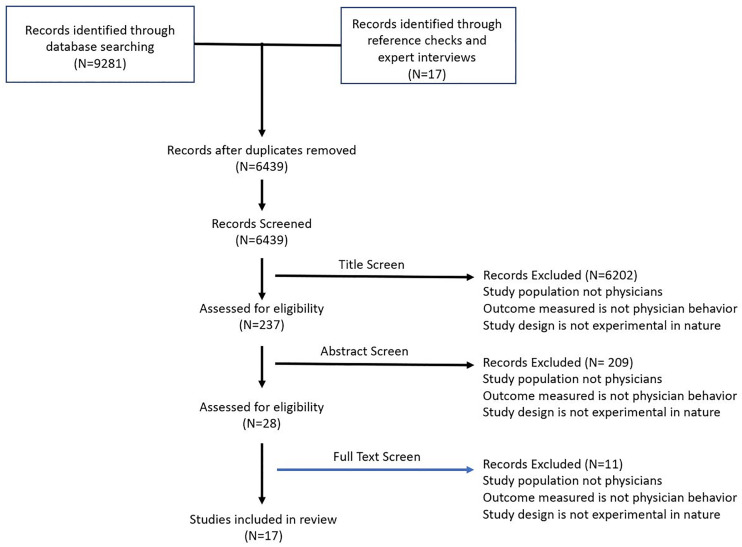
We screened 6,439 studies and included 17 studies that met our criteria, involving at least 9,834 physicians. The majority of studies were conducted in the United States, published between 2014 and 2018, and were in the patient safety and quality domain. Reporting quality of included studies included strong (n = 7), moderate (n = 6) and weak (n = 4). Changing default settings and providing social reference points were the most widely studied interventions, with these studies consistently demonstrating their effectiveness in changing physician behavior despite differences in implementation methods among studies. Prescribing behavior was most frequently targeted in included studies, with consistent effectiveness of studied interventions.
Changing default settings and providing social reference points were the most frequently studied and consistently effective interventions in changing physician behavior towards guideline-concordant practices. Additional theory-informed research is needed to better understand the mechanisms underlying the effectiveness of these interventions to guide implementation.
受行为经济学启发的干预措施有可能改变受潜在认知偏见支配的行为。这在各种医疗保健应用中得到了广泛探索,包括改变患者行为,以及最近改变医生行为。我们旨在系统地回顾关于使用和评估行为经济学启发的干预措施改变医生行为的文献。
我们在 Medline、Cochrane Library、EBM Reviews、PsychINFO、EconLit、Business Source Complete 和 Web of Science 中搜索了以英文发表的、检查行为经济学启发的干预措施对医生行为改变的有效性的同行评审研究。我们纳入了在所有医疗环境和专业领域的医生的研究,以及所有类型的客观测量的行为结果。使用有效公共卫生实践项目工具评估纳入研究的报告质量。
我们筛选了 6439 项研究,纳入了 17 项符合我们标准的研究,涉及至少 9834 名医生。大多数研究在美国进行,发表于 2014 年至 2018 年之间,且在患者安全和质量领域。纳入研究的报告质量包括强(n=7)、中(n=6)和弱(n=4)。改变默认设置和提供社会参照点是研究最多的干预措施,尽管研究之间的实施方法存在差异,但这些研究一致表明它们在改变医生行为方面的有效性。在纳入的研究中,最常针对的是开处方行为,研究干预措施具有一致的有效性。
改变默认设置和提供社会参照点是改变医生行为以符合指南的最常研究和一致有效的干预措施。需要更多基于理论的研究来更好地理解这些干预措施有效性的机制,以指导实施。