Department of Behavioral Medicine, National Institute of Mental Health, National Centre of Neurology and Psychiatry, Kodaira, Tokyo, Japan.
Department of Clinical Data Science, Clinical Research & Education Promotion Division, National Centre of Neurology and Psychiatry, Kodaira, Tokyo, Japan.
Eur J Psychotraumatol. 2023;14(1):2163127. doi: 10.1080/20008066.2022.2163127.
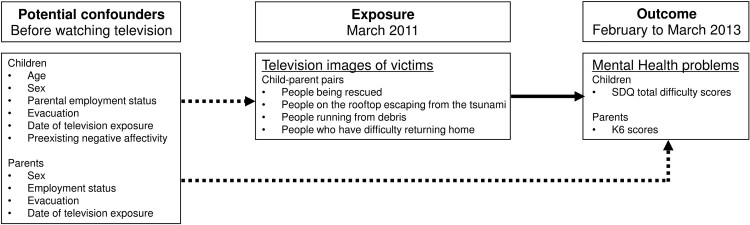
Exposure to natural disaster media coverage is associated with mental health problems, but its long-term impacts are still unclear. Also, no study has analysed the psychological impact of exposure to natural disaster media coverage among children who are generally sensitive to threatening events. We aimed to examine how television images of victims after the 2011 Great East Japan Earthquake were associated with mental health among children and their parents. In 2012, questionnaires for sociodemographic factors were distributed to 2053 families. Parents who provided written consent were contacted in 2013 and invited to provide information on mental health problems (outcome) and retrospectively provide information on television watching at the time of the earthquake (exposure). We used data from 159 parents who completed the survey as the final sample. We used a dichotomous variable to evaluate exposure to media coverage. Multivariable regression was used to examine the association between exposure to television images of victims and mental health, adjusting for potential confounders. Bias-corrected and accelerated bootstrap confidence intervals (CIs) were used. Exposure to television images of victims was significantly associated with worse psychopathology among children (, 1.51; 95% CI, 0.07-2.96) and greater psychological distress among their parents (, 1.49; 95% CI, 0.28-2.70). Child psychopathology and parental psychological distress were significantly correlated ( = 0.36, < .001). Exposure to television images of disaster victims may produce long-term impacts on mental health among children and their parents. To reduce the likelihood of mental health problems associated with disasters, clinicians may recommend reducing exposure to television images of victims.
暴露于自然灾害媒体报道与心理健康问题有关,但长期影响尚不清楚。此外,尚无研究分析一般对威胁性事件敏感的儿童暴露于自然灾害媒体报道的心理影响。我们旨在研究 2011 年东日本大地震后电视上的受害者图像如何影响儿童及其父母的心理健康。2012 年,向 2053 个家庭分发了社会人口因素问卷。在 2013 年联系了提供书面同意的父母,并邀请他们提供心理健康问题(结果)的信息,并回顾性地提供地震发生时的电视观看信息(暴露)。我们使用了完成调查的 159 位父母的数据作为最终样本。我们使用二项变量来评估对媒体报道的暴露。使用多变量回归来检验暴露于受害者电视图像与心理健康之间的关联,并调整潜在混杂因素。使用偏差校正和加速引导置信区间(CI)。暴露于受害者的电视图像与儿童的心理病理状况恶化显著相关(β,1.51;95%CI,0.07-2.96)和父母的心理困扰更大(β,1.49;95%CI,0.28-2.70)。儿童的心理病理和父母的心理困扰显著相关( = 0.36, < .001)。暴露于灾难受害者的电视图像可能会对儿童及其父母的心理健康产生长期影响。为了降低与灾难相关的心理健康问题的可能性,临床医生可能会建议减少对受害者电视图像的暴露。