Department of Psychiatry, National Disaster Medical Center, Tachikawa, Japan.
PLoS One. 2012;7(4):e35248. doi: 10.1371/journal.pone.0035248. Epub 2012 Apr 25.
The Great East Japan Earthquake of March 11, 2001 left around 20,000 dead or missing. Previous studies showed that rescue workers, as well as survivors, of disasters are at high risk for posttraumatic stress disorder (PTSD). This study examined the predictive usefulness of the Peritraumatic Distress Inventory (PDI) among rescue workers of Disaster Medical Assistance Teams (DMATs) deployed during the acute disaster phase of the Great East Japan Earthquake.
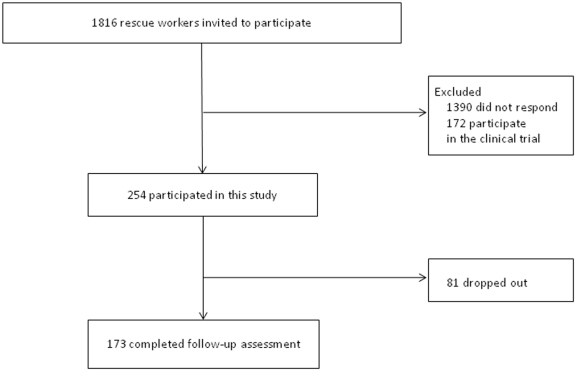
METHODOLOGY/PRINCIPAL FINDINGS: In this prospective observational study, the DMAT members recruited were assessed 1 month after the earthquake on the PDI and 4 months after the earthquake on the Impact of Event Scale-Revised to determine PTSD symptoms. The predictive value of the PDI at initial assessment for PTSD symptoms at the follow-up assessment was examined by univariate and multiple linear regression analysis. Of the 254 rescue workers who participated in the initial assessment, 173 completed the follow-up assessment. Univariate regression analysis revealed that PDI total score and most individual item scores predicted PTSD symptoms. In particular, high predictive values were seen for peritraumatic emotional distress such as losing control of emotions and being ashamed of emotional reactions. In multiple linear regression analysis, PDI total score was an independent predictor for PTSD symptoms after adjusting for covariates. As for covariates specifically, watching earthquake television news reports for more than 4 hours per day predicted PTSD symptoms.
CONCLUSIONS/SIGNIFICANCE: The PDI predicted PTSD symptoms in rescue workers after the Great East Japan Earthquake. Peritraumatic emotional distress appears to be an important factor to screen for individuals at risk for developing PTSD among medical rescue workers. In addition, watching television for extended period of time might require attention at a time of crisis.
2011 年 3 月 11 日的东日本大地震导致约 2 万人死亡或失踪。先前的研究表明,灾难救援人员以及幸存者患创伤后应激障碍(PTSD)的风险很高。本研究探讨了创伤后应激障碍诊断量表(PDI)在东日本大地震急性灾害阶段部署的灾害医疗救援队(DMAT)救援人员中的预测作用。
方法/主要发现:在这项前瞻性观察研究中,在地震后 1 个月评估 DMAT 成员的 PDI,在地震后 4 个月评估修订后的事件影响量表(IES-R)以确定 PTSD 症状。通过单变量和多元线性回归分析,检验初始评估时 PDI 总分对随访评估时 PTSD 症状的预测价值。在 254 名参加初始评估的救援人员中,有 173 名完成了随访评估。单变量回归分析显示,PDI 总分和大多数单项得分预测 PTSD 症状。特别是,情绪失控和对情绪反应感到羞耻等创伤期情绪困扰具有较高的预测价值。在多元线性回归分析中,调整协变量后,PDI 总分是 PTSD 症状的独立预测因子。至于具体的协变量,每天观看地震电视新闻报道超过 4 小时可预测 PTSD 症状。
结论/意义:PDI 预测了东日本大地震后救援人员的 PTSD 症状。创伤期情绪困扰似乎是筛选医疗救援人员中 PTSD 高危个体的一个重要因素。此外,在危机时刻,长时间看电视可能需要引起注意。