Department of Parasitology, Faculty of Science, Charles University, Prague, Czech Republic.
Department of Veterinary Medicine, University of Bari Aldo Moro, Valenzano, Italy.
Parasit Vectors. 2023 Apr 13;16(1):126. doi: 10.1186/s13071-023-05758-5.
Sergentomyia minuta (Diptera: Phlebotominae) is an abundant sand fly species in the Mediterranean basin and a proven vector of reptile parasite Leishmania (Sauroleishmania) tarentolae. Although it feeds preferentially on reptiles, blood meal analyses and detection of Leishmania (Leishmania) infantum DNA in wild-caught S. minuta suggest that occasional feeding may occur on mammals, including humans. Therefore, it is currently suspected as a potential vector of human pathogens.
A recently established S. minuta colony was allowed to feed on three reptile species (i.e. lizard Podarcis siculus and geckos Tarentola mauritanica and Hemidactylus turcicus) and three mammal species (i.e. mouse, rabbit and human). Sand fly mortality and fecundity were studied in blood-fed females, and the results were compared with Phlebotomus papatasi, vector of Leishmania (L.) major. Blood meal volumes were measured by haemoglobinometry.
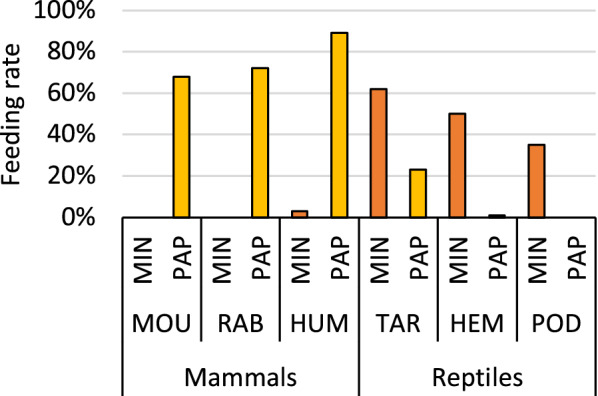
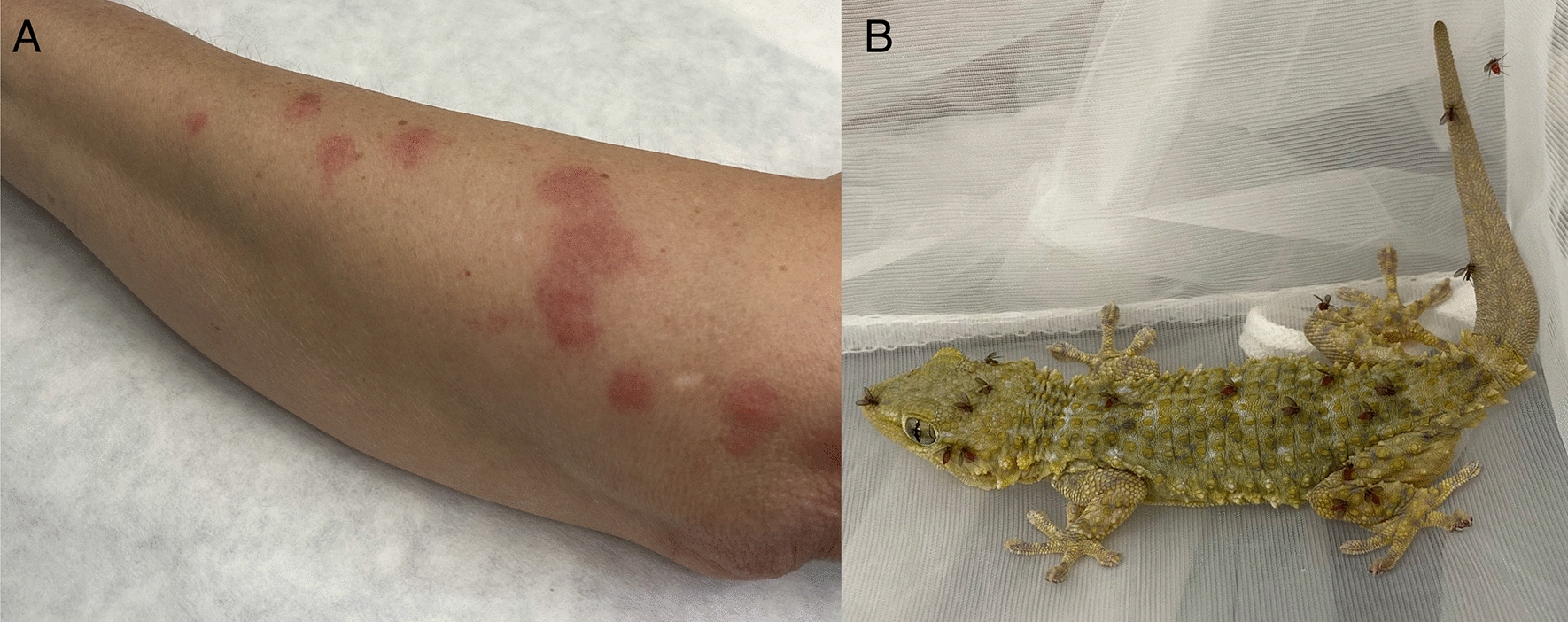
Sergentomyia minuta fed readily on three reptile species tested, neglected the mouse and the rabbit but took a blood meal on human. However, the percentage of females engorged on human volunteer was low in cage (3%) and feeding on human blood resulted in extended defecation times, higher post-feeding mortality and lower fecundity. The average volumes of blood ingested by females fed on human and gecko were 0.97 µl and 1.02 µl, respectively. Phlebotomus papatasi females readily fed on mouse, rabbit and human volunteer; a lower percentage of females (23%) took blood meal on the T. mauritanica gecko; reptilian blood increased mortality post-feeding but did not affect P. papatasi fecundity.
Anthropophilic behaviour of S. minuta was experimentally demonstrated; although sand fly females prefer reptiles as hosts, they were attracted to the human volunteer and took a relatively high volume of blood. Their feeding times were longer than in sand fly species regularly feeding on mammals and their physiological parameters suggest that S. minuta is not adapted well for digestion of mammalian blood. Nevertheless, the ability to bite humans highlights the necessity of further studies on S. minuta vector competence to elucidate its potential role in circulation of Leishmania and phleboviruses pathogenic to humans.
沙蝇属的细角沙蝇(双翅目:蚋科)在地中海盆地数量丰富,是已证实的爬行动物寄生虫利什曼原虫(Sauroleishmania)tarentolae 的传播媒介。尽管它优先以爬行动物为食,但对野外捕获的细角沙蝇进行的血餐分析和利什曼原虫(利什曼原虫)婴儿 DNA 的检测表明,偶尔也可能以哺乳动物(包括人类)为食。因此,它目前被怀疑是人类病原体的潜在传播媒介。
最近建立的细角沙蝇种群被允许以三种爬行动物物种(即蜥蜴 Podarcis siculus 和壁虎 Tarentola mauritanica 和 Hemidactylus turcicus)和三种哺乳动物物种(即小鼠、兔子和人类)为食。研究了吸血雌性沙蝇的死亡率和生殖力,并将结果与利什曼原虫(L.)主要的传播媒介埃及伊蚊进行了比较。通过血红蛋白测定法测量血餐量。
细角沙蝇容易以三种测试的爬行动物物种为食,忽略了老鼠和兔子,但在人类身上取了血餐。然而,在笼子里,人类志愿者被雌性沙蝇叮咬的比例很低(3%),而且吸食人血会导致排粪时间延长、喂食后死亡率升高和繁殖力降低。以人类和壁虎为食的雌性沙蝇分别摄入了 0.97µl 和 1.02µl 的血液。埃及伊蚊雌性容易以老鼠、兔子和人类志愿者为食;较少比例的雌性(23%)取食 T. mauritanica 壁虎的血液;爬行类血液增加了喂食后的死亡率,但不影响埃及伊蚊的生殖力。
实验证明了细角沙蝇的嗜人行为;尽管沙蝇雌性更喜欢以爬行动物为宿主,但它们被人类志愿者吸引并吸食了相对较高量的血液。它们的进食时间比经常以哺乳动物为食的沙蝇物种长,它们的生理参数表明,细角沙蝇不适应消化哺乳动物的血液。然而,细角沙蝇能够叮咬人类,这突出了进一步研究其传播媒介能力以阐明其在利什曼原虫和对人类致病的黄病毒循环中的潜在作用的必要性。